

104.6 Malthopsis luteus
Alcock, 1891
Longnose seabat
Langneus-seekolf
Malthopsis luteus Alcock, in Wood-Mason & Alcock, 1891: 26, PI. 8,
Figs. 2, 2a (Andaman Sea).
D 5-6; A 4; P 11-13.
Attains 10 cm. Eastern Indian Ocean and Japan, generally in 100 - 200 m or more; recently taken off Kenya and
considered likely to occur off southern Africa.
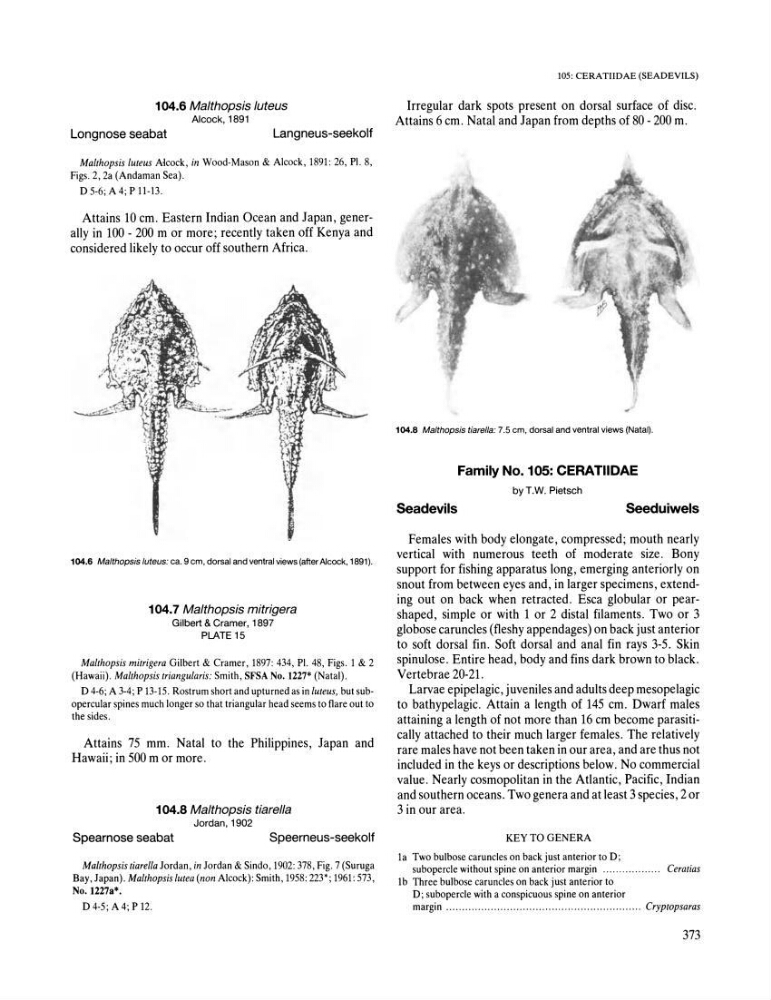
104.6 Malthopsis luteus: ca. 9 em, dorsal and ventral views (after Alcock, 1891).
104.7 Malthopsis mitrigera
Gilbert & Cramer, 1897
PLATE 15
Malthopsis mitrigera Gilbert & Cramer, 1897: 434, PI. 48, Figs. 1 & 2
(Hawaii). Malthopsis triangularis: Smith, SFSA No. 1227* (Natal).
D 4-6; A 3-4; P 13-15. Rostrum short and upturned as in lute us, but subopercular spines much longer so that triangular head seems to flare out to
the sides.
Attains 75 mm. Natal to the Philippines, Japan and
Hawaii; in 500 m or more.
104.8 Malthopsis tiare/la
Jordan, 1902
Spearnose seabat
Speerneus-seekolf
Malthopsis tiarella Jordan, in Jordan & Sindo, 1902: 378, Fig. 7 (Suruga
Bay, Japan). Malthopsis lutea (non Alcock): Smith, 1958: 223*; 1961: 573,
No. 1227a*.
D4-5; A4; P 12.
105: CERATIIDAE (SEADEVILS)
Irregular dark spots present on dorsal surface of disc.
Attains 6 cm. Natal and Japan from depths of 80 - 200 m.
104.8 Malthopsis tiarella: 7.5 em, dorsal and ventral views (Natal).
Family No. 105: CERATIIDAE
by T.w. Pietsch
Seadevils
Seeduiwels
Females with body elongate, compressed; mouth nearly
vertical with numerous teeth of moderate size. Bony
support for fishing apparatus long, emerging anteriorly on
snout from between eyes and, in larger specimens, extending out on back when retracted. Esca globular or pearshaped, simple or with 1 or 2 distal filaments. Two or 3
globose caruncles (fleshy appendages) on back just anterior
to soft dorsal fin. Soft dorsal and anal fin rays 3-5. Skin
spinulose. Entire head, body and fins dark brown to black.
Vertebrae 20-21.
Larvae epipelagic, juveniles and adults deep mesopelagic
to bathypelagic. Attain a length of 145 cm. Dwarf males
attaining a length of not more than 16 cm become parasitically attached to their much larger females. The relatively
rare males have not been taken in our area, and are thus not
included in the keys or descriptions below. No commercial
value. Nearly cosmopolitan in the Atlantic, Pacific, Indian
and southern oceans. Two genera and at least 3 species, 2 or
3 in our area.
KEY TO GENERA
1a Two bulbose caruncles on back just anterior to D;
subopercle without spine on anterior margin .................. Ceratias
1 b Three bulbose caruncles on back just anterior to
D; subopercle with a conspicuous spine on anterior
margin ............................................................. Cryptopsaras
373
Alcock, 1891
Longnose seabat
Langneus-seekolf
Malthopsis luteus Alcock, in Wood-Mason & Alcock, 1891: 26, PI. 8,
Figs. 2, 2a (Andaman Sea).
D 5-6; A 4; P 11-13.
Attains 10 cm. Eastern Indian Ocean and Japan, generally in 100 - 200 m or more; recently taken off Kenya and
considered likely to occur off southern Africa.
104.6 Malthopsis luteus: ca. 9 em, dorsal and ventral views (after Alcock, 1891).
104.7 Malthopsis mitrigera
Gilbert & Cramer, 1897
PLATE 15
Malthopsis mitrigera Gilbert & Cramer, 1897: 434, PI. 48, Figs. 1 & 2
(Hawaii). Malthopsis triangularis: Smith, SFSA No. 1227* (Natal).
D 4-6; A 3-4; P 13-15. Rostrum short and upturned as in lute us, but subopercular spines much longer so that triangular head seems to flare out to
the sides.
Attains 75 mm. Natal to the Philippines, Japan and
Hawaii; in 500 m or more.
104.8 Malthopsis tiare/la
Jordan, 1902
Spearnose seabat
Speerneus-seekolf
Malthopsis tiarella Jordan, in Jordan & Sindo, 1902: 378, Fig. 7 (Suruga
Bay, Japan). Malthopsis lutea (non Alcock): Smith, 1958: 223*; 1961: 573,
No. 1227a*.
D4-5; A4; P 12.
105: CERATIIDAE (SEADEVILS)
Irregular dark spots present on dorsal surface of disc.
Attains 6 cm. Natal and Japan from depths of 80 - 200 m.
104.8 Malthopsis tiarella: 7.5 em, dorsal and ventral views (Natal).
Family No. 105: CERATIIDAE
by T.w. Pietsch
Seadevils
Seeduiwels
Females with body elongate, compressed; mouth nearly
vertical with numerous teeth of moderate size. Bony
support for fishing apparatus long, emerging anteriorly on
snout from between eyes and, in larger specimens, extending out on back when retracted. Esca globular or pearshaped, simple or with 1 or 2 distal filaments. Two or 3
globose caruncles (fleshy appendages) on back just anterior
to soft dorsal fin. Soft dorsal and anal fin rays 3-5. Skin
spinulose. Entire head, body and fins dark brown to black.
Vertebrae 20-21.
Larvae epipelagic, juveniles and adults deep mesopelagic
to bathypelagic. Attain a length of 145 cm. Dwarf males
attaining a length of not more than 16 cm become parasitically attached to their much larger females. The relatively
rare males have not been taken in our area, and are thus not
included in the keys or descriptions below. No commercial
value. Nearly cosmopolitan in the Atlantic, Pacific, Indian
and southern oceans. Two genera and at least 3 species, 2 or
3 in our area.
KEY TO GENERA
1a Two bulbose caruncles on back just anterior to D;
subopercle without spine on anterior margin .................. Ceratias
1 b Three bulbose caruncles on back just anterior to
D; subopercle with a conspicuous spine on anterior
margin ............................................................. Cryptopsaras
373