

98: BYTHITIDAE (BYTHITIDS)
98.6 Oermatopsoides talboti
Cohen, 1966
PLATE 10
Lesser orange brotula
Kleiner oranje brotula
Dermalopsoides talboli Cohen, 1966: 196, Fig. 5 (Algoa Bay); Smith,
1966: 92; Day, Field & Penrith, 1970: 99.
D 59-80; A 36-54. V no more than ~ head length, not reaching beyond
tip of P. Eye about 15 in head.
Live colour orange, pale in preservative. Attains 57 mm.
Known only from Saldanha Bay to Algoa Bay.
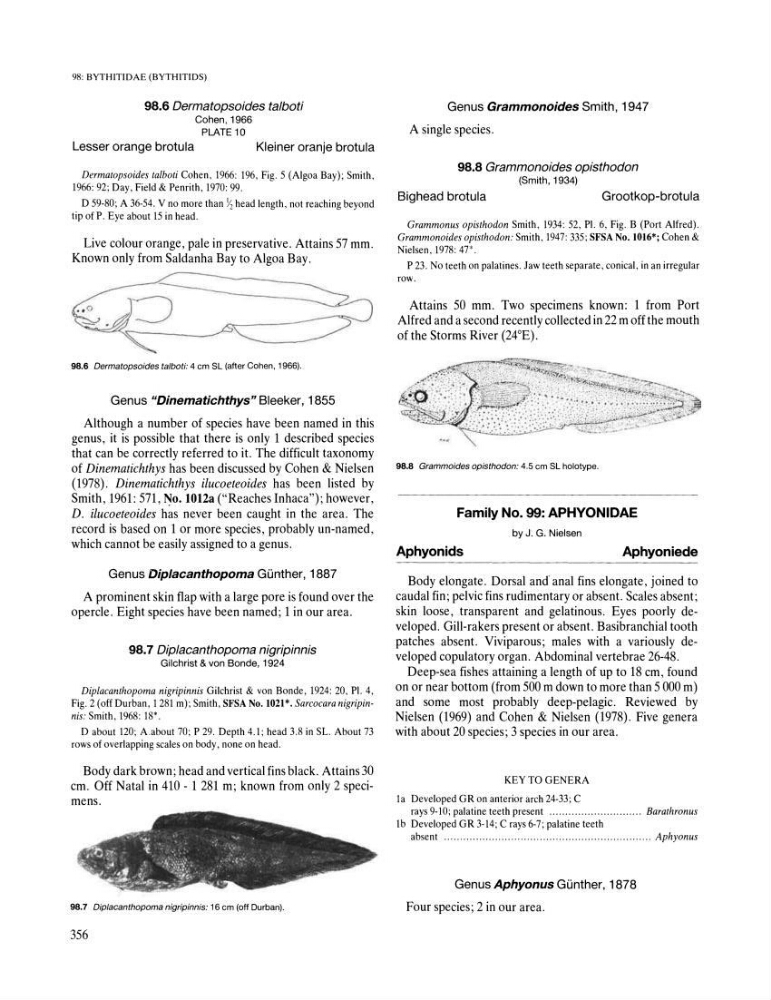
98.6 Dermalapsaides la/bali: 4 em SL (after Cohen, 1966).
Genus "Dinematichthys" Bleeker, 1855
Although a number of species have been named in this
genus, it is possible that there is only 1 described species
that can be correctly referred to it. The difficult taxonomy
of Dinematichthys has been discussed by Cohen & Nielsen
(1978). Dinematichthys ilucoeteoides has been listed by
Smith, 1961: 571, ~o. 1012a ("Reaches Inhaca"); however,
D. ilucoeteoides has never been caught in the area. The
record is based on 1 or more species, probably un-named,
which cannot be easily assigned to a genus.
Genus Dip/acanthopoma Gunther, 1887
A prominent skin flap with a large pore is found over the
opercle. Eight species have been named; 1 in our area.
98.7 Oiplacanthopoma nigripinnis
Gilchrist & von Bonde, 1924
Diplacanthopoma nigripinnis Gilchrist & von Bonde, 1924: 20, PI. 4,
Fig. 2 (off Durban, 1281 m); Smith, SFSA No. 1021*. Sarcocara nigripinnis: Smith, 1968: 18*
D about 120; A.about 70; P 29. Depth 4.1; head 3.8 in SL. About 73
rows of overlapping scales on body, none on head.
Body dark brown; head and vertical fins black. Attains 30
cm. Off Natal in 410 - 1 281 m; known from only 2 specimens.
98.7 Dip/acanthapama nigripinnis: 16 em (off Durban).
356
Genus Grammonoides Smith, 1947
A single species.
98.8 Grammonoides opisthodon
(Smith, 1934)
Bighead brotula
Grootkop-brotula
Grammonus opisthodon Smith, 1934: 52, PI. 6, Fig. B (Port Alfred).
Grammonoides opisthodon: Smith, 1947: 335; SFSA No. 1016*; Cohen &
Nielsen. 1978: 47*.
P 23. No teeth on palatines. Jaw teeth separate, conical, in an irregular
row.
Attains 50 mm. Two specimens known: 1 from Port
Alfred and a second recently coIIected in 22 m off the mouth
of the Storms River (24°E).
98.8 Grammaides apislhadan: 4.5 em SL holotype.
Family No. 99: APHYONIDAE
by J. G. Nielsen
Aphyonids
Aphyoniede
Body elongate. Dorsal and anal fins elongate, joined to
caudal fin; pelvic fins rudimentary or absent. Scales absent;
skin loose, transparent and gelatinous. Eyes poorly developed. GiII-rakers present or absent. Basibranchial tooth
patches absent. Viviparous; males with a variously developed copulatory organ. Abdominal vertebrae 26-48.
Deep-sea fishes attaining a length of up to 18 cm, found
on or near bottom (from 500 m down to more than 5 000 m)
and some most probably deep-pelagic. Reviewed by
Nielsen (1969) and Cohen & Nielsen (1978). Five genera
with about 20 species; 3 species in our area.
KEY TO GENERA
1a Developed GR on anterior arch 24-33; C
rays 9-10; palatine teeth present ............................. Baralhronus
Ib Developed GR 3-14; Crays 6-7; palatine teeth
absent ................................................................. Aphyonus
Genus Aphyonus Gunther, 1878
Four species; 2 in our area.
98.6 Oermatopsoides talboti
Cohen, 1966
PLATE 10
Lesser orange brotula
Kleiner oranje brotula
Dermalopsoides talboli Cohen, 1966: 196, Fig. 5 (Algoa Bay); Smith,
1966: 92; Day, Field & Penrith, 1970: 99.
D 59-80; A 36-54. V no more than ~ head length, not reaching beyond
tip of P. Eye about 15 in head.
Live colour orange, pale in preservative. Attains 57 mm.
Known only from Saldanha Bay to Algoa Bay.
98.6 Dermalapsaides la/bali: 4 em SL (after Cohen, 1966).
Genus "Dinematichthys" Bleeker, 1855
Although a number of species have been named in this
genus, it is possible that there is only 1 described species
that can be correctly referred to it. The difficult taxonomy
of Dinematichthys has been discussed by Cohen & Nielsen
(1978). Dinematichthys ilucoeteoides has been listed by
Smith, 1961: 571, ~o. 1012a ("Reaches Inhaca"); however,
D. ilucoeteoides has never been caught in the area. The
record is based on 1 or more species, probably un-named,
which cannot be easily assigned to a genus.
Genus Dip/acanthopoma Gunther, 1887
A prominent skin flap with a large pore is found over the
opercle. Eight species have been named; 1 in our area.
98.7 Oiplacanthopoma nigripinnis
Gilchrist & von Bonde, 1924
Diplacanthopoma nigripinnis Gilchrist & von Bonde, 1924: 20, PI. 4,
Fig. 2 (off Durban, 1281 m); Smith, SFSA No. 1021*. Sarcocara nigripinnis: Smith, 1968: 18*
D about 120; A.about 70; P 29. Depth 4.1; head 3.8 in SL. About 73
rows of overlapping scales on body, none on head.
Body dark brown; head and vertical fins black. Attains 30
cm. Off Natal in 410 - 1 281 m; known from only 2 specimens.
98.7 Dip/acanthapama nigripinnis: 16 em (off Durban).
356
Genus Grammonoides Smith, 1947
A single species.
98.8 Grammonoides opisthodon
(Smith, 1934)
Bighead brotula
Grootkop-brotula
Grammonus opisthodon Smith, 1934: 52, PI. 6, Fig. B (Port Alfred).
Grammonoides opisthodon: Smith, 1947: 335; SFSA No. 1016*; Cohen &
Nielsen. 1978: 47*.
P 23. No teeth on palatines. Jaw teeth separate, conical, in an irregular
row.
Attains 50 mm. Two specimens known: 1 from Port
Alfred and a second recently coIIected in 22 m off the mouth
of the Storms River (24°E).
98.8 Grammaides apislhadan: 4.5 em SL holotype.
Family No. 99: APHYONIDAE
by J. G. Nielsen
Aphyonids
Aphyoniede
Body elongate. Dorsal and anal fins elongate, joined to
caudal fin; pelvic fins rudimentary or absent. Scales absent;
skin loose, transparent and gelatinous. Eyes poorly developed. GiII-rakers present or absent. Basibranchial tooth
patches absent. Viviparous; males with a variously developed copulatory organ. Abdominal vertebrae 26-48.
Deep-sea fishes attaining a length of up to 18 cm, found
on or near bottom (from 500 m down to more than 5 000 m)
and some most probably deep-pelagic. Reviewed by
Nielsen (1969) and Cohen & Nielsen (1978). Five genera
with about 20 species; 3 species in our area.
KEY TO GENERA
1a Developed GR on anterior arch 24-33; C
rays 9-10; palatine teeth present ............................. Baralhronus
Ib Developed GR 3-14; Crays 6-7; palatine teeth
absent ................................................................. Aphyonus
Genus Aphyonus Gunther, 1878
Four species; 2 in our area.