

97: CARAPIDAE (PEARLFISHES)
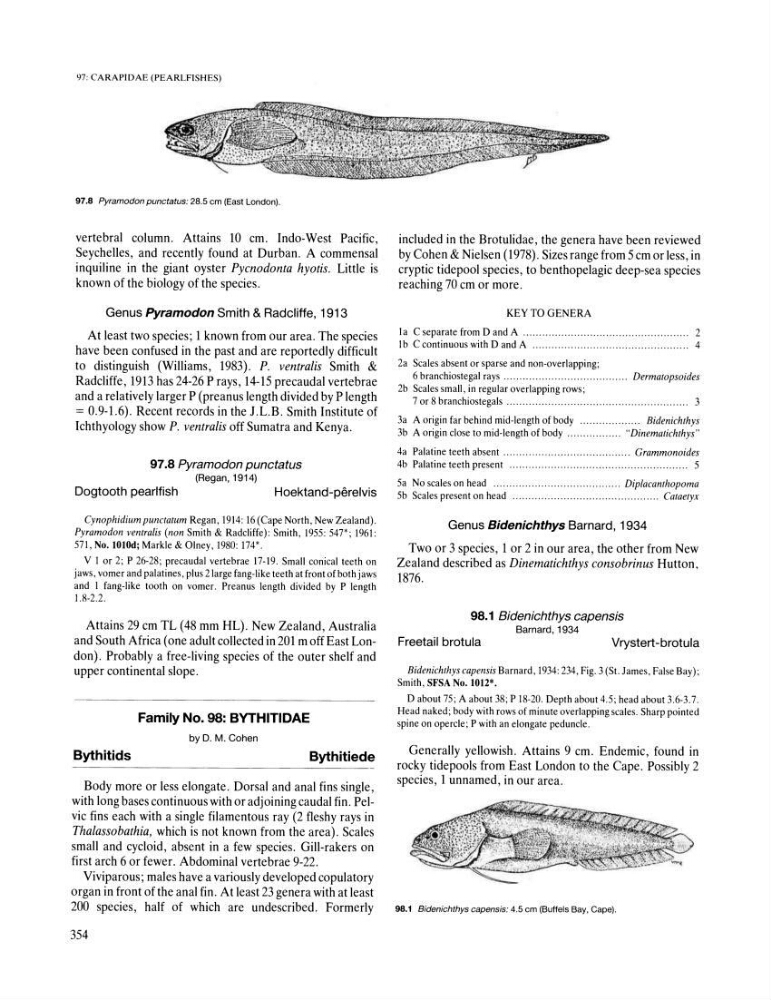
97.8 Pyramodon punctatus: 28.5 em (East London).
vertebral column. Attains 10 cm. Indo-West Pacific,
Seychelles, and recently found at Durban. A commensal
inquiline in the giant oyster Pycnodonta hyotis. Little is
known of the biology of the species.
Genus Pyramodon Smith & Radcliffe, 1913
At least two species; 1 known from our area. The species
have been confused in the past and are reportedly difficult
to distinguish (Williams, 1983). P. ventralis Smith &
Radcliffe, 1913 has 24-26 Prays, 14-15 precaudal vertebrae
and a relatively larger P (preanus length divided by P length
== 0.9-1.6) . Recent records in the J.L.B. Smith Institute of
Ichthyology show P. ventralis off Sumatra and Kenya.
97.8 Pyramodon punctatus
(Regan, 1914)
Dogtooth pearlfish
Hoektand-perelvis
Cynophidium punctatum Regan, 1914: 16 (Cape North , New Zealand) .
Pyramodon ventralis (non Smith & Radcliffe): Smith, 1955: 547*; 1961:
571 , No. 1010d; Markle & Olney , 1980: 174*'
V I or 2; P 26-28; precaudal vertebrae 17-19. Small conical teeth on
jaws, vomer and palatines, plus 2 large fang-like teeth at front of both jaws
and I fang-like tooth on vomer. Preanus length divided by P length
1.8-2.2.
Attains 29 cm TL (48 mm HL). New Zealand, Australia
and South Africa (one adult collected in 201 m off East London). Probably a free-living species of the outer shelf and
upper continental slope.
Family No. 98: BYTHITIDAE
by D. M. Cohen
Bythitids
Bythitiede
Body more or less elongate. Dorsal and anal fins single,
with long bases continuous with or adjoining caudal fin. Pelvic fins each with a single filamentous ray (2 fleshy rays in
Thalassobathia, which is not known from the area). Scales
small and cycloid, absent in a few species. Gill-rakers on
first arch 6 or fewer. Abdominal vertebrae 9-22.
Viviparous; males have a variously developed copulatory
organ in front of the anal fin . At least 23 genera with at least
200 species, half of which are undescribed . Formerly
354
included in the Brotulidae, the genera have been reviewed
by Cohen & Nielsen (1978). Sizes range from 5 cm or less, in
cryptic tidepool species, to benthopelagic deep-sea species
reaching 70 cm or more.
KEY TO GENERA
1a C separate from D and A .... ... ... ... .. .... .. ... ................ ...... ..... . 2
Ib C continuous with D and A .. ..... ........ ... ...... .... .... ... .. .... ........ 4
2a Scales absent or sparse and non-overlapping;
6 branchiostegal rays ... .................. ............... ... Dermatopsoides
2b Scales small , in regular overlapping rows ;
7 or 8 branchiostegals ......... ............. .. .. .. .. ... ... ...... ........... .... 3
3a A origin far behind mid-length of body ..... ..... .. ...... . Bidenichthys
3b A origin close to mid· length of body ................... Dinematichthys"
4a Palatine teeth absent ....... ... ...... ....... ...... .. ... ...... Grammonoides
4b Palatine teeth present .... ..... ....... .. .... ..... ............................. 5
5a No scales on head .... ... .... ......... ... ...... .. ... ...... Diplacanthopoma
5b Scales present on head ... ... ..... ... ..... ... ... ............ ... ...... Cataetyx
Genus Bidenichthys Barnard, 1934
Two or 3 species, 1 or 2 in our area, the other from New
Zealand described as Dinematichthys consobrinus Hutton,
1876.
98.1 Bidenichthys capen sis
Barnard,1934
Freetail brotula
Vrystert-brotula
Bidenichthys capensis Barnard , 1934 : 234, Fig. 3 (St. James, False Bay);
Smith, SFSA No. 1012*.
D about 75; A about 38; P 18-20. Depth about 4.5 ; head about 3.6-3.7.
Head naked; body with rows of minute overlapping scales. Sharp pointed
spine on opercle; P with an elongate peduncle.
Generally yellowish. Attains 9 cm. Endemic, found in
rocky tidepools from East London to the Cape. Possibly 2
species, 1 unnamed , in our area .
98.1 Bidenichthys capensis: 4.5 em (Buffels Bay, Cape).
97.8 Pyramodon punctatus: 28.5 em (East London).
vertebral column. Attains 10 cm. Indo-West Pacific,
Seychelles, and recently found at Durban. A commensal
inquiline in the giant oyster Pycnodonta hyotis. Little is
known of the biology of the species.
Genus Pyramodon Smith & Radcliffe, 1913
At least two species; 1 known from our area. The species
have been confused in the past and are reportedly difficult
to distinguish (Williams, 1983). P. ventralis Smith &
Radcliffe, 1913 has 24-26 Prays, 14-15 precaudal vertebrae
and a relatively larger P (preanus length divided by P length
== 0.9-1.6) . Recent records in the J.L.B. Smith Institute of
Ichthyology show P. ventralis off Sumatra and Kenya.
97.8 Pyramodon punctatus
(Regan, 1914)
Dogtooth pearlfish
Hoektand-perelvis
Cynophidium punctatum Regan, 1914: 16 (Cape North , New Zealand) .
Pyramodon ventralis (non Smith & Radcliffe): Smith, 1955: 547*; 1961:
571 , No. 1010d; Markle & Olney , 1980: 174*'
V I or 2; P 26-28; precaudal vertebrae 17-19. Small conical teeth on
jaws, vomer and palatines, plus 2 large fang-like teeth at front of both jaws
and I fang-like tooth on vomer. Preanus length divided by P length
1.8-2.2.
Attains 29 cm TL (48 mm HL). New Zealand, Australia
and South Africa (one adult collected in 201 m off East London). Probably a free-living species of the outer shelf and
upper continental slope.
Family No. 98: BYTHITIDAE
by D. M. Cohen
Bythitids
Bythitiede
Body more or less elongate. Dorsal and anal fins single,
with long bases continuous with or adjoining caudal fin. Pelvic fins each with a single filamentous ray (2 fleshy rays in
Thalassobathia, which is not known from the area). Scales
small and cycloid, absent in a few species. Gill-rakers on
first arch 6 or fewer. Abdominal vertebrae 9-22.
Viviparous; males have a variously developed copulatory
organ in front of the anal fin . At least 23 genera with at least
200 species, half of which are undescribed . Formerly
354
included in the Brotulidae, the genera have been reviewed
by Cohen & Nielsen (1978). Sizes range from 5 cm or less, in
cryptic tidepool species, to benthopelagic deep-sea species
reaching 70 cm or more.
KEY TO GENERA
1a C separate from D and A .... ... ... ... .. .... .. ... ................ ...... ..... . 2
Ib C continuous with D and A .. ..... ........ ... ...... .... .... ... .. .... ........ 4
2a Scales absent or sparse and non-overlapping;
6 branchiostegal rays ... .................. ............... ... Dermatopsoides
2b Scales small , in regular overlapping rows ;
7 or 8 branchiostegals ......... ............. .. .. .. .. ... ... ...... ........... .... 3
3a A origin far behind mid-length of body ..... ..... .. ...... . Bidenichthys
3b A origin close to mid· length of body ................... Dinematichthys"
4a Palatine teeth absent ....... ... ...... ....... ...... .. ... ...... Grammonoides
4b Palatine teeth present .... ..... ....... .. .... ..... ............................. 5
5a No scales on head .... ... .... ......... ... ...... .. ... ...... Diplacanthopoma
5b Scales present on head ... ... ..... ... ..... ... ... ............ ... ...... Cataetyx
Genus Bidenichthys Barnard, 1934
Two or 3 species, 1 or 2 in our area, the other from New
Zealand described as Dinematichthys consobrinus Hutton,
1876.
98.1 Bidenichthys capen sis
Barnard,1934
Freetail brotula
Vrystert-brotula
Bidenichthys capensis Barnard , 1934 : 234, Fig. 3 (St. James, False Bay);
Smith, SFSA No. 1012*.
D about 75; A about 38; P 18-20. Depth about 4.5 ; head about 3.6-3.7.
Head naked; body with rows of minute overlapping scales. Sharp pointed
spine on opercle; P with an elongate peduncle.
Generally yellowish. Attains 9 cm. Endemic, found in
rocky tidepools from East London to the Cape. Possibly 2
species, 1 unnamed , in our area .
98.1 Bidenichthys capensis: 4.5 em (Buffels Bay, Cape).