

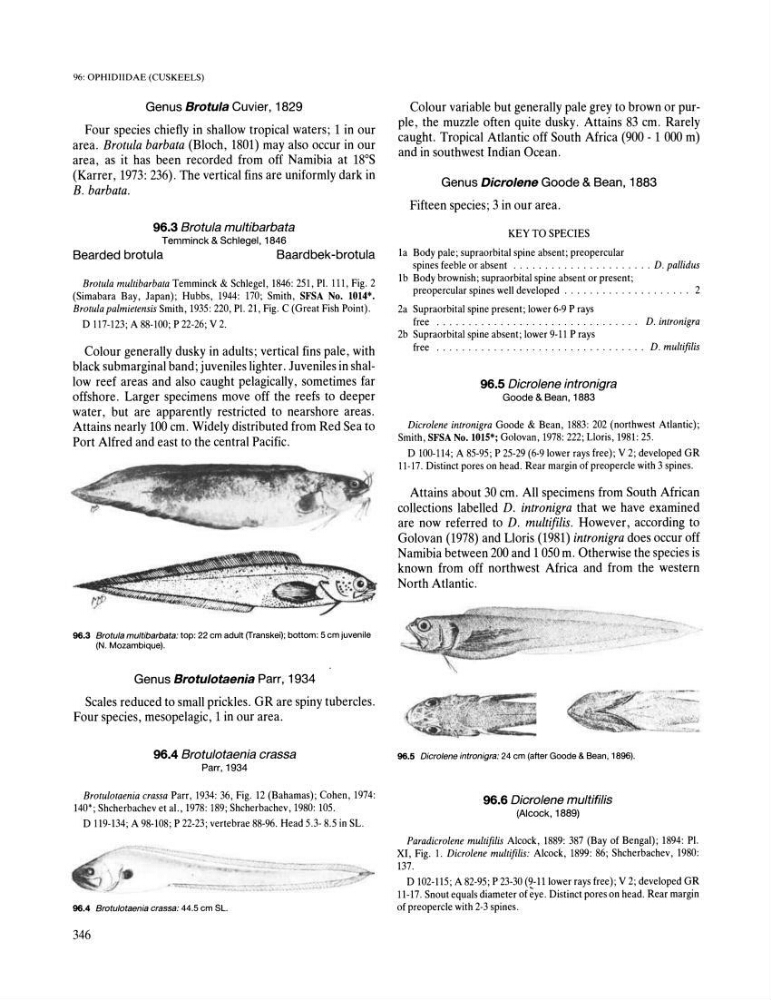
96: OPHIDIIDAE (CUSKEELS)
Genus Brotula Cuvier, 1829
Four species chiefly in shallow tropical waters; 1 in our
area. Brotula barbata (Bloch, 1801) may also occur in our
area, as it has been recorded from off Namibia at 18°S
(Karrer, 1973: 236). The vertical fins are uniformly dark in
B. barbata.
96.3 Brotu/a mu/tibarbata
Temminck & Schlegel, 1846
Bearded brotula
Baardbek-brotula
Brotula multibarbata Temminck & Schlegel, 1846: 251, PI. 111, Fig. 2
(Simabara Bay, Japan); Hubbs, 1944: 170; Smith , SFSA No. 1014*.
Brotula palmietensis Smith, 1935: 220, PI. 21, Fig. C (Great Fish Point).
D 117-123; A 88-100; P 22-26; V 2.
Colour generally dusky in adults; vertical fins pale, with
black submarginal band; juveniles lighter. Juveniles in shallow reef areas and also caught pelagically, sometimes far
offshore. Larger specimens move off the reefs to deeper
water, but are apparently restricted to nearshore areas.
Attains nearly 100 cm. Widely distributed from Red Sea to
Port Alfred and east to the central Pacific.
96.3 Brotuta muttibarbata: top: 22 em adult (Transkei); bottom: 5 em juvenile
(N. Mozambique).
Genus Brotulotaenia Parr, 1934
Scales reduced to small prickles. GR are spiny tubercles.
Four species, mesopelagic, 1 in our area.
96.4 Brotu/otaenia erassa
Parr, 1934
Brotulotaenia crassa Parr, 1934: 36, Fig. 12 (Bahamas); Cohen , 1974:
140'; Shcherbachev et aI., 1978: 189; Shcherbachev, 1980: 105.
D 119-134; A 98-108; P 22-23; vertebrae 88-96. Head 5.3- 8.5 in SL.
96.4 Brotutotaenia crassa: 44.5 em SL.
346
. , ...
........... .. - ) .
Colour variable but generally pale grey to brown or purple, the muzzle often quite dusky . Attains 83 cm. Rarely
caught. Tropical Atlantic off South Africa (900 - 1 000 m)
and in southwest Indian Ocean.
Genus Dicrolene Goode & Bean, 1883
Fifteen species; 3 in our area.
KEY TO SPECIES
1a Body pale ; supraorbital spine absent; preopercular
spines feeble or absent . ..... ................ D. pallidus
Ib Body brownish ; supraorbital spine absent or present;
preopercular spines well developed . . . . . . . . . . . . . . . . . . . . 2
2a Supraorbital spine present; lower 6-9 Prays
free . ............... . ...... . ..... .. . D. intronigra
2b Supraorbital spine absent; lower 9-11 Prays
free .............. . ...... .. ...... . ... D. multifilis
96.5 Diero/ene intronigra
Goode & Bean, 1883
Dicrolene intronigra Goode & Bean, 1883: 202 (northwest Atlantic);
Smith, SFSA No. 1015*; Golovan, 1978: 222; L1oris, 1981: 25.
D 100-114; A 85-95; P 25-29 (6-9 lower rays free); V 2; developed GR
11-17. Distinct pores on head. Rear margin of preopercle with 3 spines.
Attains about 30 cm. All specimens from South African
collections labelled D. intronigra that we have examined
are now referred to D. multifilis. However, according to
Golovan (1978) and Lloris (1981) intronigra does occur off
Namibia between 200 and 1 050 m. Otherwise the species is
known from off northwest Africa and from the western
North Atlantic.
96.5 Dicrotene intronigra: 24 em (after Goode & Bean, 1896).
96.6 Diero/ene mu/tifilis
(Alcock, 1889)
Paradicrolene multifilis Alcock, 1889: 387 (Bay of Bengal); 1894: PI.
XI, Fig. 1. Dicrolene multifilis: Alcock, 1899: 86; Shcherbachev, 1980:
137.
D 102-115; A 82-95; P 23-30 (9-11 lower rays free); V 2; developed GR
11-17. Snout equals diameter of eye. Distinct pores on head . Rear margin
of preoperc1e with 2-3 spines.
Genus Brotula Cuvier, 1829
Four species chiefly in shallow tropical waters; 1 in our
area. Brotula barbata (Bloch, 1801) may also occur in our
area, as it has been recorded from off Namibia at 18°S
(Karrer, 1973: 236). The vertical fins are uniformly dark in
B. barbata.
96.3 Brotu/a mu/tibarbata
Temminck & Schlegel, 1846
Bearded brotula
Baardbek-brotula
Brotula multibarbata Temminck & Schlegel, 1846: 251, PI. 111, Fig. 2
(Simabara Bay, Japan); Hubbs, 1944: 170; Smith , SFSA No. 1014*.
Brotula palmietensis Smith, 1935: 220, PI. 21, Fig. C (Great Fish Point).
D 117-123; A 88-100; P 22-26; V 2.
Colour generally dusky in adults; vertical fins pale, with
black submarginal band; juveniles lighter. Juveniles in shallow reef areas and also caught pelagically, sometimes far
offshore. Larger specimens move off the reefs to deeper
water, but are apparently restricted to nearshore areas.
Attains nearly 100 cm. Widely distributed from Red Sea to
Port Alfred and east to the central Pacific.
96.3 Brotuta muttibarbata: top: 22 em adult (Transkei); bottom: 5 em juvenile
(N. Mozambique).
Genus Brotulotaenia Parr, 1934
Scales reduced to small prickles. GR are spiny tubercles.
Four species, mesopelagic, 1 in our area.
96.4 Brotu/otaenia erassa
Parr, 1934
Brotulotaenia crassa Parr, 1934: 36, Fig. 12 (Bahamas); Cohen , 1974:
140'; Shcherbachev et aI., 1978: 189; Shcherbachev, 1980: 105.
D 119-134; A 98-108; P 22-23; vertebrae 88-96. Head 5.3- 8.5 in SL.
96.4 Brotutotaenia crassa: 44.5 em SL.
346
. , ...
........... .. - ) .
Colour variable but generally pale grey to brown or purple, the muzzle often quite dusky . Attains 83 cm. Rarely
caught. Tropical Atlantic off South Africa (900 - 1 000 m)
and in southwest Indian Ocean.
Genus Dicrolene Goode & Bean, 1883
Fifteen species; 3 in our area.
KEY TO SPECIES
1a Body pale ; supraorbital spine absent; preopercular
spines feeble or absent . ..... ................ D. pallidus
Ib Body brownish ; supraorbital spine absent or present;
preopercular spines well developed . . . . . . . . . . . . . . . . . . . . 2
2a Supraorbital spine present; lower 6-9 Prays
free . ............... . ...... . ..... .. . D. intronigra
2b Supraorbital spine absent; lower 9-11 Prays
free .............. . ...... .. ...... . ... D. multifilis
96.5 Diero/ene intronigra
Goode & Bean, 1883
Dicrolene intronigra Goode & Bean, 1883: 202 (northwest Atlantic);
Smith, SFSA No. 1015*; Golovan, 1978: 222; L1oris, 1981: 25.
D 100-114; A 85-95; P 25-29 (6-9 lower rays free); V 2; developed GR
11-17. Distinct pores on head. Rear margin of preopercle with 3 spines.
Attains about 30 cm. All specimens from South African
collections labelled D. intronigra that we have examined
are now referred to D. multifilis. However, according to
Golovan (1978) and Lloris (1981) intronigra does occur off
Namibia between 200 and 1 050 m. Otherwise the species is
known from off northwest Africa and from the western
North Atlantic.
96.5 Dicrotene intronigra: 24 em (after Goode & Bean, 1896).
96.6 Diero/ene mu/tifilis
(Alcock, 1889)
Paradicrolene multifilis Alcock, 1889: 387 (Bay of Bengal); 1894: PI.
XI, Fig. 1. Dicrolene multifilis: Alcock, 1899: 86; Shcherbachev, 1980:
137.
D 102-115; A 82-95; P 23-30 (9-11 lower rays free); V 2; developed GR
11-17. Snout equals diameter of eye. Distinct pores on head . Rear margin
of preoperc1e with 2-3 spines.