

93: MACROURIDAE (GRENADIERS)
capensis: Marshall, 1973: 519. Bathygadus fumosus Barnard, 1925: 500
(Cape Point); 1925: 333*; Smith, SFSA No. 247.
D 11,9-10 + ca. 160; A ca. 150; P 16-19; V 8; GR 7+(25- 28); pyloric
caeca 18-20. Upper jaw extends beyond eye, about 1.6 in head. Eye
diameter subequal to snout, slightly more than interorbital width, about 4
in head. First D, P and V with a prolonged filamentous ray, thoseofD and
P more than twice, that of V about twice, head length. Barbel rudimentary
to short, more than 1.6 in eye diameter. Teeth minute, in long narrow
bands in both jaws, upper jaw band wider.
Dr P.C. Heemstra examined the holotype of Bathygadus capensis (RUSI
36) and found "a very small but distinct, conical barbel 0.9 mm high on the
chin" (Heemstra, in litt., 5 Mar. 1981). He also reported no teeth on the
palate, contrary to the statement in the original description, " ... teeth very
minute, villiform, in bands on jaws and palatines; larger teeth on vomer."
Dr Heemstra noted that "There are minute, scattered, soft, dermal papillae on
the roof of the mouth that might have been mistaken for teeth, but these are
certainly not larger than the teeth on the jaws." Thus, no member of the
Macrouridae has teeth on the palate. Aside from the rudimentary barbel in the
holotype (and hitherto only known specimen) of G. capensis, the species
agrees completely with Bathygadus fumosus Barnard. Barbel length, however, varies considerably in some macrourids. In their description of Gadomus
introniger, Gilbert & Hubbs (1920: 402) stated that the mental barbel is "of
extreme variability, its length ranging from half that of the eye to two-thirds
that of the head ... ; it is probably a healed stub when extremely short." Thus,
no tangible difference exists to support continued recognition of B. fumosus.
Overall colour pale, flesh-coloured; blackish over gill
covers; fins dusky to black. Attains 46 cm. Table Bay to
Mozambique, 850 - 1480 m.
93.14 Gadomus eapensis: 32+ em (off Mozambique).
Genus Macrourus Bloch, 1786
Three species, 1 from our area. Species large; M. berglax
Lacepede, 1802 of the northern Atlantic fished commercially. The genus has a bipolar distribution.
93.15 Macrourus holotrachys
Gunther, 1878
Macrurus holotrachys Giinther, 1878: 24 (off Uruguay); Giinther, 1887:
136*; Marshall, 1973: 582. Coryphaenoides carinatus Giinther, 1878: 28
(Prince Edward Ids.); Giinther, 1887: 137*; Barnard, 1925: 336; Smith,
SFSA No. 238. Macrourus whitsoni Regan, 1913, described from Antarctica, may be another synonym.
336
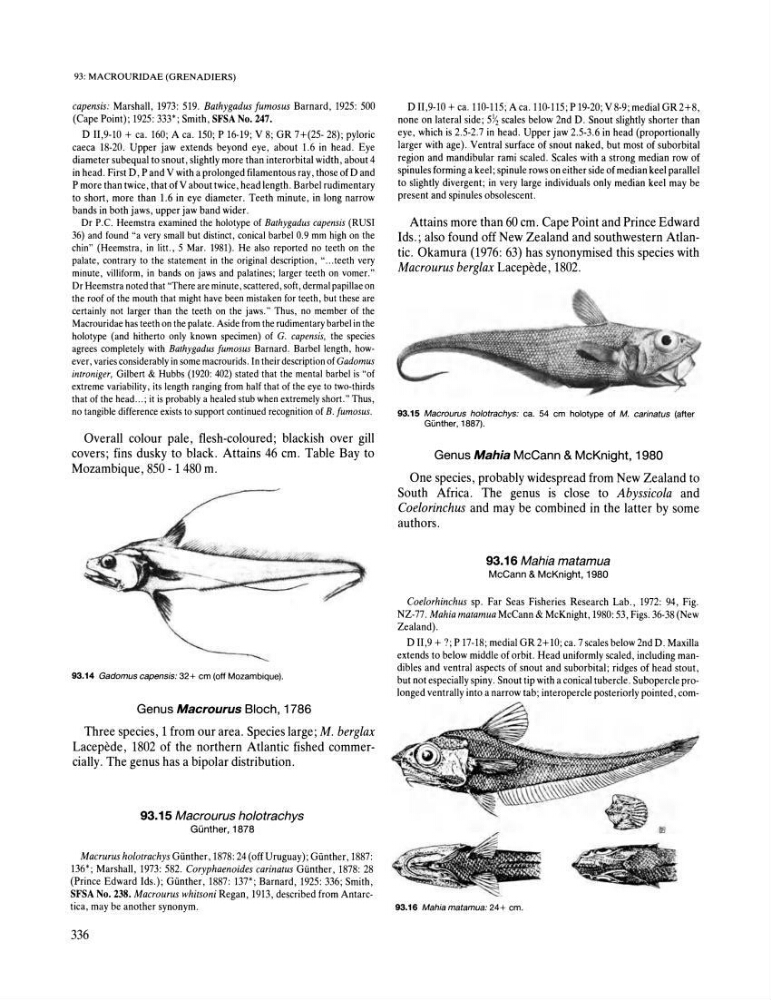
D 11,9-10 + ca. 110-115; A ca. 110-115; P 19-20; V 8-9; medial GR 2+8,
none on lateral side; 5)s scales below 2nd D. Snout slightly shorter than
eye, which is 2.5-2.7 in head. Upper jaw 2.5-3.6 in head (proportionally
larger with age). Ventral surface of snout naked, but most of suborbital
region and mandibular rami scaled. Scales with a strong median row of
spinules forming a keel; spinule rows on either side of median keel parallel
to slightly divergent; in very large individuals only median keel may be
present and spinules obsolescent.
Attains more than 60 cm. Cape Point and Prince Edward
Ids.; also found off New Zealand and southwestern Atlantic. Okamura (1976: 63) has synonymised this species with
Macrourus berglax Lacepede, 1802.
93.15 Maerourus h%traehys: ca. 54 em holotype of M. carinatus (after
Gunther, 1887).
Genus Mahia McCann & McKnight, 1980
One species, probably widespread from New Zealand to
South Africa. The genus is close to Abyssicola and
Coelorinchus and may be combined in the latter by some
authors.
93.16 Mahia matamua
McCann & McKnight, 1980
Coelorhinchus sp. Far Seas Fisheries Research Lab., 1972: 94, Fig.
NZ-77. Mahia matamua McCann & McKnight, 1980: 53, Figs. 36-38 (New
Zealand).
D 11,9 + ?; P 17-18; medial GR 2+ 10; ca. 7 scales below 2nd D. Maxilla
extends to below middle of orbit. Head uniformly scaled, including mandibles and ventral aspects of snout and suborbital; ridges of head stout,
but not especially spiny. Snout tip with a conical tubercle. Subopercle prolonged ventrally into a narrow tab; interopercle posteriorly pointed, com93.16 Mahia matamua: 24+ em.
capensis: Marshall, 1973: 519. Bathygadus fumosus Barnard, 1925: 500
(Cape Point); 1925: 333*; Smith, SFSA No. 247.
D 11,9-10 + ca. 160; A ca. 150; P 16-19; V 8; GR 7+(25- 28); pyloric
caeca 18-20. Upper jaw extends beyond eye, about 1.6 in head. Eye
diameter subequal to snout, slightly more than interorbital width, about 4
in head. First D, P and V with a prolonged filamentous ray, thoseofD and
P more than twice, that of V about twice, head length. Barbel rudimentary
to short, more than 1.6 in eye diameter. Teeth minute, in long narrow
bands in both jaws, upper jaw band wider.
Dr P.C. Heemstra examined the holotype of Bathygadus capensis (RUSI
36) and found "a very small but distinct, conical barbel 0.9 mm high on the
chin" (Heemstra, in litt., 5 Mar. 1981). He also reported no teeth on the
palate, contrary to the statement in the original description, " ... teeth very
minute, villiform, in bands on jaws and palatines; larger teeth on vomer."
Dr Heemstra noted that "There are minute, scattered, soft, dermal papillae on
the roof of the mouth that might have been mistaken for teeth, but these are
certainly not larger than the teeth on the jaws." Thus, no member of the
Macrouridae has teeth on the palate. Aside from the rudimentary barbel in the
holotype (and hitherto only known specimen) of G. capensis, the species
agrees completely with Bathygadus fumosus Barnard. Barbel length, however, varies considerably in some macrourids. In their description of Gadomus
introniger, Gilbert & Hubbs (1920: 402) stated that the mental barbel is "of
extreme variability, its length ranging from half that of the eye to two-thirds
that of the head ... ; it is probably a healed stub when extremely short." Thus,
no tangible difference exists to support continued recognition of B. fumosus.
Overall colour pale, flesh-coloured; blackish over gill
covers; fins dusky to black. Attains 46 cm. Table Bay to
Mozambique, 850 - 1480 m.
93.14 Gadomus eapensis: 32+ em (off Mozambique).
Genus Macrourus Bloch, 1786
Three species, 1 from our area. Species large; M. berglax
Lacepede, 1802 of the northern Atlantic fished commercially. The genus has a bipolar distribution.
93.15 Macrourus holotrachys
Gunther, 1878
Macrurus holotrachys Giinther, 1878: 24 (off Uruguay); Giinther, 1887:
136*; Marshall, 1973: 582. Coryphaenoides carinatus Giinther, 1878: 28
(Prince Edward Ids.); Giinther, 1887: 137*; Barnard, 1925: 336; Smith,
SFSA No. 238. Macrourus whitsoni Regan, 1913, described from Antarctica, may be another synonym.
336
D 11,9-10 + ca. 110-115; A ca. 110-115; P 19-20; V 8-9; medial GR 2+8,
none on lateral side; 5)s scales below 2nd D. Snout slightly shorter than
eye, which is 2.5-2.7 in head. Upper jaw 2.5-3.6 in head (proportionally
larger with age). Ventral surface of snout naked, but most of suborbital
region and mandibular rami scaled. Scales with a strong median row of
spinules forming a keel; spinule rows on either side of median keel parallel
to slightly divergent; in very large individuals only median keel may be
present and spinules obsolescent.
Attains more than 60 cm. Cape Point and Prince Edward
Ids.; also found off New Zealand and southwestern Atlantic. Okamura (1976: 63) has synonymised this species with
Macrourus berglax Lacepede, 1802.
93.15 Maerourus h%traehys: ca. 54 em holotype of M. carinatus (after
Gunther, 1887).
Genus Mahia McCann & McKnight, 1980
One species, probably widespread from New Zealand to
South Africa. The genus is close to Abyssicola and
Coelorinchus and may be combined in the latter by some
authors.
93.16 Mahia matamua
McCann & McKnight, 1980
Coelorhinchus sp. Far Seas Fisheries Research Lab., 1972: 94, Fig.
NZ-77. Mahia matamua McCann & McKnight, 1980: 53, Figs. 36-38 (New
Zealand).
D 11,9 + ?; P 17-18; medial GR 2+ 10; ca. 7 scales below 2nd D. Maxilla
extends to below middle of orbit. Head uniformly scaled, including mandibles and ventral aspects of snout and suborbital; ridges of head stout,
but not especially spiny. Snout tip with a conical tubercle. Subopercle prolonged ventrally into a narrow tab; interopercle posteriorly pointed, com93.16 Mahia matamua: 24+ em.