

D 12-14; A 12-15; P 12-15; GR (5-7)+(12-16); AO (4-7)+(3-5). No
luminous tissue on head in mature males and females.
Attains 117 mm. High-oceanic, mesopelagic; 375 -750 m
(day); 40 - 650 m (night); adults probably non-migratory.
Off Cape Peninsula and in Agulhas Current. Atlantic
(400N-02°S and 32°-40 0 S), Indian Ocean (21°-30 0 S), west
coast of Australia, and near Hawaii .
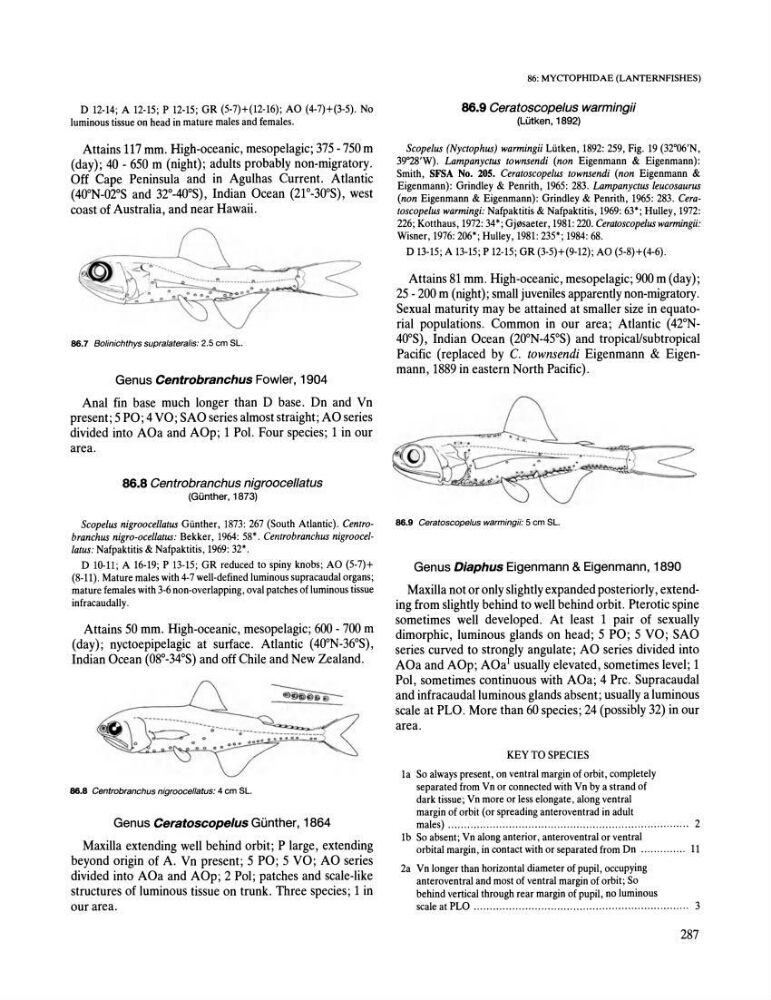
86.7 Bolinichthys supralateralis: 2.5 em SL.
Genus Centrobranchus Fowler, 1904
Anal fin base much longer than Dbase. Dn and Vn
present; 5 PO; 4 VO; SAO series almost straight; AO series
divided into AOa and AOp; 1 Pol. Four species; 1 in our
area.
86.8 Centrobranchus nigroocellatus
(Gunther, 1873)
Scopelus nigroocellatus Giinther, 1873: 267 (South Atlantic). Centrobranchus nigro-ocellatus: Bekker, 1964: 58*. Centrobranchus nigroocellatus: Nafpaktitis & Nafpaktitis, 1969: 32*.
D 10-11; A 16-19; P 13-15; GR reduced to spiny knobs; AO (5-7)+
(8-11) . Mature males with 4-7 well-defined luminous supracaudal organs;
mature females with 3-6 non-overlapping, oval patches of luminous tissue
infracaudally .
Attains 50 mm. High-oceanic, mesopelagic; 600 - 700 m
(day); nyctoepipelagic at surface. Atlantic (400N-36°S),
Indian Ocean (08°-34°S) and off Chile and New Zealand .
86.8 Centrobranehus nigroocellatus: 4 em SL.
Genus Ceratoscopelus Gunther, 1864
Maxilla extending well behind orbit; P large, extending
beyond origin of A. Vn present; 5 PO; 5 VO; AO series
divided into AOa and AOp; 2 Pol; patches and scale-like
structures of luminous tissue on trunk. Three species; 1 in
our area.
86: MYCTOPHIDAE (LANTERNFISHES)
86.9 Ceratoscopelus warmingii
(Lutken, 1892)
Scopelus (Nyctophus) warmingii Liitken, 1892: 259, Fig. 19 (32°06'N,
39"28'W). Lampanyctus townsendi (non Eigenmann & Eigenmann):
Smith, SFSA No. 205. Ceratoscopelus townsendi (non Eigenmann &
Eigenmann): Grindley & Penrith, 1965: 283. Lampanyctus leucosaurus
(non Eigenmann & Eigenmann): Grindley & Penrith, 1965: 283. Ceratoscopelus warmingi: Nafpaktitis & Nafpaktitis, 1969: 63*; Hulley, 1972:
226; Kotthaus, 1972: 34*; Gj0saeter, 1981 : 220. Ceratoscopelus warmingii:
Wisner, 1976: 206*; Hulley, 1981: 235*; 1984: 68.
D 13-15; A 13-15; P 12-15; GR (3-5)+(9-12); AO (5-8)+(4-6).
Attains 81 mm. High-oceanic, mesopelagic; 900 m (day);
25 - 200 m (night); small juveniles apparently non-migratory.
Sexual maturity may be attained at smaller size in equatorial populations. Common in our area; Atlantic (42°N40 0 S) , Indian Ocean (200N-45°S) and tropicaVsubtropical
Pacific (replaced by C. townsendi Eigenmann & Eigenmann, 1889 in eastern North Pacific).
86.9 Ceratoscopelus warmingii: 5 em SL.
Genus Diaphus Eigenmann & Eigenmann, 1890
Maxilla not or only slightly expanded posteriorly, extending from slightly behind to well behind orbit. Pterotic spine
sometimes well developed . At least 1 pair of sexually
dimorphic, luminous glands on head; 5 PO; 5 VO; SAO
series curved to strongly angulate; AO series divided into
AOa and AOp; AOa! usually elevated, sometimes level; 1
Pol, sometimes continuous with AOa; 4 Prc. Supracaudal
and infracaudalluminous glands absent; usually a luminous
scale at PLO. More than 60 species; 24 (possibly 32) in our
area.
KEY TO SPECIES
la So always present, on ventral margin of orbit, completely
separated from Vn or connected with Vn by a strand of
dark tissue; Vn more or less elongate, along ventral
margin of orbit (or spreading anteroventrad in adult
males) ........................................... ..... ........................... 2
Ib So absent; Vn along anterior, anteroventral or ventral
orbital margin, in contact with or separated from Dn .............. 11
2a Vn longer than horizontal diameter of pupil, occupying
anteroventral and most of ventral margin of orbit; So
behind vertical through rear margin of pupil, no luminous
scale at PLO .......... .............. ........ .. ...... .... ....................... 3
287
luminous tissue on head in mature males and females.
Attains 117 mm. High-oceanic, mesopelagic; 375 -750 m
(day); 40 - 650 m (night); adults probably non-migratory.
Off Cape Peninsula and in Agulhas Current. Atlantic
(400N-02°S and 32°-40 0 S), Indian Ocean (21°-30 0 S), west
coast of Australia, and near Hawaii .
86.7 Bolinichthys supralateralis: 2.5 em SL.
Genus Centrobranchus Fowler, 1904
Anal fin base much longer than Dbase. Dn and Vn
present; 5 PO; 4 VO; SAO series almost straight; AO series
divided into AOa and AOp; 1 Pol. Four species; 1 in our
area.
86.8 Centrobranchus nigroocellatus
(Gunther, 1873)
Scopelus nigroocellatus Giinther, 1873: 267 (South Atlantic). Centrobranchus nigro-ocellatus: Bekker, 1964: 58*. Centrobranchus nigroocellatus: Nafpaktitis & Nafpaktitis, 1969: 32*.
D 10-11; A 16-19; P 13-15; GR reduced to spiny knobs; AO (5-7)+
(8-11) . Mature males with 4-7 well-defined luminous supracaudal organs;
mature females with 3-6 non-overlapping, oval patches of luminous tissue
infracaudally .
Attains 50 mm. High-oceanic, mesopelagic; 600 - 700 m
(day); nyctoepipelagic at surface. Atlantic (400N-36°S),
Indian Ocean (08°-34°S) and off Chile and New Zealand .
86.8 Centrobranehus nigroocellatus: 4 em SL.
Genus Ceratoscopelus Gunther, 1864
Maxilla extending well behind orbit; P large, extending
beyond origin of A. Vn present; 5 PO; 5 VO; AO series
divided into AOa and AOp; 2 Pol; patches and scale-like
structures of luminous tissue on trunk. Three species; 1 in
our area.
86: MYCTOPHIDAE (LANTERNFISHES)
86.9 Ceratoscopelus warmingii
(Lutken, 1892)
Scopelus (Nyctophus) warmingii Liitken, 1892: 259, Fig. 19 (32°06'N,
39"28'W). Lampanyctus townsendi (non Eigenmann & Eigenmann):
Smith, SFSA No. 205. Ceratoscopelus townsendi (non Eigenmann &
Eigenmann): Grindley & Penrith, 1965: 283. Lampanyctus leucosaurus
(non Eigenmann & Eigenmann): Grindley & Penrith, 1965: 283. Ceratoscopelus warmingi: Nafpaktitis & Nafpaktitis, 1969: 63*; Hulley, 1972:
226; Kotthaus, 1972: 34*; Gj0saeter, 1981 : 220. Ceratoscopelus warmingii:
Wisner, 1976: 206*; Hulley, 1981: 235*; 1984: 68.
D 13-15; A 13-15; P 12-15; GR (3-5)+(9-12); AO (5-8)+(4-6).
Attains 81 mm. High-oceanic, mesopelagic; 900 m (day);
25 - 200 m (night); small juveniles apparently non-migratory.
Sexual maturity may be attained at smaller size in equatorial populations. Common in our area; Atlantic (42°N40 0 S) , Indian Ocean (200N-45°S) and tropicaVsubtropical
Pacific (replaced by C. townsendi Eigenmann & Eigenmann, 1889 in eastern North Pacific).
86.9 Ceratoscopelus warmingii: 5 em SL.
Genus Diaphus Eigenmann & Eigenmann, 1890
Maxilla not or only slightly expanded posteriorly, extending from slightly behind to well behind orbit. Pterotic spine
sometimes well developed . At least 1 pair of sexually
dimorphic, luminous glands on head; 5 PO; 5 VO; SAO
series curved to strongly angulate; AO series divided into
AOa and AOp; AOa! usually elevated, sometimes level; 1
Pol, sometimes continuous with AOa; 4 Prc. Supracaudal
and infracaudalluminous glands absent; usually a luminous
scale at PLO. More than 60 species; 24 (possibly 32) in our
area.
KEY TO SPECIES
la So always present, on ventral margin of orbit, completely
separated from Vn or connected with Vn by a strand of
dark tissue; Vn more or less elongate, along ventral
margin of orbit (or spreading anteroventrad in adult
males) ........................................... ..... ........................... 2
Ib So absent; Vn along anterior, anteroventral or ventral
orbital margin, in contact with or separated from Dn .............. 11
2a Vn longer than horizontal diameter of pupil, occupying
anteroventral and most of ventral margin of orbit; So
behind vertical through rear margin of pupil, no luminous
scale at PLO .......... .............. ........ .. ...... .... ....................... 3
287