

Off the Cape in 1 000 - 2 560 m, both sides of Atlantic Ocean
and off New Zealand.
Genus Saurida Valenciennes, 1849
Fourteen species; 2 in our area.
KEY TO SPECIES
la Drays 9-11; prominent dark blotches on
dorsolateral part of body; no dark spots along
upper edge of C ..................................................... S. gracilis
Ib Drays 11-13; a series of dark spots along front
edge of D and upper edge of C .......................... S. undosquamis
79.2 Saurida gracilis
(Quay & Gaimard, 1824)
Gracefullizardfish
Sierlike akkedisvis
Saurus gracilis Quoy & Gaimard, 1824: 224 (Hawaiian Ids. and
Mauritius). Saurida gracilis: Smith, SFSA No. 175. ?Saurida tumbil (non
Bloch): Smith, SFSA No. 177.
D9-11; A 8-10; P 13-14; vertebrae 47-50; LL47-51; scales above LL3Yz,
below LL 4Yz. P reaches line from D origin to V origin. Teeth on tongue
minute. Anterior nostril flap large, heavily pigmented, medial portion
attenuated and triangular.
Prominent dorsal and lateral pigment blotches distinguish this species from all other Indo-West Pacific Saurida.
Attains 20 cm. Common in shallow water over sandy
bottoms. A widely-distributed Indo-West Pacific species
extending south to Algoa Bay.
79.2 Saurida gracilis: 14 cm.
79.3 Saurida undosquamis
(Richardson, 1848)
Largescale lizardfish
Grootskub-akkedisvis
Saurus undosquamis Richardson, 1848: 138, PI. 51, Figs. 1-6 (Northwest Australia). Saurida undosquamis: Gunther, 1864: 400; Smith, SFSA
No. 176*; van der Elst, 1981: 341 *. Saurida grandisquamis Gunther, 1864:
400 (Australia).
D 11-13; A 9-12; P 14-15; vertebrae 45-48; LL 45-50; scales above LL
4Yz, below LL 5Yz. P reaches line from D origin to V origin. Anterior
nostril flap short, rounded, extending only slightly beyond nostril margin
when depressed anteriorly.
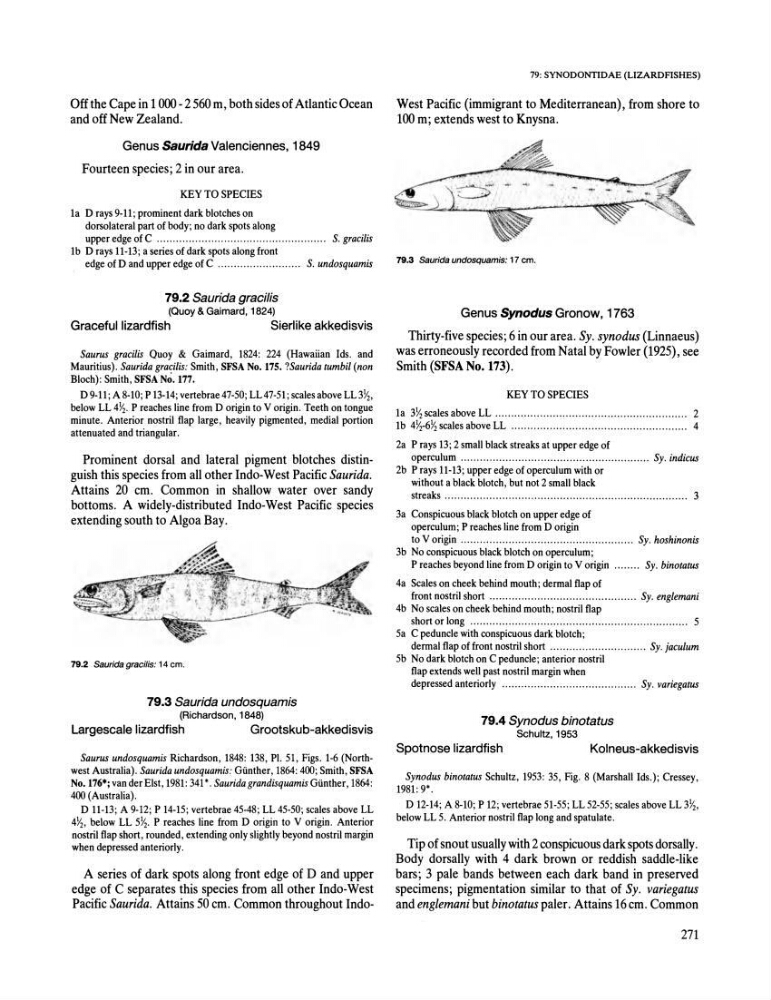
A series of dark spots along front edge of D and upper
edge of C separates this species from all other Indo-West
Pacific Saurida. Attains 50 cm. Common throughout Indo79: SYNODONTIDAE (LIZARD FISHES)
West Pacific (immigrant to Mediterranean), from shore to
100 m; extends west to Knysna.
79.3 Saurida undosquamis: 17 em.
Genus Synodus Gronow, 1763
Thirty-five species; 6 in our area. Sy. synodus (Linnaeus)
was erroneously recorded from Natal by Fowler (1925), see
Smith (SFSA No. 173).
KEY TO SPECIES
la 3Yz scales above LL ............................................................ 2
Ib 4Yz-6Yz scales above LL ....................................................... 4
2a Prays 13; 2 small black streaks at upper edge of
operculum ........................................................... Sy. indicus
2b Prays 11-13; upper edge of operculum with or
without a black blotch, but not 2 small black
streaks ............................................................................ 3
3a Conspicuous black blotch on upper edge of
operculum; P reaches line from D origin
to V origin ...................................................... Sy. hoshinonis
3b No conspicuous black blotch on operculum;
P reaches beyond line from D origin to Vorigin ........ Sy. binotatus
4a Scales on cheek behind mouth; dermal flap of
front nostril short .............................................. Sy. englemani
4b No scales on cheek behind mouth; nostril flap
short or long .................................................................... 5
5a C peduncle with conspicuous dark blotch;
dermal flap of front nostril short .............................. Sy. jaculum
5b No dark blotch on C peduncle; anterior nostril
flap extends well past nostril margin when
depressed anteriorly .......................................... Sy. variegatus
79.4 Synodus binotatus
Schultz, 1953
Spot nose lizardfish
Kolneus-akkedisvis
Synodus binotatus Schultz, 1953: 35, Fig. 8 (Marshall Ids.); Cressey,
1981: 9*.
D 12-14; A 8-10; P 12; vertebrae 51-55; LL 52-55; scales above LL 3Yz,
below LL 5. Anterior nostril flap long and spatulate.
Tip of snout usually with 2 conspicuous dark spots dorsally.
Body dorsally with 4 dark brown or reddish saddle-like
bars; 3 pale bands between each dark band in preserved
specimens; pigmentation similar to that of Sy. variegatus
and englemani but binotatus paler. Attains 16 cm. Common
271
and off New Zealand.
Genus Saurida Valenciennes, 1849
Fourteen species; 2 in our area.
KEY TO SPECIES
la Drays 9-11; prominent dark blotches on
dorsolateral part of body; no dark spots along
upper edge of C ..................................................... S. gracilis
Ib Drays 11-13; a series of dark spots along front
edge of D and upper edge of C .......................... S. undosquamis
79.2 Saurida gracilis
(Quay & Gaimard, 1824)
Gracefullizardfish
Sierlike akkedisvis
Saurus gracilis Quoy & Gaimard, 1824: 224 (Hawaiian Ids. and
Mauritius). Saurida gracilis: Smith, SFSA No. 175. ?Saurida tumbil (non
Bloch): Smith, SFSA No. 177.
D9-11; A 8-10; P 13-14; vertebrae 47-50; LL47-51; scales above LL3Yz,
below LL 4Yz. P reaches line from D origin to V origin. Teeth on tongue
minute. Anterior nostril flap large, heavily pigmented, medial portion
attenuated and triangular.
Prominent dorsal and lateral pigment blotches distinguish this species from all other Indo-West Pacific Saurida.
Attains 20 cm. Common in shallow water over sandy
bottoms. A widely-distributed Indo-West Pacific species
extending south to Algoa Bay.
79.2 Saurida gracilis: 14 cm.
79.3 Saurida undosquamis
(Richardson, 1848)
Largescale lizardfish
Grootskub-akkedisvis
Saurus undosquamis Richardson, 1848: 138, PI. 51, Figs. 1-6 (Northwest Australia). Saurida undosquamis: Gunther, 1864: 400; Smith, SFSA
No. 176*; van der Elst, 1981: 341 *. Saurida grandisquamis Gunther, 1864:
400 (Australia).
D 11-13; A 9-12; P 14-15; vertebrae 45-48; LL 45-50; scales above LL
4Yz, below LL 5Yz. P reaches line from D origin to V origin. Anterior
nostril flap short, rounded, extending only slightly beyond nostril margin
when depressed anteriorly.
A series of dark spots along front edge of D and upper
edge of C separates this species from all other Indo-West
Pacific Saurida. Attains 50 cm. Common throughout Indo79: SYNODONTIDAE (LIZARD FISHES)
West Pacific (immigrant to Mediterranean), from shore to
100 m; extends west to Knysna.
79.3 Saurida undosquamis: 17 em.
Genus Synodus Gronow, 1763
Thirty-five species; 6 in our area. Sy. synodus (Linnaeus)
was erroneously recorded from Natal by Fowler (1925), see
Smith (SFSA No. 173).
KEY TO SPECIES
la 3Yz scales above LL ............................................................ 2
Ib 4Yz-6Yz scales above LL ....................................................... 4
2a Prays 13; 2 small black streaks at upper edge of
operculum ........................................................... Sy. indicus
2b Prays 11-13; upper edge of operculum with or
without a black blotch, but not 2 small black
streaks ............................................................................ 3
3a Conspicuous black blotch on upper edge of
operculum; P reaches line from D origin
to V origin ...................................................... Sy. hoshinonis
3b No conspicuous black blotch on operculum;
P reaches beyond line from D origin to Vorigin ........ Sy. binotatus
4a Scales on cheek behind mouth; dermal flap of
front nostril short .............................................. Sy. englemani
4b No scales on cheek behind mouth; nostril flap
short or long .................................................................... 5
5a C peduncle with conspicuous dark blotch;
dermal flap of front nostril short .............................. Sy. jaculum
5b No dark blotch on C peduncle; anterior nostril
flap extends well past nostril margin when
depressed anteriorly .......................................... Sy. variegatus
79.4 Synodus binotatus
Schultz, 1953
Spot nose lizardfish
Kolneus-akkedisvis
Synodus binotatus Schultz, 1953: 35, Fig. 8 (Marshall Ids.); Cressey,
1981: 9*.
D 12-14; A 8-10; P 12; vertebrae 51-55; LL 52-55; scales above LL 3Yz,
below LL 5. Anterior nostril flap long and spatulate.
Tip of snout usually with 2 conspicuous dark spots dorsally.
Body dorsally with 4 dark brown or reddish saddle-like
bars; 3 pale bands between each dark band in preserved
specimens; pigmentation similar to that of Sy. variegatus
and englemani but binotatus paler. Attains 16 cm. Common
271