

78: NOTOSUDIDAE (NOTOSUDIDS)
Family No. 78: NOTOSUDIDAE
by G. Krefft
Notosudids
Notosudiede
Body slender, elongate, round to slightly compressed in
the abdominal region. No spiny fin rays. A single dorsal fin
of9-14 rays at about middle of body; pectoral fin rays 10-15;
pelvic fins of 8-10 rays, below or somewhat in front of dorsal
fin; anal fin of 16-21 rays, on rear quarter of body length;
dorsal adipose fin narrow, over anal fin. Snout relatively
long, spatulate with rounded tip. Gill-rakers slender, lathlike; 1-3 on upper limb of 1st gill arch, 14-31 on lower limb.
When approaching maturity, notosudids lose their gillrakers and teeth completely. Scales large, cycloid and
deciduous, covering body and tail; head with scales on
cheeks. No luminescent organs. Vertebrae 42-69 (excluding
1st preural).
Adults of most species near bottom in 300 - 2 000 m,
some of them pelagic or mesopelagic; all, however, leave
the slope areas with approaching maturity to spawn
pelagic ally under oceanic conditions. Notosudids (at least
all species known from adults) are simultaneous hermaphrodites. Small (15 cm) to moderately large (50 cm) fishes
occurring in all oceans, but nowhere of commercial importance. Three genera, with a total of 18 (or 19) species; about
8 in our area. Recently revised by Bertelsen, Krefft &
Marshall (1976).
KEY TO GENERA
1a Snout length more than 10% SL; end of maxilla
below front half of eye; posterior circumorbital
bones fused into a large, crescentic plate with
nearly smooth posterior border; lower GR 26-30 ..... Luciosudis
1 b Snout length 6-10% SL; end of maxilla below or
behind rear half of eye (in adults); circumorbital
bones separate, lower GR 13-21 . . . . . . . . . . . . . . . . . . . . . . 2
2a V inserted below or just in front of 0 origin;
posterior circumorbitals forming simple half tubes,
without posterior expansions; ventral body wall
thin and transparent ...................... Ahliesaurus
2b V distinctly in front of 0 origin; posterior
circumorbitals with lobed posterior expansions;
ventral body wall relatively thick, not (except just
around anus) transparent ................. Scopelosaurus
Genus Ahliesaurus
Bertelsen, Krefft & Marshall, 1976
Two species; 1 in our area. A. brevis of the northern
Indian and Pacific oceans has fewer vertebrae (42-46) and
pyloric caeca (4-8).
78.1 Ahliesaurus berryi
Bertelsen, Krefft & Marshall, 1976
Ahliesaurus berryi Bertelsen, Kreftt & Marshall, 1976: 22, Figs. 13-16
(South Atlantic).
268
o 10-11; A 19-21; P 10-12; V 9; GR 1+(14-16); LL 45-50; vertebrae
47-50; pyloric caeca 8-11. Body depth 5.3-8.6% SL.
Olive-brown, edges of scale pockets blackish; ventrally 2
black bands formed by peritoneum showing through the
body wall; opercles and interior of mouth black; a large
blackish triangular spot on C base. Attains 28 cm.
Mesopelagic to bathypelagic; occasionally taken in pelagic
trawls fishing deeper than 500 m. Subtropical and tropical
Atlantic, also Indian and central Pacific oceans.
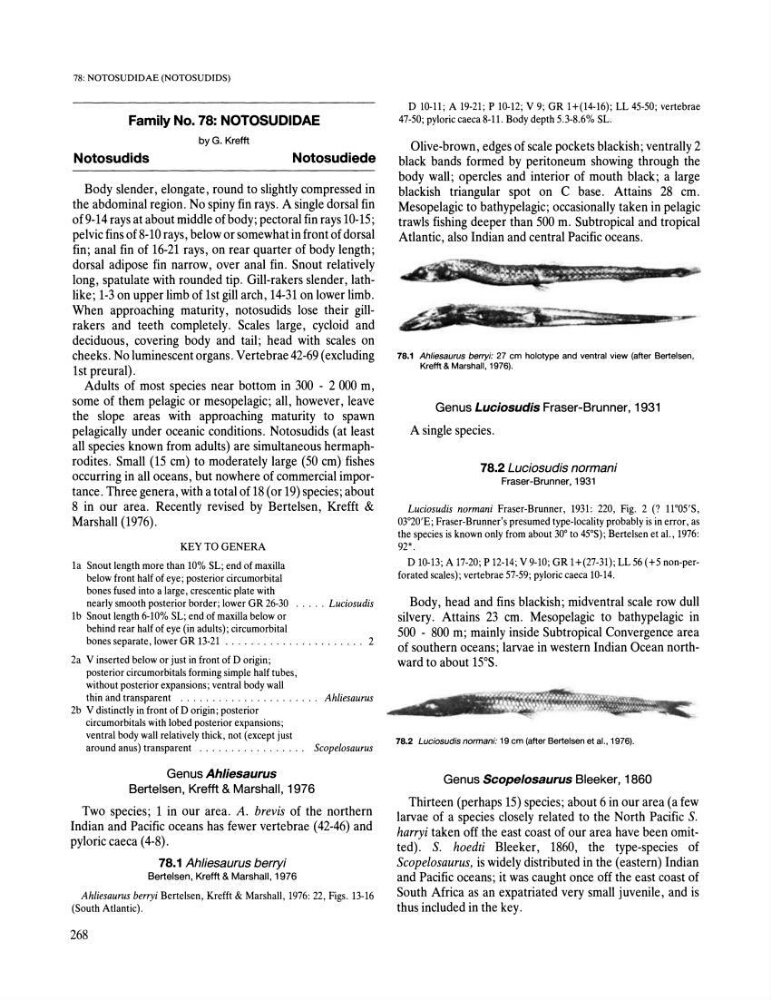
78.1 Ahliesaurus berryi: 27 em holotype and ventral view (after Bertelsen,
Krefft & Marshall, 1976).
Genus Luciosudis Fraser-Brunner, 1931
A single species.
78.2 Luciosudis normani
Fraser-Brunner, 1931
Luciosudis normani Fraser-Brunner, 1931: 220, Fig. 2 (? HOOS'S,
03°20'E; Fraser-Brunner's presumed type-locality probably is in error, as
the species is known only from about 30° to 45°S); Bertelsen et aI., 1976:
92*.
010-13; A 17-20; P 12-14; V 9-10; GR 1+(27-31); LL56 (+5 non-perforated scales); vertebrae 57-59; pyloric caeca 10-14.
Body, head and fins blackish; midventral scale row dull
silvery. Attains 23 cm. Mesopelagic to bathypelagic in
500 - 800 m; mainly inside Subtropical Convergence area
of southern oceans; larvae in western Indian Ocean northward to about 15°S.
78.2 Luciosudis normani: 19 em (after Bertelsen et aI., 1976).
Genus Scopelosaurus Bleeker, 1860
Thirteen (perhaps 15) species; about 6 in our area (a few
larvae of a species closely related to the North Pacific S.
harryi taken off the east coast of our area have been omitted). S. hoedti Bleeker, 1860, the type-species of
Scopelosaurus, is widely distributed in the (eastern) Indian
and Pacific oceans; it was caught once off the east coast of
South Africa as an expatriated very small juvenile, and is
thus included in the key.
Family No. 78: NOTOSUDIDAE
by G. Krefft
Notosudids
Notosudiede
Body slender, elongate, round to slightly compressed in
the abdominal region. No spiny fin rays. A single dorsal fin
of9-14 rays at about middle of body; pectoral fin rays 10-15;
pelvic fins of 8-10 rays, below or somewhat in front of dorsal
fin; anal fin of 16-21 rays, on rear quarter of body length;
dorsal adipose fin narrow, over anal fin. Snout relatively
long, spatulate with rounded tip. Gill-rakers slender, lathlike; 1-3 on upper limb of 1st gill arch, 14-31 on lower limb.
When approaching maturity, notosudids lose their gillrakers and teeth completely. Scales large, cycloid and
deciduous, covering body and tail; head with scales on
cheeks. No luminescent organs. Vertebrae 42-69 (excluding
1st preural).
Adults of most species near bottom in 300 - 2 000 m,
some of them pelagic or mesopelagic; all, however, leave
the slope areas with approaching maturity to spawn
pelagic ally under oceanic conditions. Notosudids (at least
all species known from adults) are simultaneous hermaphrodites. Small (15 cm) to moderately large (50 cm) fishes
occurring in all oceans, but nowhere of commercial importance. Three genera, with a total of 18 (or 19) species; about
8 in our area. Recently revised by Bertelsen, Krefft &
Marshall (1976).
KEY TO GENERA
1a Snout length more than 10% SL; end of maxilla
below front half of eye; posterior circumorbital
bones fused into a large, crescentic plate with
nearly smooth posterior border; lower GR 26-30 ..... Luciosudis
1 b Snout length 6-10% SL; end of maxilla below or
behind rear half of eye (in adults); circumorbital
bones separate, lower GR 13-21 . . . . . . . . . . . . . . . . . . . . . . 2
2a V inserted below or just in front of 0 origin;
posterior circumorbitals forming simple half tubes,
without posterior expansions; ventral body wall
thin and transparent ...................... Ahliesaurus
2b V distinctly in front of 0 origin; posterior
circumorbitals with lobed posterior expansions;
ventral body wall relatively thick, not (except just
around anus) transparent ................. Scopelosaurus
Genus Ahliesaurus
Bertelsen, Krefft & Marshall, 1976
Two species; 1 in our area. A. brevis of the northern
Indian and Pacific oceans has fewer vertebrae (42-46) and
pyloric caeca (4-8).
78.1 Ahliesaurus berryi
Bertelsen, Krefft & Marshall, 1976
Ahliesaurus berryi Bertelsen, Kreftt & Marshall, 1976: 22, Figs. 13-16
(South Atlantic).
268
o 10-11; A 19-21; P 10-12; V 9; GR 1+(14-16); LL 45-50; vertebrae
47-50; pyloric caeca 8-11. Body depth 5.3-8.6% SL.
Olive-brown, edges of scale pockets blackish; ventrally 2
black bands formed by peritoneum showing through the
body wall; opercles and interior of mouth black; a large
blackish triangular spot on C base. Attains 28 cm.
Mesopelagic to bathypelagic; occasionally taken in pelagic
trawls fishing deeper than 500 m. Subtropical and tropical
Atlantic, also Indian and central Pacific oceans.
78.1 Ahliesaurus berryi: 27 em holotype and ventral view (after Bertelsen,
Krefft & Marshall, 1976).
Genus Luciosudis Fraser-Brunner, 1931
A single species.
78.2 Luciosudis normani
Fraser-Brunner, 1931
Luciosudis normani Fraser-Brunner, 1931: 220, Fig. 2 (? HOOS'S,
03°20'E; Fraser-Brunner's presumed type-locality probably is in error, as
the species is known only from about 30° to 45°S); Bertelsen et aI., 1976:
92*.
010-13; A 17-20; P 12-14; V 9-10; GR 1+(27-31); LL56 (+5 non-perforated scales); vertebrae 57-59; pyloric caeca 10-14.
Body, head and fins blackish; midventral scale row dull
silvery. Attains 23 cm. Mesopelagic to bathypelagic in
500 - 800 m; mainly inside Subtropical Convergence area
of southern oceans; larvae in western Indian Ocean northward to about 15°S.
78.2 Luciosudis normani: 19 em (after Bertelsen et aI., 1976).
Genus Scopelosaurus Bleeker, 1860
Thirteen (perhaps 15) species; about 6 in our area (a few
larvae of a species closely related to the North Pacific S.
harryi taken off the east coast of our area have been omitted). S. hoedti Bleeker, 1860, the type-species of
Scopelosaurus, is widely distributed in the (eastern) Indian
and Pacific oceans; it was caught once off the east coast of
South Africa as an expatriated very small juvenile, and is
thus included in the key.