

Ipnops murrayi (non Giinther): Smith, SFSA No. 189 (in part, figure is of
I. murrayi) .
D 9-11; A 15-19; P 13-16; V 8; LL 55-58; vertebrae 57- 61; GR (total)
20-24. Head 18-21, depth 6-8, preanal distance 61-66, and length of A base
18-26 %SL.
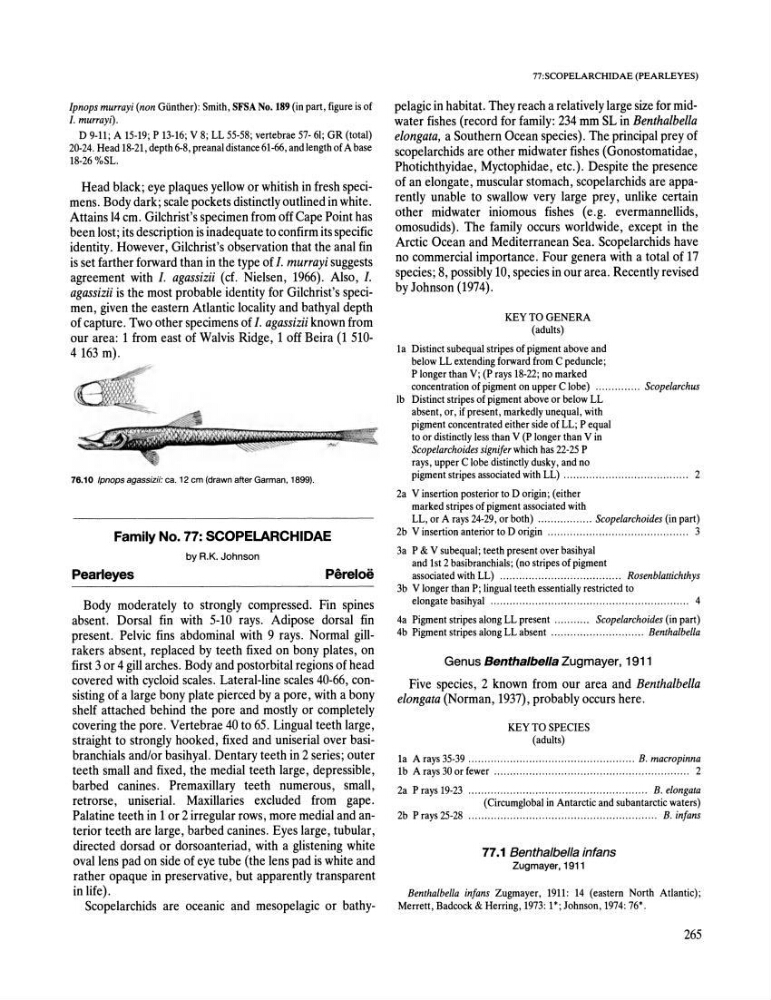
Head black; eye plaques yellow or whitish in fresh specimens. Body dark; scale pockets distinctly outlined in white.
Attains 14 cm. Gilchrist's specimen from off Cape Point has
been lost; its description is inadequate to confirm its specific
identity. However, Gilchrist's observation that the anal fin
is set farther forward than in the type of I. murrayi suggests
agreement with I. agassizii (d. Nielsen, 1966). Also, I.
agassizii is the most probable identity for Gilchrist's specimen, given the eastern Atlantic locality and bathyal depth
of capture. Two other specimens of I. agassizii known from
our area: 1 from east of Walvis Ridge, 1 off Beira (1 5104163 m).
76.10 ipnops agassizii: ea. 12 em (drawn after Garman, 1899).
Family No. 77: SCOPELARCHIDAE
by R.K. Johnson
Pearleyes
Pereloe
Body moderately to strongly compressed. Fin spines
absent. Dorsal fin with 5-10 rays. Adipose dorsal fin
present. Pelvic fins abdominal with 9 rays. Normal gillrakers absent, replaced by teeth fixed on bony plates, on
first 3 or 4 gill arches. Body and postorbital regions of head
covered with cycloid scales. Lateral-line scales 40-66, consisting of a large bony plate pierced by a pore, with a bony
shelf attached behind the pore and mostly or completely
covering the pore. Vertebrae 40 to 65 . Lingual teeth large,
straight to strongly hooked, fixed and uniserial over basibranchials and/or basihyal. Dentary teeth in 2 series; outer
teeth small and fixed, the medial teeth large, depressible,
barbed canines. Premaxillary teeth numerous, small,
retrorse, uniserial. Maxillaries excluded from gape.
Palatine teeth in 1 or 2 irregular rows, more medial and anterior teeth are large, barbed canines. Eyes large, tubular,
directed dorsad or dorsoanteriad, with a glistening white
oval lens pad on side of eye tube (the lens pad is white and
rather opaque in preservative, but apparently transparent
in life).
Scopelarchids are oceanic and mesopelagic or bathy77:SCOPELARCHIDAE (PEARLEYES)
pelagic in habitat. They reach a relatively large size for midwater fishes (record for family: 234 mm SL in Benthalbella
e!ongata, a Southern Ocean species). The principal prey of
scopelarchids are other midwater fishes (Gonostomatidae,
Photichthyidae, Myctophidae, etc.). Despite the presence
of an elongate, muscular stomach, scopelarchids are apparently unable to swallow very large prey, unlike certain
other midwater iniomous fishes (e.g. evermannellids,
omosudids) . The family occurs worldwide, except in the
Arctic Ocean and Mediterranean Sea. Scopelarchids have
no commercial importance. Four genera with a total of 17
species; 8, possibly 10, species in our area. Recently revised
by Johnson (1974) .
KEY TO GENERA
(adults)
la Distinct subequal stripes of pigment above and
below LL extending forward from C peduncle;
P longer than V; (P rays 18-22; no marked
concentration of pigment on upper C lobe) ...... ..... ... Scopelarchus
Ib Distinct stripes of pigment above or below LL
absent, or, if present, markedly unequal, with
pigment concentrated either side of LL; P equal
to or distinctly less than V (P longer than V in
Scopelarchoides signifer which has 22-25 P
rays, upper C lobe distinctly dusky, and no
pigment stripes associated with LL) .. . .... .. ... .... .... ..... ... .. ..... ... . 2
2a V insertion posterior to D origin; (either
marked stripes of pigment associated with
LL, or A rays 24-29, or both) .............. .. . Scopelarchoides (in part)
2b V insertion anterior to D origin .......... ... .. ....... ... ..... ...... ..... ... 3
3a P & V subequal; teeth present over basihyal
and 1st 2 basibranchials; (no stripes of pigment
associated with LL) .... ...... .......... ... ........... ... . Rosenblattichthys
3b V longer than P; lingual teeth essentially restricted to
elongate basihyal ....... .. .................... .. .............. ..... ..... ..... .. 4
4a Pigment stripes along LL present ... ... ..... Scopelarchoides (in part)
4b Pigment stripes along LL absent ...... ..... ...... ... ...... ... Benthalbella
Genus Benthalbella Zugmayer, 1911
Five species, 2 known from our area and Benthalbella
elongata (Norman, 1937), probably occurs here.
KEY TO SPECIES
(adults)
la A rays 35-39 ... ...... ........ ... .. ..... ... ....... .. .. ..... .. .. .. B. macropinna
Ib A rays 30 orfewer ........... ... ... .......... .... .... ............. ............. 2
2a Prays 19-23 ... ......... ... ... ... ..... .. ..... .... ........ .... ..... .. B. elongata
(Circumglobal in Antarctic and subantarctic waters)
2b Prays 25-28 ...... ....... ...... .... ..... .. .... ...................... .. . B. infans
77.1 Benthalbella infans
Zugmayer, 1911
Benthalbella infans Zugmayer, 1911: 14 (eastern North Atlantic) ;
Merrett, Badcock & Herring, 1973: 1*; Johnson , 1974: 76* .
265
I. murrayi) .
D 9-11; A 15-19; P 13-16; V 8; LL 55-58; vertebrae 57- 61; GR (total)
20-24. Head 18-21, depth 6-8, preanal distance 61-66, and length of A base
18-26 %SL.
Head black; eye plaques yellow or whitish in fresh specimens. Body dark; scale pockets distinctly outlined in white.
Attains 14 cm. Gilchrist's specimen from off Cape Point has
been lost; its description is inadequate to confirm its specific
identity. However, Gilchrist's observation that the anal fin
is set farther forward than in the type of I. murrayi suggests
agreement with I. agassizii (d. Nielsen, 1966). Also, I.
agassizii is the most probable identity for Gilchrist's specimen, given the eastern Atlantic locality and bathyal depth
of capture. Two other specimens of I. agassizii known from
our area: 1 from east of Walvis Ridge, 1 off Beira (1 5104163 m).
76.10 ipnops agassizii: ea. 12 em (drawn after Garman, 1899).
Family No. 77: SCOPELARCHIDAE
by R.K. Johnson
Pearleyes
Pereloe
Body moderately to strongly compressed. Fin spines
absent. Dorsal fin with 5-10 rays. Adipose dorsal fin
present. Pelvic fins abdominal with 9 rays. Normal gillrakers absent, replaced by teeth fixed on bony plates, on
first 3 or 4 gill arches. Body and postorbital regions of head
covered with cycloid scales. Lateral-line scales 40-66, consisting of a large bony plate pierced by a pore, with a bony
shelf attached behind the pore and mostly or completely
covering the pore. Vertebrae 40 to 65 . Lingual teeth large,
straight to strongly hooked, fixed and uniserial over basibranchials and/or basihyal. Dentary teeth in 2 series; outer
teeth small and fixed, the medial teeth large, depressible,
barbed canines. Premaxillary teeth numerous, small,
retrorse, uniserial. Maxillaries excluded from gape.
Palatine teeth in 1 or 2 irregular rows, more medial and anterior teeth are large, barbed canines. Eyes large, tubular,
directed dorsad or dorsoanteriad, with a glistening white
oval lens pad on side of eye tube (the lens pad is white and
rather opaque in preservative, but apparently transparent
in life).
Scopelarchids are oceanic and mesopelagic or bathy77:SCOPELARCHIDAE (PEARLEYES)
pelagic in habitat. They reach a relatively large size for midwater fishes (record for family: 234 mm SL in Benthalbella
e!ongata, a Southern Ocean species). The principal prey of
scopelarchids are other midwater fishes (Gonostomatidae,
Photichthyidae, Myctophidae, etc.). Despite the presence
of an elongate, muscular stomach, scopelarchids are apparently unable to swallow very large prey, unlike certain
other midwater iniomous fishes (e.g. evermannellids,
omosudids) . The family occurs worldwide, except in the
Arctic Ocean and Mediterranean Sea. Scopelarchids have
no commercial importance. Four genera with a total of 17
species; 8, possibly 10, species in our area. Recently revised
by Johnson (1974) .
KEY TO GENERA
(adults)
la Distinct subequal stripes of pigment above and
below LL extending forward from C peduncle;
P longer than V; (P rays 18-22; no marked
concentration of pigment on upper C lobe) ...... ..... ... Scopelarchus
Ib Distinct stripes of pigment above or below LL
absent, or, if present, markedly unequal, with
pigment concentrated either side of LL; P equal
to or distinctly less than V (P longer than V in
Scopelarchoides signifer which has 22-25 P
rays, upper C lobe distinctly dusky, and no
pigment stripes associated with LL) .. . .... .. ... .... .... ..... ... .. ..... ... . 2
2a V insertion posterior to D origin; (either
marked stripes of pigment associated with
LL, or A rays 24-29, or both) .............. .. . Scopelarchoides (in part)
2b V insertion anterior to D origin .......... ... .. ....... ... ..... ...... ..... ... 3
3a P & V subequal; teeth present over basihyal
and 1st 2 basibranchials; (no stripes of pigment
associated with LL) .... ...... .......... ... ........... ... . Rosenblattichthys
3b V longer than P; lingual teeth essentially restricted to
elongate basihyal ....... .. .................... .. .............. ..... ..... ..... .. 4
4a Pigment stripes along LL present ... ... ..... Scopelarchoides (in part)
4b Pigment stripes along LL absent ...... ..... ...... ... ...... ... Benthalbella
Genus Benthalbella Zugmayer, 1911
Five species, 2 known from our area and Benthalbella
elongata (Norman, 1937), probably occurs here.
KEY TO SPECIES
(adults)
la A rays 35-39 ... ...... ........ ... .. ..... ... ....... .. .. ..... .. .. .. B. macropinna
Ib A rays 30 orfewer ........... ... ... .......... .... .... ............. ............. 2
2a Prays 19-23 ... ......... ... ... ... ..... .. ..... .... ........ .... ..... .. B. elongata
(Circumglobal in Antarctic and subantarctic waters)
2b Prays 25-28 ...... ....... ...... .... ..... .. .... ...................... .. . B. infans
77.1 Benthalbella infans
Zugmayer, 1911
Benthalbella infans Zugmayer, 1911: 14 (eastern North Atlantic) ;
Merrett, Badcock & Herring, 1973: 1*; Johnson , 1974: 76* .
265