

72: MELANOSTOMIIDAE (SCALELESS DRAGONFISHES)
72.13 Eustomias sp.
(To be described by Gibbs & Clarke)
D 27-31; A 43·49; P 8·10. Photophores in ventral series: IP 7-8, PV 2831, VAV 15-19, AC 22-24, total 73-77; photophores in lateral series: OV
27-31, VAL 15-19, total 43-47 . Anterior vertebral centra unossified; 66-69
ossified vertebrae. Barbel to end of terminal bulb 26-36% of SL, its stem
unpigmented externally, with 2 tiny branches just before terminal bulb; a
single, long·ovoid terminal bulb without filaments.
Attains 20 cm. One specimen from south of Cape
Agulhas; mainly in tropical waters of Pacific and Indian
oceans .
Genus Flagel/ostomias Parr, 1927
Monotypic.
72.14 Flagellostomias boureei
(Zugmayer, 1913)
Eustomias boureei Zugmayer, 1913: 1 (North Atlantic, ca. 39°N, 24°W).
Flagellostomias boureei: Regan & Trewavas , 1930: 57'; Morrow & Gibbs,
1964: 430'; Hulley, 1972: 213; Gibbs, 1984: 352*.
D 14-17; A 21-26; P 1+(8·11). Photophores in ventral series: IP 8-10,
PV 31-34, VAV 14-16, AC 15-18; photophores in lateral series: OV30-32,
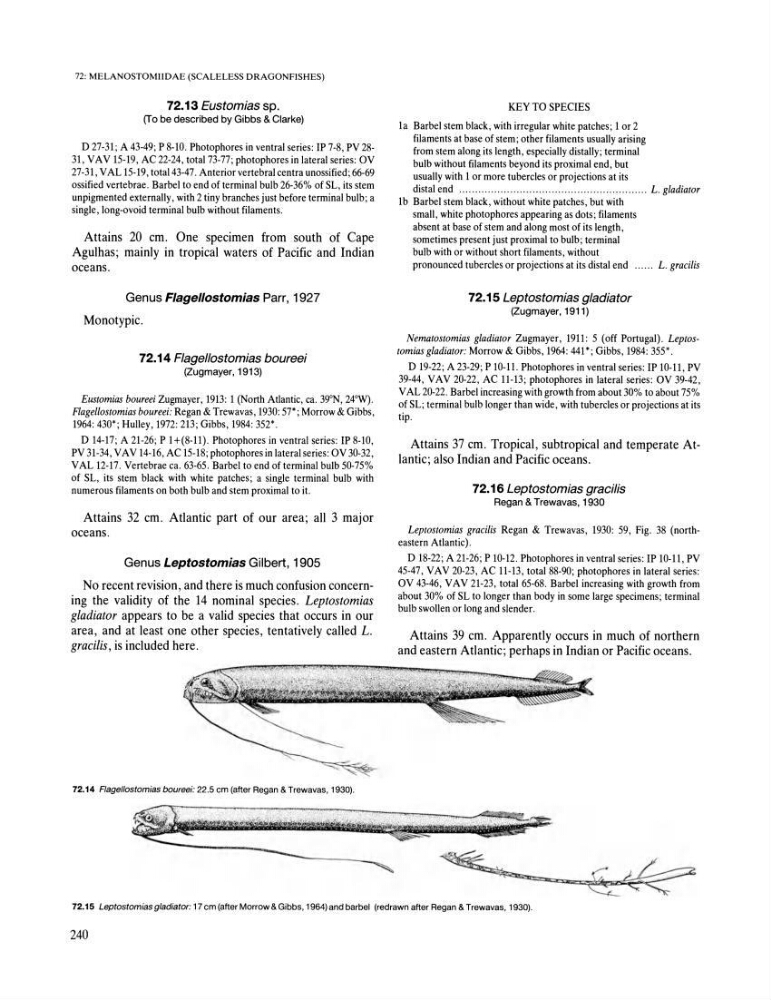
VAL 12-17 . Vertebrae ca. 63·65. Barbel to end of terminal bulb 50-75%
of SL, its stem black with white patches; a single terminal bulb with
numerous filaments on both bulb and stem proximal to it.
Attains 32 cm. Atlantic part of our area; all 3 major
oceans.
Genus Leptostomias Gilbert, 1905
No recent revision, and there is much confusion concerning the validity of the 14 nominal species. Leptostomias
gladiator appears to be a valid species that occurs in our
area, and at least one other species, tentatively called L.
gracilis, is included here.
72.14 Flagel/ostomias boureei: 22.5 em (after Regan & Trewavas, 1930).
KEY TO SPECIES
la Barbel stem black, with irregular white patches; lor 2
filaments at base of stem; other filaments usually arising
from stem along its length, especially distally; terminal
bulb without filaments beyond its proximal end, but
usually with 1 or more tubercles or projections at its
distal end .. ......... .. .. ........ ... ...... .. ...... ......... ..... ..... L. gladiator
Ib Barbel stem black , without white patches, but with
small, white photophores appearing as dots; filaments
absent at base of stem and along most of its length,
sometimes present just proximal to bulb; terminal
bulb with or without short filaments, without
pronounced tubercles or projections at its distal end
L. gracilis
72.15 Leptostomias gladiator
(Zugmayer, 1911)
Nematostomias gladiator Zugmayer, 1911 : 5 (off Portugal). Leptos·
tamias gladiator: Morrow & Gibbs, 1964: 441*; Gibbs, 1984: 355*.
D 19-22; A 23-29; P 10· 11. Photophores in ventral series: IP 10-11, PV
39-44, VAV 20-22, AC 11-13; photo ph ores in lateral series: OV 39-42,
VAL 20-22. Barbel increasing with growth from about 30% to about 75%
of SL; terminal bulb longer than wide, with tubercles or projections at its
tip.
Attains 37 cm. Tropical, subtropical and temperate Atlantic; also Indian and Pacific oceans.
72.16 Leptostomias gracilis
Regan & Trewavas, 1930
Leptostamias gracilis Regan & Trewavas, 1930: 59, Fig. 38 (northeastern Atlantic).
D 18-22; A 21-26; P 10-12. Photophores in ventral series: IP 10·11, PV
45-47, VAV 20-23, AC 11-13, total 88·90; photophores in lateral series:
OV 43·46, VAV 21·23, total 65-68. Barbel increasing with growth from
about 30% of SL to longer than body in some large specimens; terminal
bulb swollen or long and slender.
Attains 39 cm. Apparently occurs in much of northern
and eastern Atlantic; perhaps in Indian or Pacific oceans.
~~r
~~~~~
72.15 Leptostomias gladiator: 17 em (after Morrow & Gibbs, 1964) and barbel (redrawn after Regan & Trewavas, 1930).
240
72.13 Eustomias sp.
(To be described by Gibbs & Clarke)
D 27-31; A 43·49; P 8·10. Photophores in ventral series: IP 7-8, PV 2831, VAV 15-19, AC 22-24, total 73-77; photophores in lateral series: OV
27-31, VAL 15-19, total 43-47 . Anterior vertebral centra unossified; 66-69
ossified vertebrae. Barbel to end of terminal bulb 26-36% of SL, its stem
unpigmented externally, with 2 tiny branches just before terminal bulb; a
single, long·ovoid terminal bulb without filaments.
Attains 20 cm. One specimen from south of Cape
Agulhas; mainly in tropical waters of Pacific and Indian
oceans .
Genus Flagel/ostomias Parr, 1927
Monotypic.
72.14 Flagellostomias boureei
(Zugmayer, 1913)
Eustomias boureei Zugmayer, 1913: 1 (North Atlantic, ca. 39°N, 24°W).
Flagellostomias boureei: Regan & Trewavas , 1930: 57'; Morrow & Gibbs,
1964: 430'; Hulley, 1972: 213; Gibbs, 1984: 352*.
D 14-17; A 21-26; P 1+(8·11). Photophores in ventral series: IP 8-10,
PV 31-34, VAV 14-16, AC 15-18; photophores in lateral series: OV30-32,
VAL 12-17 . Vertebrae ca. 63·65. Barbel to end of terminal bulb 50-75%
of SL, its stem black with white patches; a single terminal bulb with
numerous filaments on both bulb and stem proximal to it.
Attains 32 cm. Atlantic part of our area; all 3 major
oceans.
Genus Leptostomias Gilbert, 1905
No recent revision, and there is much confusion concerning the validity of the 14 nominal species. Leptostomias
gladiator appears to be a valid species that occurs in our
area, and at least one other species, tentatively called L.
gracilis, is included here.
72.14 Flagel/ostomias boureei: 22.5 em (after Regan & Trewavas, 1930).
KEY TO SPECIES
la Barbel stem black, with irregular white patches; lor 2
filaments at base of stem; other filaments usually arising
from stem along its length, especially distally; terminal
bulb without filaments beyond its proximal end, but
usually with 1 or more tubercles or projections at its
distal end .. ......... .. .. ........ ... ...... .. ...... ......... ..... ..... L. gladiator
Ib Barbel stem black , without white patches, but with
small, white photophores appearing as dots; filaments
absent at base of stem and along most of its length,
sometimes present just proximal to bulb; terminal
bulb with or without short filaments, without
pronounced tubercles or projections at its distal end
L. gracilis
72.15 Leptostomias gladiator
(Zugmayer, 1911)
Nematostomias gladiator Zugmayer, 1911 : 5 (off Portugal). Leptos·
tamias gladiator: Morrow & Gibbs, 1964: 441*; Gibbs, 1984: 355*.
D 19-22; A 23-29; P 10· 11. Photophores in ventral series: IP 10-11, PV
39-44, VAV 20-22, AC 11-13; photo ph ores in lateral series: OV 39-42,
VAL 20-22. Barbel increasing with growth from about 30% to about 75%
of SL; terminal bulb longer than wide, with tubercles or projections at its
tip.
Attains 37 cm. Tropical, subtropical and temperate Atlantic; also Indian and Pacific oceans.
72.16 Leptostomias gracilis
Regan & Trewavas, 1930
Leptostamias gracilis Regan & Trewavas, 1930: 59, Fig. 38 (northeastern Atlantic).
D 18-22; A 21-26; P 10-12. Photophores in ventral series: IP 10·11, PV
45-47, VAV 20-23, AC 11-13, total 88·90; photophores in lateral series:
OV 43·46, VAV 21·23, total 65-68. Barbel increasing with growth from
about 30% of SL to longer than body in some large specimens; terminal
bulb swollen or long and slender.
Attains 39 cm. Apparently occurs in much of northern
and eastern Atlantic; perhaps in Indian or Pacific oceans.
~~r
~~~~~
72.15 Leptostomias gladiator: 17 em (after Morrow & Gibbs, 1964) and barbel (redrawn after Regan & Trewavas, 1930).
240