

72: MELANOSTOMIIDAE (SCALELESS DRAGONFISHES
D 14-15; A 12-15; P 31-57; V 16-24. Photophores in ventral series: IP 5,
PV 12, VA V 11-13, AC 3-6, total 33-35; photophores in lateral series: OV
12, VAL 10-12, tot
and from Mozambique Channel to off Port Elizabeth.
Occurs widely in all 3 major oceans.
Genus Echiostoma Lowe, 1843
Probably monotypic.
72.6 Echiostoma barbatum
Lowe, 1843
Echiostoma barbatum Lowe, 1843: 87 (Madeira); Smith, SFSA No.
135*; Morrow & Gibbs, 1964: 482*; Krueger & Gibbs, 1966: 43; Hulley,
1972: 211; Gibbs, 1984: 345*. Echiostoma tanneri: Barnard, 1937: 48.
D 12-15; A 14-18; P 1 +3-4; V 8 (5-9). Photophores in ventral series: IP
7-8+2, PV 25-28, VAV 15-19, AC 9-13, total 62-68; photophores in
lateral series: OV 24-27, VAL 14-19, total 39- 45. Vertebrae 56-59. Barbel
to end of terminal bulb 7-16% of SL, its stem black, with many filaments
before the bulbs; 2 contiguous terminal bulbs in small specimens, becoming indistinct in large ones, with a branched filament arising from distal
bulb.
Attains 37 cm. Southeast of Algoa Bay and off Cape
Town; widespread in tropical/subtropical waters of all
oceans.
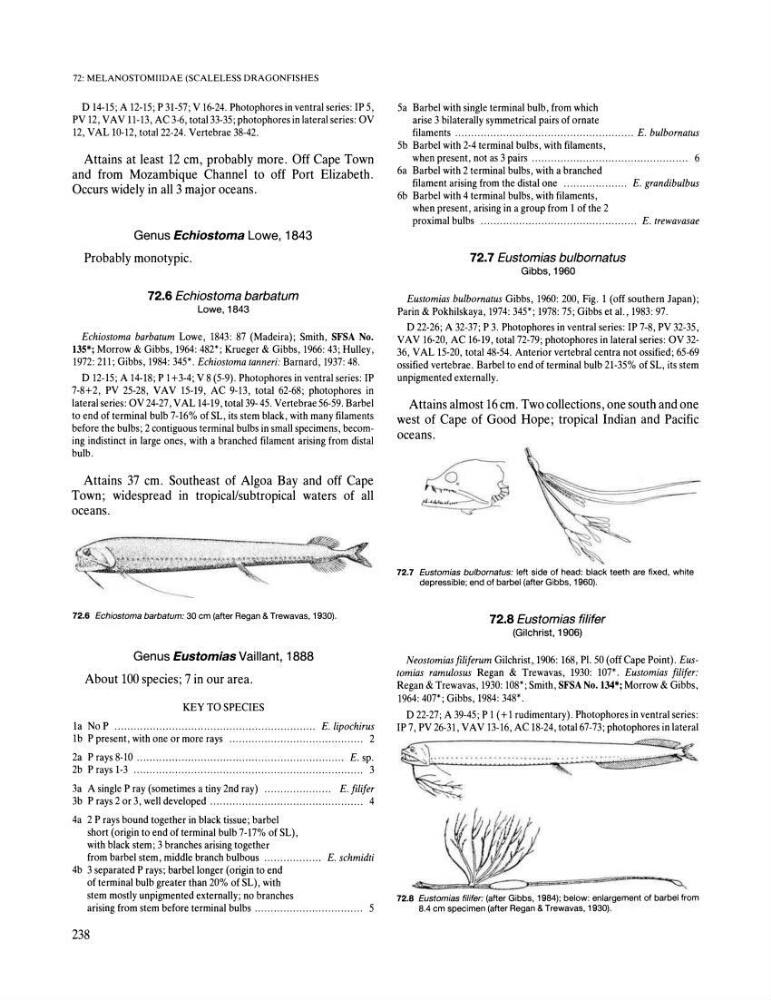
72.6 Echiostoma barbatum: 30 cm (after Regan & Trewavas, 1930).
Genus Eustomias Vaillant, 1888
About 100 species; 7 in our area.
KEY TO SPECIES
la No P ............................................................... E. Upochirus
Ib P present, with one or more rays .......................................... 2
2a Prays 8-10 ................................................................. E. sp.
2b Prays 1-3 ............................................... .. ... ... .. ............... 3
3a A single P ray (sometimes a tiny 2nd ray) ............. ........ E. filifer
3b Prays 2 or 3, well developed ................................................ 4
4a 2 P rays bound together in black tissue; barbel
short (origin to end of terminal bulb 7-17% of SL),
with black stem; 3 branches arising together
from barbel stem, middle branch bulbous .................. E. schmidti
4b 3 separated Prays; barbel longer (origin to end
of terminal bulb greater than 20% of SL), with
stem mostly unpigmented externally; no branches
arising from stem before terminal bulbs.................................. 5
238
5a Barbel with single terminal bulb, from which
arise 3 bilaterally symmetrical pairs of ornate
filaments ........................................................ E. bulbornatus
5b Barbel with 2-4 terminal bulbs, with filaments,
when present, not as 3 pairs................................................. 6
6a Barbel with 2 terminal bulbs, with a branched
filament arising from the distal one .................... E. grandibulbus
6b Barbel with 4 terminal bulbs, with filaments,
when present, arising in a group from 1 of the 2
proximal bulbs ................................................. E. trewavasae
72.7 Eustomias bulbornatus
Gibbs, 1960
Eustomias bulbornatus Gibbs, 1960: 200, Fig. 1 (off southern Japan);
Parin & Pokhilskaya, 1974: 345*; 1978: 75; Gibbs et aI., 1983: 97.
D 22-26; A 32-37; P 3. Photophores in ventral series: IP 7-8, PV 32-35,
VA V 16-20, AC 16-19, total 72-79; photophores in lateral series: OV 3236, VAL 15-20, total 48-54. Anterior vertebral centra not ossified; 65-69
ossified vertebrae. Barbel to end of terminal bulb 21-35% of SL, its stem
unpigmented externally.
Attains almost 16 cm. Two collections, one south and one
west of Cape of Good Hope; tropical Indian and Pacific
oceans.
72.7 Eustomias bulbornatus: left side of head: black teeth are fixed, white
depressible; end of barbel (after Gibbs, 1960).
72.8 Eustomias tilifer
(Gilchrist, 1906)
Neostomias filiferum Gilchrist,. 1906: 168, PI. 50 (off Cape Point). Eustomias ramulosus Regan & Trewavas, 1930: 107*. Eustomias flUfer:
Regan & Trewavas, 1930: 108*; Smith, SFSA No. 134*; Morrow & Gibbs,
1964: 407*; Gibbs, 1984: 348*.
D 22-27; A 39-45; P 1 (+ 1 rudimentary). Photophores in ventral series:
IP 7, PV 26-31, VA V 13-16, AC 18-24, total 67-73; photophores in lateral
~ .......... .. .. , . . c~.
72.8 Eustomias filifer: (after Gibbs, 1984); below: enlargement of barbel from
8.4 cm specimen (after Regan & Trewavas, 1930).
D 14-15; A 12-15; P 31-57; V 16-24. Photophores in ventral series: IP 5,
PV 12, VA V 11-13, AC 3-6, total 33-35; photophores in lateral series: OV
12, VAL 10-12, tot
and from Mozambique Channel to off Port Elizabeth.
Occurs widely in all 3 major oceans.
Genus Echiostoma Lowe, 1843
Probably monotypic.
72.6 Echiostoma barbatum
Lowe, 1843
Echiostoma barbatum Lowe, 1843: 87 (Madeira); Smith, SFSA No.
135*; Morrow & Gibbs, 1964: 482*; Krueger & Gibbs, 1966: 43; Hulley,
1972: 211; Gibbs, 1984: 345*. Echiostoma tanneri: Barnard, 1937: 48.
D 12-15; A 14-18; P 1 +3-4; V 8 (5-9). Photophores in ventral series: IP
7-8+2, PV 25-28, VAV 15-19, AC 9-13, total 62-68; photophores in
lateral series: OV 24-27, VAL 14-19, total 39- 45. Vertebrae 56-59. Barbel
to end of terminal bulb 7-16% of SL, its stem black, with many filaments
before the bulbs; 2 contiguous terminal bulbs in small specimens, becoming indistinct in large ones, with a branched filament arising from distal
bulb.
Attains 37 cm. Southeast of Algoa Bay and off Cape
Town; widespread in tropical/subtropical waters of all
oceans.
72.6 Echiostoma barbatum: 30 cm (after Regan & Trewavas, 1930).
Genus Eustomias Vaillant, 1888
About 100 species; 7 in our area.
KEY TO SPECIES
la No P ............................................................... E. Upochirus
Ib P present, with one or more rays .......................................... 2
2a Prays 8-10 ................................................................. E. sp.
2b Prays 1-3 ............................................... .. ... ... .. ............... 3
3a A single P ray (sometimes a tiny 2nd ray) ............. ........ E. filifer
3b Prays 2 or 3, well developed ................................................ 4
4a 2 P rays bound together in black tissue; barbel
short (origin to end of terminal bulb 7-17% of SL),
with black stem; 3 branches arising together
from barbel stem, middle branch bulbous .................. E. schmidti
4b 3 separated Prays; barbel longer (origin to end
of terminal bulb greater than 20% of SL), with
stem mostly unpigmented externally; no branches
arising from stem before terminal bulbs.................................. 5
238
5a Barbel with single terminal bulb, from which
arise 3 bilaterally symmetrical pairs of ornate
filaments ........................................................ E. bulbornatus
5b Barbel with 2-4 terminal bulbs, with filaments,
when present, not as 3 pairs................................................. 6
6a Barbel with 2 terminal bulbs, with a branched
filament arising from the distal one .................... E. grandibulbus
6b Barbel with 4 terminal bulbs, with filaments,
when present, arising in a group from 1 of the 2
proximal bulbs ................................................. E. trewavasae
72.7 Eustomias bulbornatus
Gibbs, 1960
Eustomias bulbornatus Gibbs, 1960: 200, Fig. 1 (off southern Japan);
Parin & Pokhilskaya, 1974: 345*; 1978: 75; Gibbs et aI., 1983: 97.
D 22-26; A 32-37; P 3. Photophores in ventral series: IP 7-8, PV 32-35,
VA V 16-20, AC 16-19, total 72-79; photophores in lateral series: OV 3236, VAL 15-20, total 48-54. Anterior vertebral centra not ossified; 65-69
ossified vertebrae. Barbel to end of terminal bulb 21-35% of SL, its stem
unpigmented externally.
Attains almost 16 cm. Two collections, one south and one
west of Cape of Good Hope; tropical Indian and Pacific
oceans.
72.7 Eustomias bulbornatus: left side of head: black teeth are fixed, white
depressible; end of barbel (after Gibbs, 1960).
72.8 Eustomias tilifer
(Gilchrist, 1906)
Neostomias filiferum Gilchrist,. 1906: 168, PI. 50 (off Cape Point). Eustomias ramulosus Regan & Trewavas, 1930: 107*. Eustomias flUfer:
Regan & Trewavas, 1930: 108*; Smith, SFSA No. 134*; Morrow & Gibbs,
1964: 407*; Gibbs, 1984: 348*.
D 22-27; A 39-45; P 1 (+ 1 rudimentary). Photophores in ventral series:
IP 7, PV 26-31, VA V 13-16, AC 18-24, total 67-73; photophores in lateral
~ .......... .. .. , . . c~.
72.8 Eustomias filifer: (after Gibbs, 1984); below: enlargement of barbel from
8.4 cm specimen (after Regan & Trewavas, 1930).