

Sa No floor of mouth, lower jaws not
connected by membrane; either or both
preorbital or suborbital luminous
organ present, in addition to postorbital
organ .... ................ ... ................ MALACOSTEIDAE (No. 71)
Sb Floor of mouth formed by membrane
connecting lower jaws; only postorbital
organ present ....... ....... ... ..... .. MELANOSTOMIIDAE (No. 72)
~ . .. ... . ........ : .. . ~
72
cs::
Family No 67: STOMIIDAE
by R.H. Gibbs, Jr.
Scaly dragonfishes
Skubbige draakvisse
Body long, slender, with hexagonal areas ("scales") on
sides, covered by a gelatinous membrane in life; 2 rows of
prominent photophores on ventral part of body on each
side; hexagonal areas each with 1 or more smaller photophores; jaws somewhat curved upward, with moderately
long fangs; dorsal and anal fins both far posterior, close
to tail; no dorsal adipose fin; a prominent slender barbel
arising under chin with a bulb and filaments at its end.
Occurring in mid-depths of the open oceans around the
world, often migrating to near-surface waters at night. Two
genera with a total of 11 species. Recently revised by
Shcherbachev and Novikova (1976) and Gibbs (1969,
Stomias only); also see Gibbs, 1984.
67: STOMIIDAE (SeALY DRAGONFISHES)
KEY TO GENERA
la Chin barbel shorter to slightly longer than head,
its terminal bulb with 3 or 4 short, simple filaments
at end; body length 10 to 20 times its depth;
fewer than 100 photophores in ventral series ................... Stomias
Ib Chin barbel much longer than head, up to ~ of SL,
its terminal bulb with several complex filaments on
sides and end; body length 20 to 35 times its depth;
more than 170 photophores in ventral series ............ Macrostomias
Genus Macrostomias Brauer, 1902
Two species, 1 in our area.
67.1 Macrostomias /ongibarbatus
Brauer, 1902
Macrostomias longibarbatus Brauer, 1902: 52, PI. 3, Fig. 2 (Gulf of
Guinea); Shcherbachev & Novikova, 1976: lOS.
D 13-14; A 15-17; P6-7; V 4-5.
Body iridescent silver. Attains 40 cm. Taken once west of
Cape of Good Hope. Widespread in subtropical and tropical Atlantic and tropical Indian and Pacific oceans.
Genus Stomias Cuvier, 1816
Nine species; 2 in our area.
KEY TO SPECIES
la Most mandibular teeth longer than longest premaxillary
teeth; premaxillary teeth 16-25, more than mandibular
teeth (9-16); fewer than 75 photophores in ventral
row (IC); fewer than 10 VA V or VAL photophores .... S. nebulosus
Ib Longest mandibular tooth shorter than longest
premaxillary tooth; premaxillary teeth 5-6, fewer
than mandibular teeth (7-11); more than 75 IC
photophores; more than 10 V A V or VAL photophores . S. boa boa
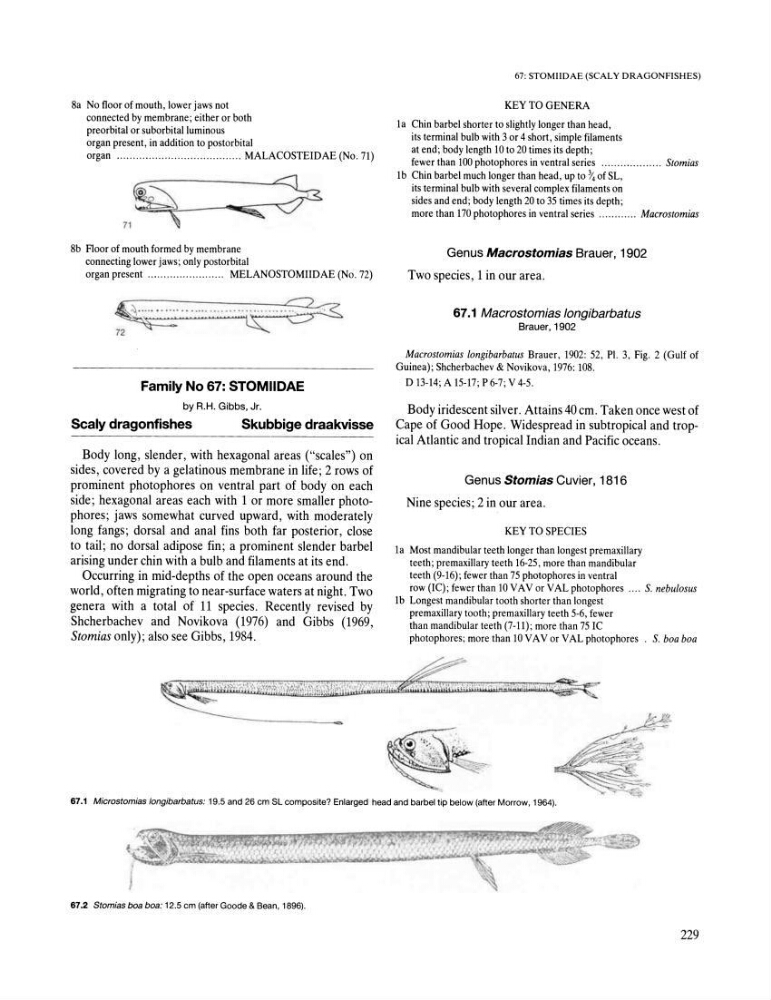
67.1 Microstomias longibarbatus: 19.5 and 26 cm SL composite? Enlarged head and barbel tip below (after Morrow, 1964).
67.2 Stomias boa boa: 12.5 em (after Goode & Bean, 1896).
229
connected by membrane; either or both
preorbital or suborbital luminous
organ present, in addition to postorbital
organ .... ................ ... ................ MALACOSTEIDAE (No. 71)
Sb Floor of mouth formed by membrane
connecting lower jaws; only postorbital
organ present ....... ....... ... ..... .. MELANOSTOMIIDAE (No. 72)
~ . .. ... . ........ : .. . ~
72
cs::
Family No 67: STOMIIDAE
by R.H. Gibbs, Jr.
Scaly dragonfishes
Skubbige draakvisse
Body long, slender, with hexagonal areas ("scales") on
sides, covered by a gelatinous membrane in life; 2 rows of
prominent photophores on ventral part of body on each
side; hexagonal areas each with 1 or more smaller photophores; jaws somewhat curved upward, with moderately
long fangs; dorsal and anal fins both far posterior, close
to tail; no dorsal adipose fin; a prominent slender barbel
arising under chin with a bulb and filaments at its end.
Occurring in mid-depths of the open oceans around the
world, often migrating to near-surface waters at night. Two
genera with a total of 11 species. Recently revised by
Shcherbachev and Novikova (1976) and Gibbs (1969,
Stomias only); also see Gibbs, 1984.
67: STOMIIDAE (SeALY DRAGONFISHES)
KEY TO GENERA
la Chin barbel shorter to slightly longer than head,
its terminal bulb with 3 or 4 short, simple filaments
at end; body length 10 to 20 times its depth;
fewer than 100 photophores in ventral series ................... Stomias
Ib Chin barbel much longer than head, up to ~ of SL,
its terminal bulb with several complex filaments on
sides and end; body length 20 to 35 times its depth;
more than 170 photophores in ventral series ............ Macrostomias
Genus Macrostomias Brauer, 1902
Two species, 1 in our area.
67.1 Macrostomias /ongibarbatus
Brauer, 1902
Macrostomias longibarbatus Brauer, 1902: 52, PI. 3, Fig. 2 (Gulf of
Guinea); Shcherbachev & Novikova, 1976: lOS.
D 13-14; A 15-17; P6-7; V 4-5.
Body iridescent silver. Attains 40 cm. Taken once west of
Cape of Good Hope. Widespread in subtropical and tropical Atlantic and tropical Indian and Pacific oceans.
Genus Stomias Cuvier, 1816
Nine species; 2 in our area.
KEY TO SPECIES
la Most mandibular teeth longer than longest premaxillary
teeth; premaxillary teeth 16-25, more than mandibular
teeth (9-16); fewer than 75 photophores in ventral
row (IC); fewer than 10 VA V or VAL photophores .... S. nebulosus
Ib Longest mandibular tooth shorter than longest
premaxillary tooth; premaxillary teeth 5-6, fewer
than mandibular teeth (7-11); more than 75 IC
photophores; more than 10 V A V or VAL photophores . S. boa boa
67.1 Microstomias longibarbatus: 19.5 and 26 cm SL composite? Enlarged head and barbel tip below (after Morrow, 1964).
67.2 Stomias boa boa: 12.5 em (after Goode & Bean, 1896).
229