

Genus Xenodermichthys Gunther, 1878
Two species; 1 from our area.
64.18 Xenodermichthys copei
(Gill,1884)
Aleposomus copei Gill, 1884: 433 (37°12'20"N, 69°39'W). Xenodermichthys socialis Vaillant, 1888: 162*; Barnard, 1925: 123; Smith, SFSA
No. 126*; Grindley & Penrith, 1965: 282. Xenodermichthys copei:
Markle, 1978: 79; Sazonov & Ivanov, 1980: 71*.
D 27-31; A 26-30; P 7-8; V 6; GR (7-9)+(16-18); 46-50 vertebrae.
Attains 20 cm SL. Common off South Africa and
Madagascar Ridge; widely distributed in Atlantic, tropical
Pacific, Tasman Sea, Great Australian Bight and Indian
Ocean in depths of 100 - 1 230 m. Mesopelagic to benthopelagic as adults.
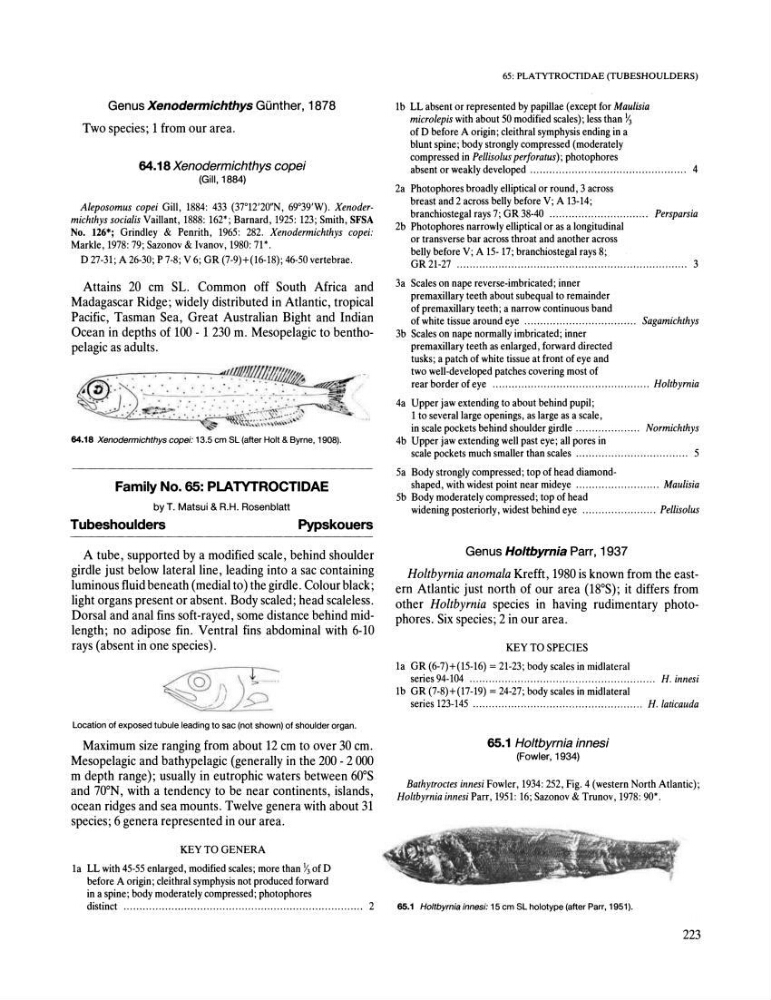
64.18 Xenodermichthys copei: 13.5 cm SL (after Holt & Byrne, 1908).
Family No. 65: PLATYTROCTIDAE
by T. Matsui & R.H. Rosenblatt
Tubeshoulders
Pypskouers
A tube, supported by a modified scale, behind shoulder
girdle just below lateral line, leading into a sac containing
luminous fluid beneath (medial to) the girdle. Colour black;
light organs present or absent. Body scaled; head scaleless.
Dorsal and anal fins soft-rayed, some distance behind midlength; no adipose fin. Ventral fins abdominal with 6-10
rays (absent in one species).
Location of exposed tubule leading to sac (not shown) of shoulder organ.
Maximum size ranging from about 12 cm to over 30 cm.
Mesopelagic and bathypelagic (generally in the 200 - 2 000
m depth range); usually in eutrophic waters between 60 0 S
and 70 o N, with a tendency to be near continents, islands,
ocean ridges and sea mounts. Twelve genera with about 31
species; 6 genera represented in our area.
KEY TO GENERA
la LL with 45-55 enlarged, modified scales; more than )j of D
before A origin; cleithral symphysis not produced forward
in a spine; body moderately compressed; photophores
distinct ........................................................................... 2
65: PLATYTROCfIDAE (TUBESHOULDERS)
Ib LL absent or represented by papillae (except for Maulisia
microlepis with about 50 modified scales); less than )j
of D before A origin; cleithral symphysis ending in a
blunt spine; body strongly compressed (moderately
compressed in Pellisolus perforatus); photophores
absent or weakly developed ................................................. 4
2a Photophores broadly elliptical or round, 3 across
breast and 2 across belly before V; A 13-14;
branchiostegal rays 7; GR 38-40 ............................... Persparsia
2b Photophores narrowly elliptical or as a longitudinal
or transverse bar across throat and another across
belly before V; A 15- 17; branchiostegal rays 8;
GR21-27 ........................................................................ 3
3a Scales on nape reverse-imbricated; inner
premaxillary teeth about subequal to remainder
of premaxillary teeth; a narrow continuous band
of white tissue around eye ................................... Sagamichthys
3b Scales on nape normally imbricated; inner
premaxillary teeth as enlarged, forward directed
tusks; a patch of white tissue at front of eye and
two well-developed patches covering most of
rear border of eye ................................................. Holtbyrnia
4a Upper jaw extending to about behind pupil;
1 to several large openings, as large as a scale,
in scale pockets behind shoulder girdle .................... Normichthys
4b Upper jaw extending well past eye; all pores in
scale pockets much smaller than scales ................................... 5
5a Body strongly compressed; top of head diamondshaped, with widest point near mideye .......................... Maulisia
5b Body moderately compressed; top of head
widening posteriorly, widest behind eye ................ ....... Pellisolus
Genus Holtbyrnia Parr, 1937
Holtbyrnia anomala Krefft, 1980 is known from the eastern Atlantic just north of our area (18°S); it differs from
other Holtbyrnia species in having rudimentary photophores. Six species; 2 in our area.
KEY TO SPECIES
la GR (6-7)+(15-16) = 21-23; body scales in midlateral
series 94-104 .......................................................... H. innesi
Ib GR (7-8)+(17-19) = 24-27; body scales in midlateral
series 123-145 ..................................................... H. laticauda
65.1 Holtbyrnia innesi
(Fowler, 1934)
Bathytroctes innesi Fowler, 1934: 252, Fig. 4 (western North Atlantic);
Holtbyrnia innesiParr, 1951: 16; Sazonov & Trunov, 1978: 90*.
65.1 Holtbyrnia innesi: 15 cm SL holotype (after Parr, 1951).
223
Two species; 1 from our area.
64.18 Xenodermichthys copei
(Gill,1884)
Aleposomus copei Gill, 1884: 433 (37°12'20"N, 69°39'W). Xenodermichthys socialis Vaillant, 1888: 162*; Barnard, 1925: 123; Smith, SFSA
No. 126*; Grindley & Penrith, 1965: 282. Xenodermichthys copei:
Markle, 1978: 79; Sazonov & Ivanov, 1980: 71*.
D 27-31; A 26-30; P 7-8; V 6; GR (7-9)+(16-18); 46-50 vertebrae.
Attains 20 cm SL. Common off South Africa and
Madagascar Ridge; widely distributed in Atlantic, tropical
Pacific, Tasman Sea, Great Australian Bight and Indian
Ocean in depths of 100 - 1 230 m. Mesopelagic to benthopelagic as adults.
64.18 Xenodermichthys copei: 13.5 cm SL (after Holt & Byrne, 1908).
Family No. 65: PLATYTROCTIDAE
by T. Matsui & R.H. Rosenblatt
Tubeshoulders
Pypskouers
A tube, supported by a modified scale, behind shoulder
girdle just below lateral line, leading into a sac containing
luminous fluid beneath (medial to) the girdle. Colour black;
light organs present or absent. Body scaled; head scaleless.
Dorsal and anal fins soft-rayed, some distance behind midlength; no adipose fin. Ventral fins abdominal with 6-10
rays (absent in one species).
Location of exposed tubule leading to sac (not shown) of shoulder organ.
Maximum size ranging from about 12 cm to over 30 cm.
Mesopelagic and bathypelagic (generally in the 200 - 2 000
m depth range); usually in eutrophic waters between 60 0 S
and 70 o N, with a tendency to be near continents, islands,
ocean ridges and sea mounts. Twelve genera with about 31
species; 6 genera represented in our area.
KEY TO GENERA
la LL with 45-55 enlarged, modified scales; more than )j of D
before A origin; cleithral symphysis not produced forward
in a spine; body moderately compressed; photophores
distinct ........................................................................... 2
65: PLATYTROCfIDAE (TUBESHOULDERS)
Ib LL absent or represented by papillae (except for Maulisia
microlepis with about 50 modified scales); less than )j
of D before A origin; cleithral symphysis ending in a
blunt spine; body strongly compressed (moderately
compressed in Pellisolus perforatus); photophores
absent or weakly developed ................................................. 4
2a Photophores broadly elliptical or round, 3 across
breast and 2 across belly before V; A 13-14;
branchiostegal rays 7; GR 38-40 ............................... Persparsia
2b Photophores narrowly elliptical or as a longitudinal
or transverse bar across throat and another across
belly before V; A 15- 17; branchiostegal rays 8;
GR21-27 ........................................................................ 3
3a Scales on nape reverse-imbricated; inner
premaxillary teeth about subequal to remainder
of premaxillary teeth; a narrow continuous band
of white tissue around eye ................................... Sagamichthys
3b Scales on nape normally imbricated; inner
premaxillary teeth as enlarged, forward directed
tusks; a patch of white tissue at front of eye and
two well-developed patches covering most of
rear border of eye ................................................. Holtbyrnia
4a Upper jaw extending to about behind pupil;
1 to several large openings, as large as a scale,
in scale pockets behind shoulder girdle .................... Normichthys
4b Upper jaw extending well past eye; all pores in
scale pockets much smaller than scales ................................... 5
5a Body strongly compressed; top of head diamondshaped, with widest point near mideye .......................... Maulisia
5b Body moderately compressed; top of head
widening posteriorly, widest behind eye ................ ....... Pellisolus
Genus Holtbyrnia Parr, 1937
Holtbyrnia anomala Krefft, 1980 is known from the eastern Atlantic just north of our area (18°S); it differs from
other Holtbyrnia species in having rudimentary photophores. Six species; 2 in our area.
KEY TO SPECIES
la GR (6-7)+(15-16) = 21-23; body scales in midlateral
series 94-104 .......................................................... H. innesi
Ib GR (7-8)+(17-19) = 24-27; body scales in midlateral
series 123-145 ..................................................... H. laticauda
65.1 Holtbyrnia innesi
(Fowler, 1934)
Bathytroctes innesi Fowler, 1934: 252, Fig. 4 (western North Atlantic);
Holtbyrnia innesiParr, 1951: 16; Sazonov & Trunov, 1978: 90*.
65.1 Holtbyrnia innesi: 15 cm SL holotype (after Parr, 1951).
223