

63: OPHISTHOPROCTIDAE (BARRELEYES)
lucent; eye black. Attains 16 cm. Atlantic Ocean: Bermuda
to off Cape Town.
Genus Winteria Brauer, 1901
Body plump, cylindrical, somewhat compressed at
caudal peduncle, the depth much less than head length.
Eyes directed forward; suborbital light organ absent. Anus
between V. Haedrich & Craddock (1968) examined 17
specimens from all three major oceans and concluded that
they represented a single species.
63.4 Winteria te/escopa
Brauer, 1901
Winteria telescopa Brauer, 1901: 126 (Gulf of Guinea); 1906: 14, PI. I,
Figs. 4-6; Haedrich & Craddock, 1969: 1-11*.
D 8-9; A 7-9; P 12-14; V 7-10; LL 34-38; vertebrae 33-36. Head 2.6-3.4,
body depth 4.3-S.6 in SL. No teeth in jaws.
Colour in life: dark blue-black with silvery reflections on
the head. Attains 16 cm. Circumglobal; not yet recorded
from our area, but probably occurs here.
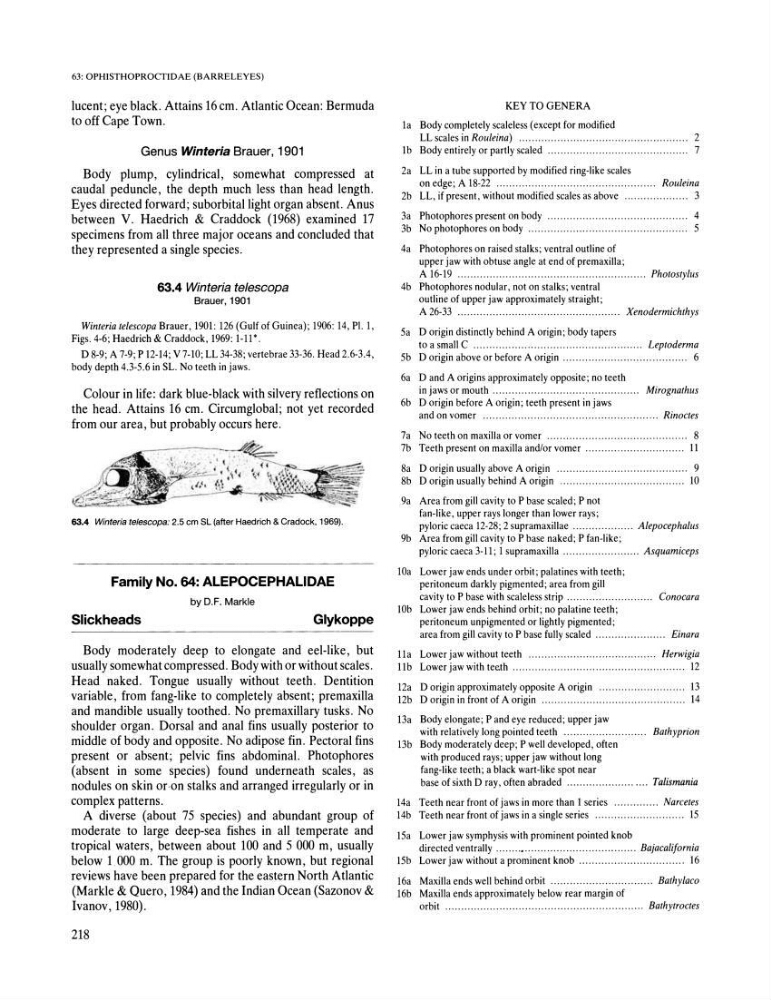
63.4 Winteria te/escopa: 2.5 em SL (after Haedrieh & Cradoek, 1969).
Family No. 64: ALEPOCEPHALIDAE
by D.F. Markle
Slickheads
Glykoppe
Body moderately deep to elongate and eel-like, but
usually somewhat compressed. Body with or without scales.
Head naked. Tongue usually without teeth. Dentition
variable, from fang-like to completely absent; premaxilla
and mandible usually toothed. No premaxillary tusks. No
shoulder organ. Dorsal and anal fins usually posterior to
middle of body and opposite. No adipose fin. Pectoral fins
present or absent; pelvic fins abdominal. Photophores
(absent in some species) found underneath scales, as
nodules on skin oron stalks and arranged irregularly or in
complex patterns.
A diverse (about 75 species) and abundant group of
moderate to large deep-sea fishes in all temperate and
tropical waters, between about 100 and 5 000 m, usually
below 1000 m. The group is poorly known, but regional
reviews have been prepared for the eastern North Atlantic
(Markle & Quero, 1984) and the Indian Ocean (Sazonov &
Ivanov, 1980).
218
KEY TO GENERA
la Body completely scaleless (except for modified
LL scales in Rouleina) ......................................... ............ 2
I b Body entirely or partly scaled ....................................... ..... 7
2a LL in a tube supported by modified ring-like scales
on edge; A 18-22 .................................................. Rouleina
2b LL, if present, without modified scales as above .................... 3
3a Photophores present on body .................. .......................... 4
3b No photophores on body .................................................. S
4a Photophores on raised stalks; ventral outline of
upper jaw with obtuse angle at end of premaxilla;
A 16-19 ........................................................... Photostylus
4b Photophores nodular, not on stalks; ventral
outline of upper jaw approximately straight;
A 26-33 ................................................... Xenodermichthys
Sa D origin distinctly behind A origin; body tapers
to a small C ..................................................... Leptoderma
Sb D origin above or before A origin ....................................... 6
6a D and A origins approximately opposite; no teeth
in jaws or mouth.............................................. Mirognathus
6b D origin before A origin; teeth present in jaws
and on vomer ....................................................... Rinoctes
7a No teeth on maxilla orvomer ................. ....... .................... 8
7b Teeth present on maxilla and/or vomer ........ ....................... 11
8a D origin usually above A origin ......................................... 9
8b D origin usually behind A origin ....................................... 10
9a Area from gill cavity to P base scaled; P not
fan-like, upper rays longer than lower rays;
pyloric caeca 12-28; 2 supramaxillae ................... Alepocephalus
9b Area from gill cavity to P base naked; P fan-like;
pyloric caeca 3-11; I supramaxilla ........................ Asquamiceps
lOa Lower jaw ends under orbit; palatines with teeth;
peritoneum darkly pigmented; area from gill
cavity to P base with scaleless strip ........................... Conocara
lOb Lower jaw ends behind orbit; no palatine teeth;
peritoneum unpigmented or lightly pigmented;
area from gill cavity to P base fully scaled ...................... Einara
lla Lower jaw without teeth ................ ... ... ... ..... ... ....... Herwigia
Ilb Lower jaw with tee.th ...................................................... 12
12a D origin approximately opposite A origin ........................... 13
12b D origin in front of A origin ................................... . .. . ...... 14
13a Body elongate; P and eye reduced; upper jaw
with relatively long pointed teeth .......................... Bathyprion
13b Body moderately deep; P well developed, often
with produced rays; upper jaw without long
fang-like teeth; a black wart-like spot near
base of sixth Dray, often abraded ......................... Talismania
14a Teeth nearfront of jaws in more than I series .............. Narcetes
14b Teeth near front of jaws in a single series ............................ IS
ISa Lower jaw symphysis with prominent pointed knob
directed ventrally ........•................................... Bajacalifornia
ISb Lower jaw without a prominent knob ................................. 16
16a Maxilla ends well behind orbit ................................ Bathylaco
16b Maxilla ends approximately below rear margin of
orbit .............................................................. Bathytroctes
lucent; eye black. Attains 16 cm. Atlantic Ocean: Bermuda
to off Cape Town.
Genus Winteria Brauer, 1901
Body plump, cylindrical, somewhat compressed at
caudal peduncle, the depth much less than head length.
Eyes directed forward; suborbital light organ absent. Anus
between V. Haedrich & Craddock (1968) examined 17
specimens from all three major oceans and concluded that
they represented a single species.
63.4 Winteria te/escopa
Brauer, 1901
Winteria telescopa Brauer, 1901: 126 (Gulf of Guinea); 1906: 14, PI. I,
Figs. 4-6; Haedrich & Craddock, 1969: 1-11*.
D 8-9; A 7-9; P 12-14; V 7-10; LL 34-38; vertebrae 33-36. Head 2.6-3.4,
body depth 4.3-S.6 in SL. No teeth in jaws.
Colour in life: dark blue-black with silvery reflections on
the head. Attains 16 cm. Circumglobal; not yet recorded
from our area, but probably occurs here.
63.4 Winteria te/escopa: 2.5 em SL (after Haedrieh & Cradoek, 1969).
Family No. 64: ALEPOCEPHALIDAE
by D.F. Markle
Slickheads
Glykoppe
Body moderately deep to elongate and eel-like, but
usually somewhat compressed. Body with or without scales.
Head naked. Tongue usually without teeth. Dentition
variable, from fang-like to completely absent; premaxilla
and mandible usually toothed. No premaxillary tusks. No
shoulder organ. Dorsal and anal fins usually posterior to
middle of body and opposite. No adipose fin. Pectoral fins
present or absent; pelvic fins abdominal. Photophores
(absent in some species) found underneath scales, as
nodules on skin oron stalks and arranged irregularly or in
complex patterns.
A diverse (about 75 species) and abundant group of
moderate to large deep-sea fishes in all temperate and
tropical waters, between about 100 and 5 000 m, usually
below 1000 m. The group is poorly known, but regional
reviews have been prepared for the eastern North Atlantic
(Markle & Quero, 1984) and the Indian Ocean (Sazonov &
Ivanov, 1980).
218
KEY TO GENERA
la Body completely scaleless (except for modified
LL scales in Rouleina) ......................................... ............ 2
I b Body entirely or partly scaled ....................................... ..... 7
2a LL in a tube supported by modified ring-like scales
on edge; A 18-22 .................................................. Rouleina
2b LL, if present, without modified scales as above .................... 3
3a Photophores present on body .................. .......................... 4
3b No photophores on body .................................................. S
4a Photophores on raised stalks; ventral outline of
upper jaw with obtuse angle at end of premaxilla;
A 16-19 ........................................................... Photostylus
4b Photophores nodular, not on stalks; ventral
outline of upper jaw approximately straight;
A 26-33 ................................................... Xenodermichthys
Sa D origin distinctly behind A origin; body tapers
to a small C ..................................................... Leptoderma
Sb D origin above or before A origin ....................................... 6
6a D and A origins approximately opposite; no teeth
in jaws or mouth.............................................. Mirognathus
6b D origin before A origin; teeth present in jaws
and on vomer ....................................................... Rinoctes
7a No teeth on maxilla orvomer ................. ....... .................... 8
7b Teeth present on maxilla and/or vomer ........ ....................... 11
8a D origin usually above A origin ......................................... 9
8b D origin usually behind A origin ....................................... 10
9a Area from gill cavity to P base scaled; P not
fan-like, upper rays longer than lower rays;
pyloric caeca 12-28; 2 supramaxillae ................... Alepocephalus
9b Area from gill cavity to P base naked; P fan-like;
pyloric caeca 3-11; I supramaxilla ........................ Asquamiceps
lOa Lower jaw ends under orbit; palatines with teeth;
peritoneum darkly pigmented; area from gill
cavity to P base with scaleless strip ........................... Conocara
lOb Lower jaw ends behind orbit; no palatine teeth;
peritoneum unpigmented or lightly pigmented;
area from gill cavity to P base fully scaled ...................... Einara
lla Lower jaw without teeth ................ ... ... ... ..... ... ....... Herwigia
Ilb Lower jaw with tee.th ...................................................... 12
12a D origin approximately opposite A origin ........................... 13
12b D origin in front of A origin ................................... . .. . ...... 14
13a Body elongate; P and eye reduced; upper jaw
with relatively long pointed teeth .......................... Bathyprion
13b Body moderately deep; P well developed, often
with produced rays; upper jaw without long
fang-like teeth; a black wart-like spot near
base of sixth Dray, often abraded ......................... Talismania
14a Teeth nearfront of jaws in more than I series .............. Narcetes
14b Teeth near front of jaws in a single series ............................ IS
ISa Lower jaw symphysis with prominent pointed knob
directed ventrally ........•................................... Bajacalifornia
ISb Lower jaw without a prominent knob ................................. 16
16a Maxilla ends well behind orbit ................................ Bathylaco
16b Maxilla ends approximately below rear margin of
orbit .............................................................. Bathytroctes