

61: ARGENTINIDAE (ARGENTINES)
May reach 20 cm. Mesopelagic. Described from off
Natal; recorded also from west of Cape Peninsula. The
taxonomy of Nansenia is confused and the precise ranges of
species cannot be given.
~
~
~
. .
..
..
.
61.3 Nansenia macrolepis: 11 cm (off South Africa).
Family No. 62 BATHYLAGIDAE
by D. M. Cohen
Deepsea smelts
Diepsee-spierings
Body elongate to robust, silvery to dark. Single dorsal
fin near mid-length of body; anal fin on posterior third or
fourth of body. No spines in fins. Pectoral fins close to
ventral surface of body; ventral fins beneath or near level of
dorsal fin. Scales large, deciduous; no photophores. Two
branchiostegal rays on each side. Mouth small; snout
usually short and blunt, especially in larger examples. No
teeth on upper jaw bones. No swimbladder.
Mesopelagic to bathypelagic in seas around the world;
most abundant in temperate to boreal waters, where they
can sometimes be important forage items for commercial
species. One or 2 genera, 1 in our area.
Genus 8athy/agus Gunther, 1878
About a dozen species; 2 species from our area, perhaps
another unrecorded. Taxonomy of this genus is not clear,
hence species ranges are not easily defined.
KEY TO SPECIES
la Scale pockets generally in regular rows; LL about
35-45; eye large, usually entering dorsal outline of
head; GR on lower limb 19-24 ............... B. antarcticus
Ib Scale pockets ragged, in irregular rows; LL about
50; eye smaller, not entering dorsal outline of head;
GR on lower limb 16-18 ................... B. bericoides
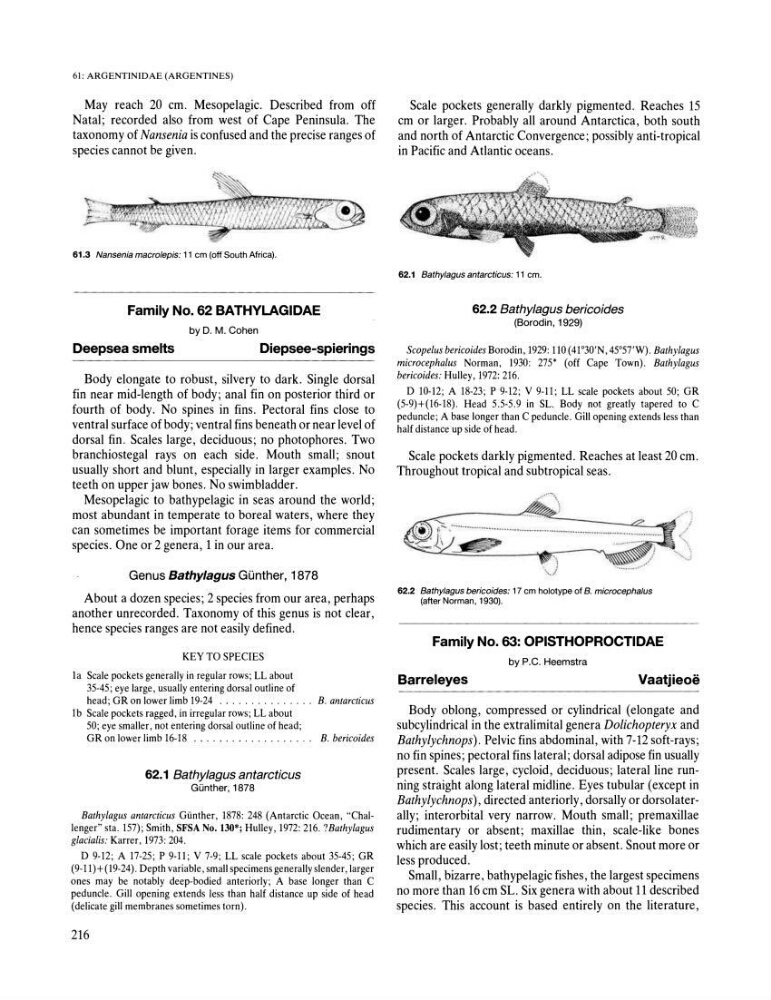
62.1 8athy/agus antarcticus
Gunther, 1878
Bathylagus antarcticus Gunther, 1878: 248 (Antarctic Ocean, "Challenger" sta. 157); Smith, SFSA No. 130*; Hulley, 1972: 216. ? Bathylagus
glacialis: Karrer, 1973: 204.
D 9-12; A 17-25; P 9-11; V 7-9; LL scale pockets about 35-45; GR
(9-11) + (19-24). Depth variable, small specimens generally slender, larger
ones may be notably deep-bodied anteriorly; A base longer than C
peduncle. Gill opening extends less than half distance up side of head
(delicate gill membranes sometimes torn).
216
Scale pockets generally darkly pigmented. Reaches 15
cm or larger. Probably all around Antarctica, both south
and north of Antarctic Convergence; possibly anti-tropical
in Pacific and Atlantic oceans.
62.1 Bathylagus antarcticus: 11 cm.
62.2 8athy/agus bericoides
(8orodin, 1929)
Scopelus bericoides Borodin, 1929: 110 (41 °30'N, 45°57'W). Bathylagus
microcephalus Norman, 1930: 275* (off Cape Town). Bathylagus
bericoides: Hulley, 1972: 216.
D 10-12; A 18-23; P 9-12; V 9-11; LL scale pockets about 50; GR
(5-9)+(16-18). Head 5.5-5.9 in SL. Body not greatly tapered to C
peduncle; A base longer than C peduncle. Gill opening extends less than
half distance up side of head.
Scale pockets darkly pigmented. Reaches at least 20 cm.
Throughout tropical and subtropical seas.
.........
~
: ...... ~.... . .. ... )
~~ . . . . . . . . . . . . . . . . . . . . . . . . . . = . h
. . h . . . " . . . . ~ ./ . .
C ,1_
_, ~' !
~J~ . . . . . . ~)
......
62.2 Bathylagus bericoides: 17 cm holotype of B. microcephalus
(after Norman, 1930).
Family No. 63: OPISTHOPROCTIDAE
by P.C. Heemstra
Barreleyes
Vaatjieoe
Body oblong, compressed or cylindrical (elongate and
subcylindrical in the extralimital genera Dolichopteryx and
Bathylychnops). Pelvic fins abdominal, with 7-12 soft-rays;
no fin spines; pectoral fins lateral; dorsal adipose fin usually
present. Scales large, cycloid, deciduous; lateral line running straight along lateral midline. Eyes tubular (except in
Bathylychnops) , directed anteriorly, dorsally or dorsolaterally; interorbital very narrow. Mouth small; premaxillae
rudimentary or absent; maxillae thin, scale-like bones
which are easily lost; teeth minute or absent. Snout more or
less produced.
Small, bizarre, bathypelagic fishes, the largest specimens
no more than 16 cm SL. Six genera with about 11 described
species. This account is based entirely on the literature,
May reach 20 cm. Mesopelagic. Described from off
Natal; recorded also from west of Cape Peninsula. The
taxonomy of Nansenia is confused and the precise ranges of
species cannot be given.
~
~
~
. .
..
..
.
61.3 Nansenia macrolepis: 11 cm (off South Africa).
Family No. 62 BATHYLAGIDAE
by D. M. Cohen
Deepsea smelts
Diepsee-spierings
Body elongate to robust, silvery to dark. Single dorsal
fin near mid-length of body; anal fin on posterior third or
fourth of body. No spines in fins. Pectoral fins close to
ventral surface of body; ventral fins beneath or near level of
dorsal fin. Scales large, deciduous; no photophores. Two
branchiostegal rays on each side. Mouth small; snout
usually short and blunt, especially in larger examples. No
teeth on upper jaw bones. No swimbladder.
Mesopelagic to bathypelagic in seas around the world;
most abundant in temperate to boreal waters, where they
can sometimes be important forage items for commercial
species. One or 2 genera, 1 in our area.
Genus 8athy/agus Gunther, 1878
About a dozen species; 2 species from our area, perhaps
another unrecorded. Taxonomy of this genus is not clear,
hence species ranges are not easily defined.
KEY TO SPECIES
la Scale pockets generally in regular rows; LL about
35-45; eye large, usually entering dorsal outline of
head; GR on lower limb 19-24 ............... B. antarcticus
Ib Scale pockets ragged, in irregular rows; LL about
50; eye smaller, not entering dorsal outline of head;
GR on lower limb 16-18 ................... B. bericoides
62.1 8athy/agus antarcticus
Gunther, 1878
Bathylagus antarcticus Gunther, 1878: 248 (Antarctic Ocean, "Challenger" sta. 157); Smith, SFSA No. 130*; Hulley, 1972: 216. ? Bathylagus
glacialis: Karrer, 1973: 204.
D 9-12; A 17-25; P 9-11; V 7-9; LL scale pockets about 35-45; GR
(9-11) + (19-24). Depth variable, small specimens generally slender, larger
ones may be notably deep-bodied anteriorly; A base longer than C
peduncle. Gill opening extends less than half distance up side of head
(delicate gill membranes sometimes torn).
216
Scale pockets generally darkly pigmented. Reaches 15
cm or larger. Probably all around Antarctica, both south
and north of Antarctic Convergence; possibly anti-tropical
in Pacific and Atlantic oceans.
62.1 Bathylagus antarcticus: 11 cm.
62.2 8athy/agus bericoides
(8orodin, 1929)
Scopelus bericoides Borodin, 1929: 110 (41 °30'N, 45°57'W). Bathylagus
microcephalus Norman, 1930: 275* (off Cape Town). Bathylagus
bericoides: Hulley, 1972: 216.
D 10-12; A 18-23; P 9-12; V 9-11; LL scale pockets about 50; GR
(5-9)+(16-18). Head 5.5-5.9 in SL. Body not greatly tapered to C
peduncle; A base longer than C peduncle. Gill opening extends less than
half distance up side of head.
Scale pockets darkly pigmented. Reaches at least 20 cm.
Throughout tropical and subtropical seas.
.........
~
: ...... ~.... . .. ... )
~~ . . . . . . . . . . . . . . . . . . . . . . . . . . = . h
. . h . . . " . . . . ~ ./ . .
C ,1_
_, ~' !
~J~ . . . . . . ~)
......
62.2 Bathylagus bericoides: 17 cm holotype of B. microcephalus
(after Norman, 1930).
Family No. 63: OPISTHOPROCTIDAE
by P.C. Heemstra
Barreleyes
Vaatjieoe
Body oblong, compressed or cylindrical (elongate and
subcylindrical in the extralimital genera Dolichopteryx and
Bathylychnops). Pelvic fins abdominal, with 7-12 soft-rays;
no fin spines; pectoral fins lateral; dorsal adipose fin usually
present. Scales large, cycloid, deciduous; lateral line running straight along lateral midline. Eyes tubular (except in
Bathylychnops) , directed anteriorly, dorsally or dorsolaterally; interorbital very narrow. Mouth small; premaxillae
rudimentary or absent; maxillae thin, scale-like bones
which are easily lost; teeth minute or absent. Snout more or
less produced.
Small, bizarre, bathypelagic fishes, the largest specimens
no more than 16 cm SL. Six genera with about 11 described
species. This account is based entirely on the literature,