

Anatomy of fishes
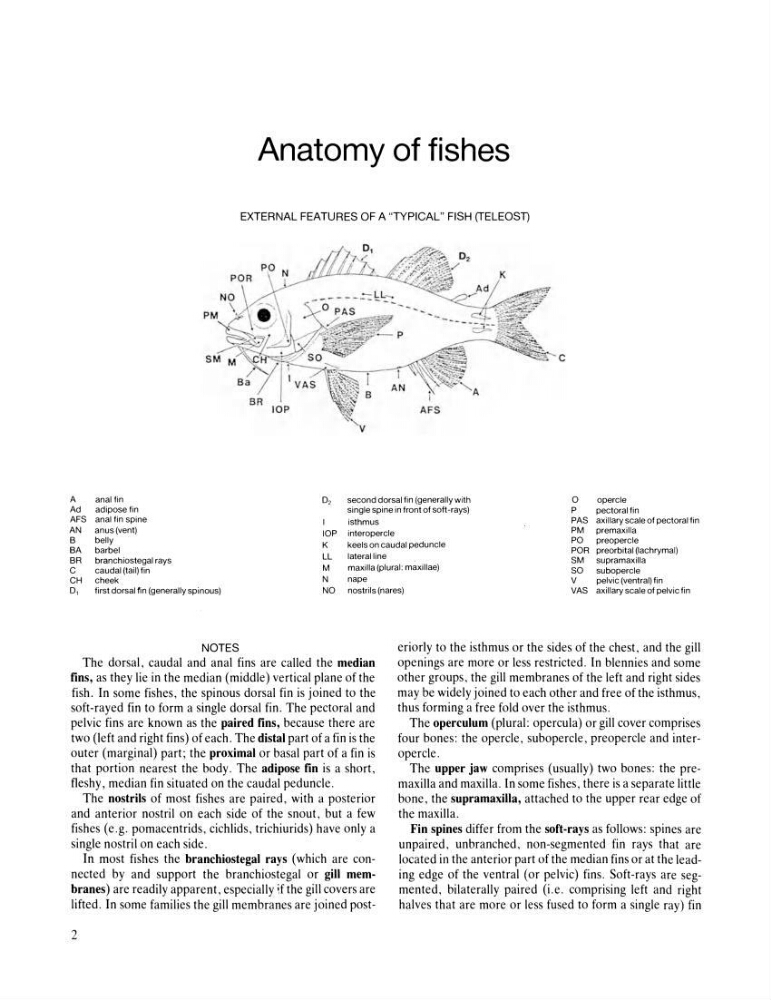
EXTERNAL FEATURES OF A "TYPICAL" FISH (TELEOST)
c
A
anal fin
D2
second dorsal fin (generally with
0
opercle
Ad
adipose fin
single spine in front of soft-rays)
P
pectoral fin
AFS anal fin spine
isthmus
PAS axillary scale of pectoral fin
AN
anus (vent)
lOP interopercle
PM
premaxilla
S
belly
K
keels on caudal peduncle
PO
preopercle
SA
barbel
POR preorbital (lachrymal)
SR
LL lateral line
SM
branchiostegal rays
supramaxilla
C
caudal (tail) fin
M
maxilla (plural: maxillae)
SO
subopercle
CH
cheek
N
nape
V
pelvic (ventral) fin
D,
first dorsal fin (generally spinous)
NO
nostrils (nares)
VAS axillary scale of pelvic fin
NOTES
The dorsal, caudal and anal fins are called the median
fins, as they lie in the median (middle) vertical plane of the
fish. In some fishes, the spinous dorsal fin is joined to the
soft-rayed fin to form a single dorsal fin. The pectoral and
pelvic fins are known as the paired fins, because there are
two (left and right fins) of each. The distal part of a fin is the
outer (marginal) part; the proximal or basal part of a fin is
that portion nearest the body. The adipose fin is a short,
fleshy, median fin situated on the caudal peduncle.
The nostrils of most fishes are paired, with a posterior
and anterior nostril on each side of the snout, but a few
fishes (e.g. pomacentrids, cichlids, trichiurids) have only a
single nostril on each side.
In most fishes the branchiostegal rays (which are connected by and support the branchiostegal or gill membranes) are readily apparent, especially if the gill covers are
lifted. In some families the gill membranes are joined post2
eriorly to the isthmus or the sides of the chest, and the gill
openings are more or less restricted. In blennies and some
other groups, the gill membranes of the left and right sides
may be widely joined to each other and free of the isthmus,
thus forming a free fold over the isthmus.
The operculum (plural: opercula) or gill cover comprises
four bones: the opercle, subopercle, preopercle and interopercle.
The upper jaw comprises (usually) two bones: the premaxilla and maxilla. In some fishes, there is a separate little
bone, the supramaxilla, attached to the upper rear edge of
the maxilla.
Fin spines differ from the soft-rays as follows: spines are
unpaired, unbranched, non-segmented fin rays that are
located in the anterior part of the median fins or at the leading edge of the ventral (or pelvic) fins. Soft-rays are segmented, bilaterally paired (i.e. comprising left and right
halves that are more or less fused to form a single ray) fin
EXTERNAL FEATURES OF A "TYPICAL" FISH (TELEOST)
c
A
anal fin
D2
second dorsal fin (generally with
0
opercle
Ad
adipose fin
single spine in front of soft-rays)
P
pectoral fin
AFS anal fin spine
isthmus
PAS axillary scale of pectoral fin
AN
anus (vent)
lOP interopercle
PM
premaxilla
S
belly
K
keels on caudal peduncle
PO
preopercle
SA
barbel
POR preorbital (lachrymal)
SR
LL lateral line
SM
branchiostegal rays
supramaxilla
C
caudal (tail) fin
M
maxilla (plural: maxillae)
SO
subopercle
CH
cheek
N
nape
V
pelvic (ventral) fin
D,
first dorsal fin (generally spinous)
NO
nostrils (nares)
VAS axillary scale of pelvic fin
NOTES
The dorsal, caudal and anal fins are called the median
fins, as they lie in the median (middle) vertical plane of the
fish. In some fishes, the spinous dorsal fin is joined to the
soft-rayed fin to form a single dorsal fin. The pectoral and
pelvic fins are known as the paired fins, because there are
two (left and right fins) of each. The distal part of a fin is the
outer (marginal) part; the proximal or basal part of a fin is
that portion nearest the body. The adipose fin is a short,
fleshy, median fin situated on the caudal peduncle.
The nostrils of most fishes are paired, with a posterior
and anterior nostril on each side of the snout, but a few
fishes (e.g. pomacentrids, cichlids, trichiurids) have only a
single nostril on each side.
In most fishes the branchiostegal rays (which are connected by and support the branchiostegal or gill membranes) are readily apparent, especially if the gill covers are
lifted. In some families the gill membranes are joined post2
eriorly to the isthmus or the sides of the chest, and the gill
openings are more or less restricted. In blennies and some
other groups, the gill membranes of the left and right sides
may be widely joined to each other and free of the isthmus,
thus forming a free fold over the isthmus.
The operculum (plural: opercula) or gill cover comprises
four bones: the opercle, subopercle, preopercle and interopercle.
The upper jaw comprises (usually) two bones: the premaxilla and maxilla. In some fishes, there is a separate little
bone, the supramaxilla, attached to the upper rear edge of
the maxilla.
Fin spines differ from the soft-rays as follows: spines are
unpaired, unbranched, non-segmented fin rays that are
located in the anterior part of the median fins or at the leading edge of the ventral (or pelvic) fins. Soft-rays are segmented, bilaterally paired (i.e. comprising left and right
halves that are more or less fused to form a single ray) fin