

41: MURAENIDAE (MORAY EELS)
Variable in coloration, including plain, freckled, spotted
and striped. Adults benthic, generally in shallow water
among rocks and coral heads; larvae epipelagic, widespread
and abundant. Vicious reputation undeserved, although
some species will bite if provoked. None is venomous, but
in some areas certain large species can cause tropical fish
poisoning (ciguatera) if eaten. In all oceans, some entering
estuaries. About 13 genera and 200 species worldwide; 6
genera and 33 species in our area, several of which need
further study and comparison with extralimital specimens.
Western Indian Ocean species revised by Smith (1962)
who with others has divided Gymnothorax into Lycodontis
for those morays without, and Gymnothorax for those with,
serrations on the lateral jaw teeth. Because some species
are intermediate in this condition, we here recognise only
Gymnothorax.
The genus Monopenchelys is included in the key because
its rare single species M. acuta (Parr) is known from the
Seychelles and Comoro Islands (Bohlke and McCosker,
1982) and may be found in our area.
KEY TO GENERA
la D short, either a skin-covered ridge on end of
tailor well behind anus; teeth needle-like and pointed ............... 2
Ib D and A skin-covered but distinct, beginning ahead of
gill opening and just behind anus, respectively; teeth
either pointed, blunt, or chisel-like ....................................... 4
2a Rear nostril contiguous with enlarged interorbital
pore, so that it appears double; adults small, less than
30 cm long ............................................................ Anarchias
2b Rear nostril not contiguous with interorbital pore;
adults may be longer than 30 cm ........................................... 3
3a D origin in mid-tail region; A origin behind anus;
a single gill opening low on throat; adults small,
less than 25 cm long ....................................... [Monopenchelys]
3b D and A short, skin-covered ridges on end of tail;
gill opening single or double, either low or at midthroat; adults often longer than 30 cm ..................... Uropterygius
4a Some teeth molariform or granular, at least on
vomer; no canine teeth .............................................. Echidna
4b Teeth not noticeably molariform; usually some canine
teeth present .................................................................... 5
5a Body 1.5-2 in tail length; body nearly uniformly
coloured; depth about 40 in TL ....... ........................ Thyrsoidea
5b Body and tail nearly subequal, tail not more than
1.5 times body length; numerous species, variable in
coloration, dentition and body depth ..................................... 6
6a One or more depressible fangs in middle of front of
upper jaw; teeth on vomer usually in a single row ..... Gymnothorax
6b No median depressible fangs in upper jaw; 2 rows of
low, conical teeth on vomer ......................................... Siderea
Genus Anarchias Jordan & Starks, 1906
About 9 species; 1 in our area. Smith's (1980) record of
A. fuscus Smith, 1962 is apparently erroneous. Anarchias
vermiformis Smith, 1962, is a species of Uropterygius, cf. U.
concolor (Erling Holm, personal communication).
166
41.1 Anarchias seychel/ensis
Smith,1962
Marbled reef-eel
Marmer-rifpaling
Anarchias seychellensis Smith, 1962: 429, PI. 53 F (Seychelles).
A slender, variously coloured little moray; head 8.1-9.6, depth 20-25. D
and A restricted to tail tip. Teeth sharp, slender, recurved; those on jaws
biserial, outer row smaller; a few larger, inner depressible teeth; several
larger depressible teeth on intermaxillary; 7-8 uniserial small teeth on
vomer. Vertebrae 115-121.
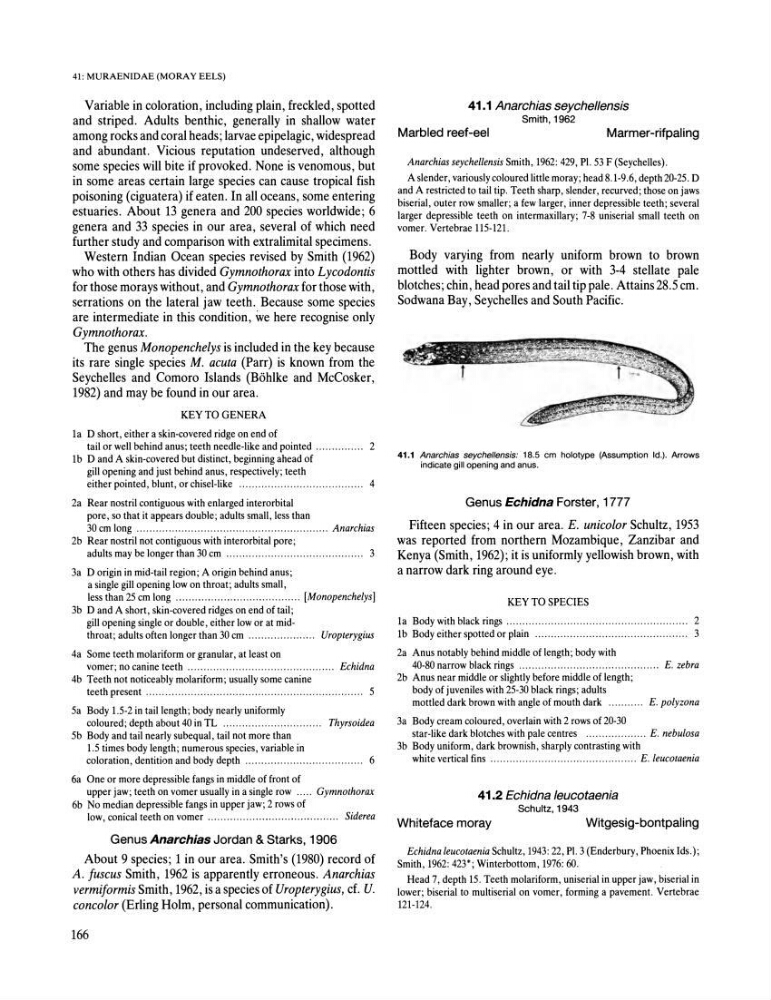
Body varying from nearly uniform brown to brown
mottled with lighter brown, or with 3-4 stellate pale
blotches; chin, head pores and tail tip pale. Attains 28.5 cm.
Sodwana Bay, Seychelles and South Pacific.
41.1 Anarchias seychellensis: 18.5 cm holotype (Assumption Id.). Arrows
indicate gill opening and anus.
Genus Echidna Forster, 1777
Fifteen species; 4 in our area. E. unicolor Schultz, 1953
was reported from northern Mozambique, Zanzibar and
Kenya (Smith, 1962); it is uniformly yellowish brown, with
a narrow dark ring around eye.
KEY TO SPECIES
la Body with black rings ....................... .................................. 2
Ib Body either spotted or plain ..................... ........................... 3
2a Anus notably behind middle of length; body with
40-80 narrow black rings ............................................ E. zebra
2b Anus near middle or slightly before middle of length;
body of juveniles with 25-30 black rings; adults
mottled dark brown with angle of mouth dark ........... E. poly zona
3a Body cream coloured, overlain with 2 rows of 20-30
star-like dark blotches with pale centres ................... E. nebulosa
3b Body uniform, dark brownish, sharply contrasting with
white vertical fins .............................................. E. leucotaenia
41.2 Echidna leucotaenia
Schultz, 1943
Whiteface moray
Witgesig-bontpaling
Echidna leucotaenia Schultz, 1943: 22, PI. 3 (Enderbury, Phoenix Ids.);
Smith, 1962: 423*; Winterbottom, 1976: 60.
Head 7, depth 15. Teeth molariform, uniserial in upper jaw, biserial in
lower; biserial to multiserial on vomer, forming a pavement. Vertebrae
121-124.
Variable in coloration, including plain, freckled, spotted
and striped. Adults benthic, generally in shallow water
among rocks and coral heads; larvae epipelagic, widespread
and abundant. Vicious reputation undeserved, although
some species will bite if provoked. None is venomous, but
in some areas certain large species can cause tropical fish
poisoning (ciguatera) if eaten. In all oceans, some entering
estuaries. About 13 genera and 200 species worldwide; 6
genera and 33 species in our area, several of which need
further study and comparison with extralimital specimens.
Western Indian Ocean species revised by Smith (1962)
who with others has divided Gymnothorax into Lycodontis
for those morays without, and Gymnothorax for those with,
serrations on the lateral jaw teeth. Because some species
are intermediate in this condition, we here recognise only
Gymnothorax.
The genus Monopenchelys is included in the key because
its rare single species M. acuta (Parr) is known from the
Seychelles and Comoro Islands (Bohlke and McCosker,
1982) and may be found in our area.
KEY TO GENERA
la D short, either a skin-covered ridge on end of
tailor well behind anus; teeth needle-like and pointed ............... 2
Ib D and A skin-covered but distinct, beginning ahead of
gill opening and just behind anus, respectively; teeth
either pointed, blunt, or chisel-like ....................................... 4
2a Rear nostril contiguous with enlarged interorbital
pore, so that it appears double; adults small, less than
30 cm long ............................................................ Anarchias
2b Rear nostril not contiguous with interorbital pore;
adults may be longer than 30 cm ........................................... 3
3a D origin in mid-tail region; A origin behind anus;
a single gill opening low on throat; adults small,
less than 25 cm long ....................................... [Monopenchelys]
3b D and A short, skin-covered ridges on end of tail;
gill opening single or double, either low or at midthroat; adults often longer than 30 cm ..................... Uropterygius
4a Some teeth molariform or granular, at least on
vomer; no canine teeth .............................................. Echidna
4b Teeth not noticeably molariform; usually some canine
teeth present .................................................................... 5
5a Body 1.5-2 in tail length; body nearly uniformly
coloured; depth about 40 in TL ....... ........................ Thyrsoidea
5b Body and tail nearly subequal, tail not more than
1.5 times body length; numerous species, variable in
coloration, dentition and body depth ..................................... 6
6a One or more depressible fangs in middle of front of
upper jaw; teeth on vomer usually in a single row ..... Gymnothorax
6b No median depressible fangs in upper jaw; 2 rows of
low, conical teeth on vomer ......................................... Siderea
Genus Anarchias Jordan & Starks, 1906
About 9 species; 1 in our area. Smith's (1980) record of
A. fuscus Smith, 1962 is apparently erroneous. Anarchias
vermiformis Smith, 1962, is a species of Uropterygius, cf. U.
concolor (Erling Holm, personal communication).
166
41.1 Anarchias seychel/ensis
Smith,1962
Marbled reef-eel
Marmer-rifpaling
Anarchias seychellensis Smith, 1962: 429, PI. 53 F (Seychelles).
A slender, variously coloured little moray; head 8.1-9.6, depth 20-25. D
and A restricted to tail tip. Teeth sharp, slender, recurved; those on jaws
biserial, outer row smaller; a few larger, inner depressible teeth; several
larger depressible teeth on intermaxillary; 7-8 uniserial small teeth on
vomer. Vertebrae 115-121.
Body varying from nearly uniform brown to brown
mottled with lighter brown, or with 3-4 stellate pale
blotches; chin, head pores and tail tip pale. Attains 28.5 cm.
Sodwana Bay, Seychelles and South Pacific.
41.1 Anarchias seychellensis: 18.5 cm holotype (Assumption Id.). Arrows
indicate gill opening and anus.
Genus Echidna Forster, 1777
Fifteen species; 4 in our area. E. unicolor Schultz, 1953
was reported from northern Mozambique, Zanzibar and
Kenya (Smith, 1962); it is uniformly yellowish brown, with
a narrow dark ring around eye.
KEY TO SPECIES
la Body with black rings ....................... .................................. 2
Ib Body either spotted or plain ..................... ........................... 3
2a Anus notably behind middle of length; body with
40-80 narrow black rings ............................................ E. zebra
2b Anus near middle or slightly before middle of length;
body of juveniles with 25-30 black rings; adults
mottled dark brown with angle of mouth dark ........... E. poly zona
3a Body cream coloured, overlain with 2 rows of 20-30
star-like dark blotches with pale centres ................... E. nebulosa
3b Body uniform, dark brownish, sharply contrasting with
white vertical fins .............................................. E. leucotaenia
41.2 Echidna leucotaenia
Schultz, 1943
Whiteface moray
Witgesig-bontpaling
Echidna leucotaenia Schultz, 1943: 22, PI. 3 (Enderbury, Phoenix Ids.);
Smith, 1962: 423*; Winterbottom, 1976: 60.
Head 7, depth 15. Teeth molariform, uniserial in upper jaw, biserial in
lower; biserial to multiserial on vomer, forming a pavement. Vertebrae
121-124.