

40: CONGRIDAE (CONGER EELS)
Dark blackish brown but integument readily damaged.
Attains 51 cm. Natal and southern Mozambique in deep
water, but probably much more widespread; also South
China Sea and east Australia.
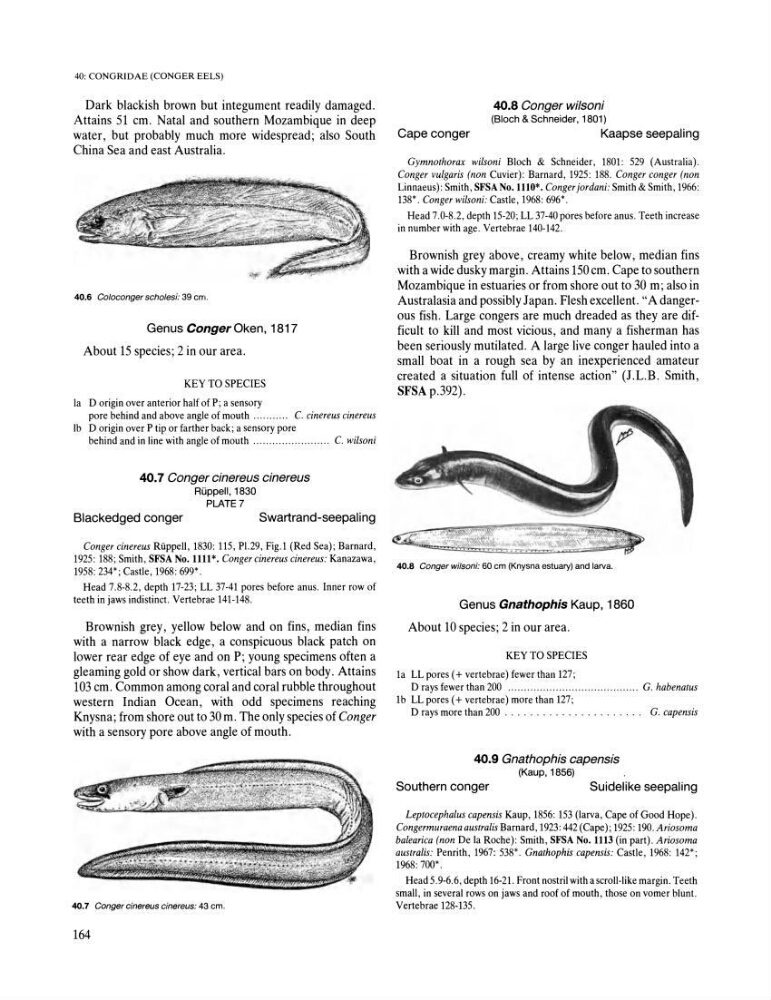
40.6 Coloconger scholesi: 39 ern.
Genus CongerOken, 1817
About 15 species; 2 in our area.
KEY TO SPECIES
la D origin over anterior half of P; a sensory
pore behind and above angle of mouth ........... C. cine reus cinereus
lb D origin over P tip or farther back; a sensory pore
behind and in line with angle of mouth ........................ C. wilsoni
40.7 Conger cinereus cinereus
Ruppell,1830
PLATE 7
Blackedged conger
Swartrand-seepaling
Conger cinereus Riippell, 1830: 115, P1.29, Fig.l (Red Sea); Barnard,
1925: 188; Smith, SFSA No. 1111*. Conger cinereus cinereus: Kanazawa,
1958: 234*; Castle, 1968: 699*.
Head 7.8-8.2, depth 17-23; LL 37-41 pores before anus. Inner row of
teeth in jaws indistinct. Vertebrae 141-148.
Brownish grey, yellow below and on fins, median fins
with a narrow black edge, a conspicuous black patch on
lower rear edge of eye and on P; young specimens often a
gleaming gold or show dark, vertical bars on body. Attains
103 cm. Common among coral and coral rubble throughout
western Indian Ocean, with odd specimens reaching
Knysna; from shore out to 30 m. The only species of Conger
with a sensory pore above angle of mouth.
40.7 Conger cinereus cinereus: 43 em.
164
Cape conger
40.8 Conger wi/sani
(Bloch & Schneider, 1801)
Kaapse seepaling
Gymnothorax wilsoni Bloch & Schneider, 1801: 529 (Australia).
Conger vulgaris (non Cuvier): Barnard, 1925: 188. Conger conger (non
Linnaeus): Smith, SFSA No. 1110*. Conger jordani: Smith & Smith, 1966:
138*. Conger wilsoni: Castle, 1968: 696*.
Head 7.0-8.2, depth 15-20; LL 37-40 pores before anus. Teeth increase
in number with age. Vertebrae 140-142.
Brownish grey above, creamy white below, median fins
with a wide dusky margin. Attains 150 cm. Cape to southern
Mozambique in estuaries or from shore out to 30 m; also in
Australasia and possibly Japan. Flesh excellent. "A dangerous fish. Large congers are much dreaded as they are difficult to kill and most vicious, and many a fisherman has
been seriously mutilated. A large live conger hauled into a
small boat in a rough sea by an inexperienced amateur
created a situation full of intense action" (J.L.B. Smith,
SFSA p.392).
40.8 Conger wilsoni: 60 em (Knysna estuary) and larva.
Genus Gnathophis Kaup, 1860
About 10 species; 2 in our area.
KEY TO SPECIES
la LL pores (+ vertebrae) fewer than 127;
D rays fewer than 200 ......................................... G. habenatus
Ib LL pores (+ vertebrae) more than 127;
D rays more than 200 . . . . . . . . . . . . . . . . . . . . .. G. capensis
40.9 Gnathophis capensis
(Kaup, 1856)
Southern conger
Suidelike seepaling
Leptocephalus capensis Kaup, 1856: 153 (larva, Cape of Good Hope).
Congermuraena australis Barnard, 1923: 442 (Cape); 1925: 190. Ariosoma
balearica (non De la Roche): Smith, SFSA No. 1113 (in part). Ariosoma
australis: Penrith, 1967: 538*. Gnathophis capensis: Castle, 1968: 142*;
1968: 700*.
Head 5.9-6.6, depth 16-21. Front nostril with a scroll-like margin. Teeth
small, in several rows on jaws and roof of mouth, those on vomer blunt.
Vertebrae 128-135.
Dark blackish brown but integument readily damaged.
Attains 51 cm. Natal and southern Mozambique in deep
water, but probably much more widespread; also South
China Sea and east Australia.
40.6 Coloconger scholesi: 39 ern.
Genus CongerOken, 1817
About 15 species; 2 in our area.
KEY TO SPECIES
la D origin over anterior half of P; a sensory
pore behind and above angle of mouth ........... C. cine reus cinereus
lb D origin over P tip or farther back; a sensory pore
behind and in line with angle of mouth ........................ C. wilsoni
40.7 Conger cinereus cinereus
Ruppell,1830
PLATE 7
Blackedged conger
Swartrand-seepaling
Conger cinereus Riippell, 1830: 115, P1.29, Fig.l (Red Sea); Barnard,
1925: 188; Smith, SFSA No. 1111*. Conger cinereus cinereus: Kanazawa,
1958: 234*; Castle, 1968: 699*.
Head 7.8-8.2, depth 17-23; LL 37-41 pores before anus. Inner row of
teeth in jaws indistinct. Vertebrae 141-148.
Brownish grey, yellow below and on fins, median fins
with a narrow black edge, a conspicuous black patch on
lower rear edge of eye and on P; young specimens often a
gleaming gold or show dark, vertical bars on body. Attains
103 cm. Common among coral and coral rubble throughout
western Indian Ocean, with odd specimens reaching
Knysna; from shore out to 30 m. The only species of Conger
with a sensory pore above angle of mouth.
40.7 Conger cinereus cinereus: 43 em.
164
Cape conger
40.8 Conger wi/sani
(Bloch & Schneider, 1801)
Kaapse seepaling
Gymnothorax wilsoni Bloch & Schneider, 1801: 529 (Australia).
Conger vulgaris (non Cuvier): Barnard, 1925: 188. Conger conger (non
Linnaeus): Smith, SFSA No. 1110*. Conger jordani: Smith & Smith, 1966:
138*. Conger wilsoni: Castle, 1968: 696*.
Head 7.0-8.2, depth 15-20; LL 37-40 pores before anus. Teeth increase
in number with age. Vertebrae 140-142.
Brownish grey above, creamy white below, median fins
with a wide dusky margin. Attains 150 cm. Cape to southern
Mozambique in estuaries or from shore out to 30 m; also in
Australasia and possibly Japan. Flesh excellent. "A dangerous fish. Large congers are much dreaded as they are difficult to kill and most vicious, and many a fisherman has
been seriously mutilated. A large live conger hauled into a
small boat in a rough sea by an inexperienced amateur
created a situation full of intense action" (J.L.B. Smith,
SFSA p.392).
40.8 Conger wilsoni: 60 em (Knysna estuary) and larva.
Genus Gnathophis Kaup, 1860
About 10 species; 2 in our area.
KEY TO SPECIES
la LL pores (+ vertebrae) fewer than 127;
D rays fewer than 200 ......................................... G. habenatus
Ib LL pores (+ vertebrae) more than 127;
D rays more than 200 . . . . . . . . . . . . . . . . . . . . .. G. capensis
40.9 Gnathophis capensis
(Kaup, 1856)
Southern conger
Suidelike seepaling
Leptocephalus capensis Kaup, 1856: 153 (larva, Cape of Good Hope).
Congermuraena australis Barnard, 1923: 442 (Cape); 1925: 190. Ariosoma
balearica (non De la Roche): Smith, SFSA No. 1113 (in part). Ariosoma
australis: Penrith, 1967: 538*. Gnathophis capensis: Castle, 1968: 142*;
1968: 700*.
Head 5.9-6.6, depth 16-21. Front nostril with a scroll-like margin. Teeth
small, in several rows on jaws and roof of mouth, those on vomer blunt.
Vertebrae 128-135.