

33: RHINOCHIMAERIDAE (LONGNOSE CHIMAERAS)
Family No. 33: RHINOCHIMAERIDAE
by L.J.V. Compagno
Longnose chimaeras
Langneus-chimaeras
Snout elongated into a cylindrical or flattened, pointed
projection, not hoe-like. First dorsal fin erectile, with a
strong, smooth or serrate spine; second dorsal fin long, low
and not falcate; caudal fin with horizontal axis; anal fin high
and narrow-based or absent. Egg-cases spindle-shaped,
with broad filamentous horizontal flanges. Peculiar deepwater chimaeras found at scattered localities worldwide in
temperate to tropical seas, in 200 to more than 2 000 m.
Three genera, all in our area.
KEY TO GENERA
1a Anal fin present ....... .......................................... Neoharriotta
1b No anal fin ................ ....................... ............................... 2
2a Dorsal profile of head nearly straight; mouth in
front of eye; tooth plates narrow, sharp-edged and
smooth ......................................................... Rhinochimaera
2b Dorsal profile of head arched; mouth below eyes;
tooth plates broad, blunt-edged and ridged ................... Harriotta
Genus Harriotta Goode & Bean, 1895
Two species, 1 in our area; H. haeckeli Karrer, 1972
occurs in the North Atlantic.
33.1 Harriotta raleighana
Goode & Bean, 1895
Harriotta raleighana Goode & Bean, 1895: 472, PI. 19 (Atlantic coast of
U.S.A.); Bigelow & Schroeder, 1953: 551*; Smith, SFSA No. 96; Karrer,
1973: 217;Shcherbachev, 1978:8.
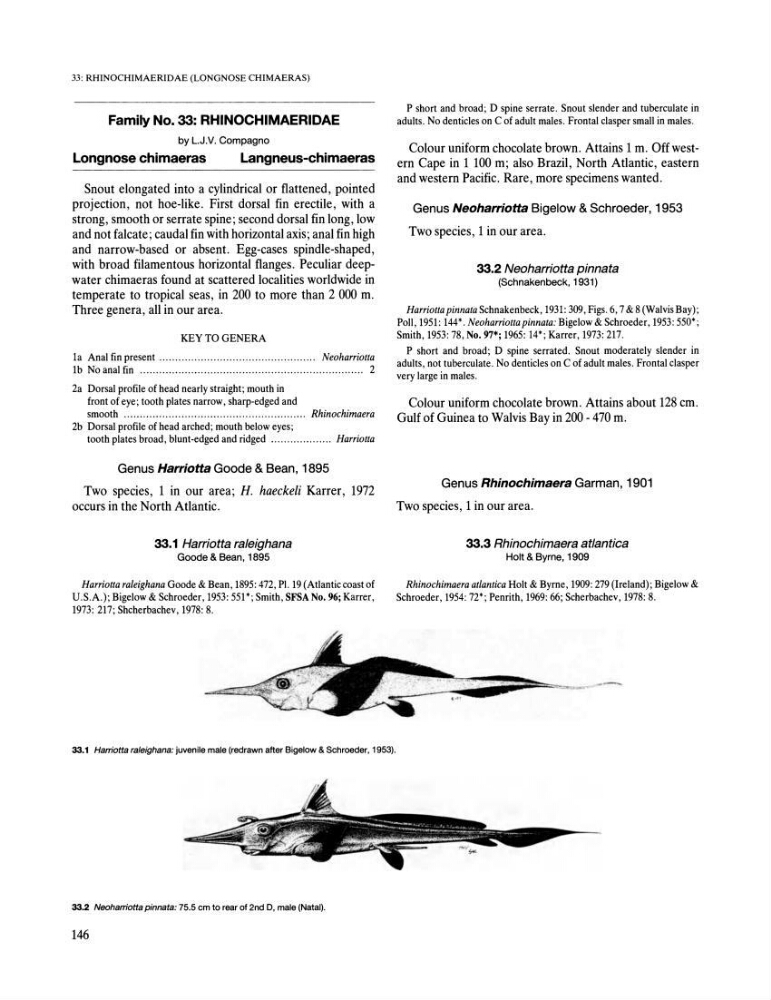
33.1 Harriotta raleighana: juvenile male (redrawn after Bigelow & Schroeder, 1953).
33.2 Neoharriotta pinnata: 75.5 cm to rear of 2nd D, male (Natal).
146
P short and broad; D spine serrate. Snout slender and tuberculate in
adults. No denticles on C of adult males. Frontal clasper small in males.
Colour uniform chocolate brown. Attains 1 m. Off western Cape in 1 100 m; also Brazil, North Atlantic, eastern
and western Pacific. Rare, more specimens wanted.
Genus Neoharriotta Bigelow & Schroeder, 1953
Two species, 1 in our area.
33.2 Neoharriotta pinnata
(Schnakenbeck,1931)
Harriottapinnata Schnakenbeck, 1931: 309, Figs. 6, 7 &8 (Walvis Bay);
Poll, 1951: 144*. Neoharriottapinnata: Bigelow & Schroeder, 1953: 550*;
Smith, 1953: 78, No. 97*; 1965: 14*; Karrer, 1973: 217.
P short and broad; D spine serrated. Snout moderately slender in
adults, not tuberculate. No denticles on C of adult males. Frontal clasper
very large in males.
Colour uniform chocolate brown. Attains about 128 cm.
Gulf of Guinea to Walvis Bay in 200 - 470 m.
Genus Rhinochimaera Garman, 1901
Two species, 1 in our area.
33.3 Rhinochimaera atlantica
Holt & Byrne, 1909
Rhinochimaera atlantica Holt & Byrne, 1909: 279 (Ireland); Bigelow &
Schroeder, 1954: 72*; Penrith, 1969: 66; Scherbachev, 1978:8.
Family No. 33: RHINOCHIMAERIDAE
by L.J.V. Compagno
Longnose chimaeras
Langneus-chimaeras
Snout elongated into a cylindrical or flattened, pointed
projection, not hoe-like. First dorsal fin erectile, with a
strong, smooth or serrate spine; second dorsal fin long, low
and not falcate; caudal fin with horizontal axis; anal fin high
and narrow-based or absent. Egg-cases spindle-shaped,
with broad filamentous horizontal flanges. Peculiar deepwater chimaeras found at scattered localities worldwide in
temperate to tropical seas, in 200 to more than 2 000 m.
Three genera, all in our area.
KEY TO GENERA
1a Anal fin present ....... .......................................... Neoharriotta
1b No anal fin ................ ....................... ............................... 2
2a Dorsal profile of head nearly straight; mouth in
front of eye; tooth plates narrow, sharp-edged and
smooth ......................................................... Rhinochimaera
2b Dorsal profile of head arched; mouth below eyes;
tooth plates broad, blunt-edged and ridged ................... Harriotta
Genus Harriotta Goode & Bean, 1895
Two species, 1 in our area; H. haeckeli Karrer, 1972
occurs in the North Atlantic.
33.1 Harriotta raleighana
Goode & Bean, 1895
Harriotta raleighana Goode & Bean, 1895: 472, PI. 19 (Atlantic coast of
U.S.A.); Bigelow & Schroeder, 1953: 551*; Smith, SFSA No. 96; Karrer,
1973: 217;Shcherbachev, 1978:8.
33.1 Harriotta raleighana: juvenile male (redrawn after Bigelow & Schroeder, 1953).
33.2 Neoharriotta pinnata: 75.5 cm to rear of 2nd D, male (Natal).
146
P short and broad; D spine serrate. Snout slender and tuberculate in
adults. No denticles on C of adult males. Frontal clasper small in males.
Colour uniform chocolate brown. Attains 1 m. Off western Cape in 1 100 m; also Brazil, North Atlantic, eastern
and western Pacific. Rare, more specimens wanted.
Genus Neoharriotta Bigelow & Schroeder, 1953
Two species, 1 in our area.
33.2 Neoharriotta pinnata
(Schnakenbeck,1931)
Harriottapinnata Schnakenbeck, 1931: 309, Figs. 6, 7 &8 (Walvis Bay);
Poll, 1951: 144*. Neoharriottapinnata: Bigelow & Schroeder, 1953: 550*;
Smith, 1953: 78, No. 97*; 1965: 14*; Karrer, 1973: 217.
P short and broad; D spine serrated. Snout moderately slender in
adults, not tuberculate. No denticles on C of adult males. Frontal clasper
very large in males.
Colour uniform chocolate brown. Attains about 128 cm.
Gulf of Guinea to Walvis Bay in 200 - 470 m.
Genus Rhinochimaera Garman, 1901
Two species, 1 in our area.
33.3 Rhinochimaera atlantica
Holt & Byrne, 1909
Rhinochimaera atlantica Holt & Byrne, 1909: 279 (Ireland); Bigelow &
Schroeder, 1954: 72*; Penrith, 1969: 66; Scherbachev, 1978:8.