

30: DASYATIDAE (STINGRAYS)
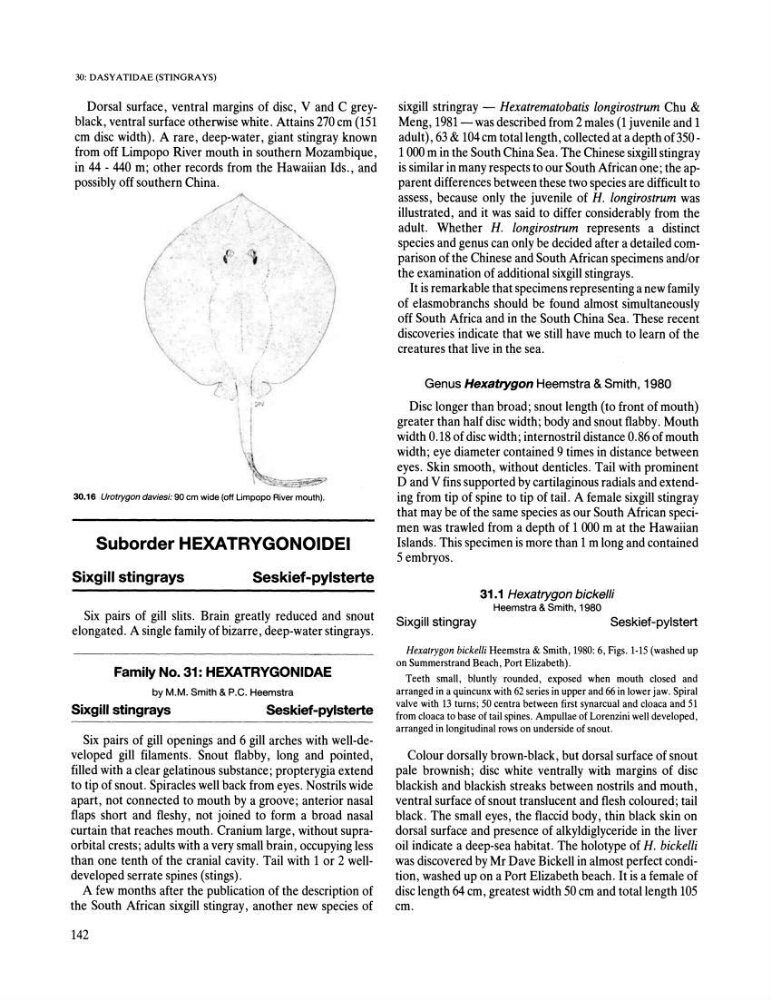
Dorsal surface, ventral margins of disc, V and C greyblack, ventral surface otherwise white. Attains 270 cm (151
cm disc width). A rare, deep-water, giant stingray known
from off Limpopo River mouth in southern Mozambique,
in 44 - 440 m; other records from the Hawaiian Ids., and
possibly off southern China.
~//~.
.
'~.'.~
,,) ·1
30.16 Urotrygon daviesi: 90 em wide (off Limpopo River mouth).
Suborder HEXATRYGONOIDEI
Sixgill stingrays
Seskief-pylsterte
Six pairs of gill slits. Brain greatly reduced and snout
elongated. A single family of bizarre, deep-water stingrays.
Family No. 31: HEXA TRYGONIDAE
by M.M. Smith & P.C. Heemstra
Sixgill stingrays
Seskief-pylsterte
Six pairs of gill openings and 6 gill arches with well-developed gill filaments. Snout flabby, long and pointed,
filled with a clear gelatinous substance; propterygia extend
to tip of snout. Spiracles well back from eyes. Nostrils wide
apart, not connected to mouth by a groove; anterior nasal
flaps short and fleshy, not joined to form a broad nasal
curtain that reaches mouth. Cranium large, without supraorbital crests; adults with a very small brain, occupying less
than one tenth of the cranial cavity. Tail with 1 or 2 welldeveloped serrate spines (stings).
A few months after the publication of the description of
the South African six gill stingray, another new species of
142
sixgill stringray - Hexatrematobatis longirostrum Chu &
Meng, 1981- was described from 2 males (1 juvenile and 1
adult), 63 & 104 cm total length, collected at a depth of3501000 m in the South China Sea. The Chinese sixgill stingray
is similar in many respects to our South African one; the apparent differences between these two species are difficult to
assess, because only the juvenile of H. longirostrum was
illustrated, and it was said to differ considerably from the
adult. Whether H. longirostrum represents a distinct
species and genus can only be decided after a detailed comparison of the Chinese and South African specimens and/or
the examination of additional sixgill stingrays.
I t is remarkable that specimens representing a new family
of elasmobranchs should be found almost simultaneously
off South Africa and in the South China Sea. These recent
discoveries indicate that we still have much to learn of the
creatures that live in the sea.
Genus Hexatrygon Heemstra & Smith, 1980
Disc longer than broad; snout length (to front of mouth)
greater than half disc width; body and snout flabby. Mouth
width 0.18 of disc width; internostril distance 0.86 of mouth
width; eye diameter contained 9 times in distance between
eyes. Skin smooth, without denticles. Tail with prominent
D and V fins supported by cartilaginous radials and extending from tip of spine to tip of tail. A female sixgill stingray
that may be of the same species as our South African specimen was trawled from a depth of 1 000 m at the Hawaiian
Islands. This specimen is more than 1 m long and contained
5 embryos.
31.1 Hexatrygon bickelli
Heemstra & Smith, 1980
Sixgill stingray
Seskief-pylstert
Hexatrygon bickelli Heemstra & Smith, 1980: 6, Figs. 1-15 (washed up
on Summerstrand Beach, Port Elizabeth) ,
Teeth small, bluntly rounded, exposed when mouth closed and
arranged in a quincunx with 62 series in upper and 66 in lower jaw. Spiral
valve with 13 turns; 50 centra between first synarcual and cloaca and 51
from cloaca to base of tail spines. Ampullae of Lorenzini well developed,
arranged in longitudinal rows on underside of snout.
Colour dorsally brown-black, but dorsal surface of snout
pale brownish; disc white ventrally with margins of disc
blackish and blackish streaks between nostrils and mouth,
ventral surface of snout translucent and flesh coloured; tail
black . The small eyes, the flaccid body, thin black skin on
dorsal surface and presence of alkyldiglyceride in the liver
oil indicate a deep-sea habitat. The holotype of H. bickelli
was discovered by Mr Dave Bickell in almost perfect condition, washed up on a Port Elizabeth beach. It is a female of
disc length 64 cm, greatest width 50 cm and total length 105
cm.
Dorsal surface, ventral margins of disc, V and C greyblack, ventral surface otherwise white. Attains 270 cm (151
cm disc width). A rare, deep-water, giant stingray known
from off Limpopo River mouth in southern Mozambique,
in 44 - 440 m; other records from the Hawaiian Ids., and
possibly off southern China.
~//~.
.
'~.'.~
,,) ·1
30.16 Urotrygon daviesi: 90 em wide (off Limpopo River mouth).
Suborder HEXATRYGONOIDEI
Sixgill stingrays
Seskief-pylsterte
Six pairs of gill slits. Brain greatly reduced and snout
elongated. A single family of bizarre, deep-water stingrays.
Family No. 31: HEXA TRYGONIDAE
by M.M. Smith & P.C. Heemstra
Sixgill stingrays
Seskief-pylsterte
Six pairs of gill openings and 6 gill arches with well-developed gill filaments. Snout flabby, long and pointed,
filled with a clear gelatinous substance; propterygia extend
to tip of snout. Spiracles well back from eyes. Nostrils wide
apart, not connected to mouth by a groove; anterior nasal
flaps short and fleshy, not joined to form a broad nasal
curtain that reaches mouth. Cranium large, without supraorbital crests; adults with a very small brain, occupying less
than one tenth of the cranial cavity. Tail with 1 or 2 welldeveloped serrate spines (stings).
A few months after the publication of the description of
the South African six gill stingray, another new species of
142
sixgill stringray - Hexatrematobatis longirostrum Chu &
Meng, 1981- was described from 2 males (1 juvenile and 1
adult), 63 & 104 cm total length, collected at a depth of3501000 m in the South China Sea. The Chinese sixgill stingray
is similar in many respects to our South African one; the apparent differences between these two species are difficult to
assess, because only the juvenile of H. longirostrum was
illustrated, and it was said to differ considerably from the
adult. Whether H. longirostrum represents a distinct
species and genus can only be decided after a detailed comparison of the Chinese and South African specimens and/or
the examination of additional sixgill stingrays.
I t is remarkable that specimens representing a new family
of elasmobranchs should be found almost simultaneously
off South Africa and in the South China Sea. These recent
discoveries indicate that we still have much to learn of the
creatures that live in the sea.
Genus Hexatrygon Heemstra & Smith, 1980
Disc longer than broad; snout length (to front of mouth)
greater than half disc width; body and snout flabby. Mouth
width 0.18 of disc width; internostril distance 0.86 of mouth
width; eye diameter contained 9 times in distance between
eyes. Skin smooth, without denticles. Tail with prominent
D and V fins supported by cartilaginous radials and extending from tip of spine to tip of tail. A female sixgill stingray
that may be of the same species as our South African specimen was trawled from a depth of 1 000 m at the Hawaiian
Islands. This specimen is more than 1 m long and contained
5 embryos.
31.1 Hexatrygon bickelli
Heemstra & Smith, 1980
Sixgill stingray
Seskief-pylstert
Hexatrygon bickelli Heemstra & Smith, 1980: 6, Figs. 1-15 (washed up
on Summerstrand Beach, Port Elizabeth) ,
Teeth small, bluntly rounded, exposed when mouth closed and
arranged in a quincunx with 62 series in upper and 66 in lower jaw. Spiral
valve with 13 turns; 50 centra between first synarcual and cloaca and 51
from cloaca to base of tail spines. Ampullae of Lorenzini well developed,
arranged in longitudinal rows on underside of snout.
Colour dorsally brown-black, but dorsal surface of snout
pale brownish; disc white ventrally with margins of disc
blackish and blackish streaks between nostrils and mouth,
ventral surface of snout translucent and flesh coloured; tail
black . The small eyes, the flaccid body, thin black skin on
dorsal surface and presence of alkyldiglyceride in the liver
oil indicate a deep-sea habitat. The holotype of H. bickelli
was discovered by Mr Dave Bickell in almost perfect condition, washed up on a Port Elizabeth beach. It is a female of
disc length 64 cm, greatest width 50 cm and total length 105
cm.