

30: DASY ATIDAE (STINGRAYS)
should be promptly removed from wounds and the wound
should be immediately bathed or immersed in hot (55°C)
water. These fishes should be handled with great care;
some, such as Hypolophus sephen, can drive their sting into
a limb touching virtually any part of its disc. Live-bearing
(ovoviviparous). The family Dasyatidae is here used in a
broad sense to include the subfamilies Gymnurinae and
Urolophinae. Nine or 10 genera and about 89 species; 7
genera and 16 species in our area.
KEY TO GENERA
la Disc about twice as wide as long; tail half disc length
or less ...... ........................ ................................... . Gymnura
Ib Disc width 0.9-1.3 times disc length; tail 0.9-3 times
disc length' ..................... , . .. . . .. .. . .. . . . . . .. . . . . . . . .. .. . . . .. . . . . . .. . . . . . 2
2a C consists of broad dorsal and ventral cutaneous
folds meeting at tail tip; distance from snout tip to
orbits about twice distance between spiracles ... ........... . Urotrygon
2b No C, though ventral cutaneous fold may reach tail
tip; distance from snout tip to orbits much less than
distance between spiracles .................... .. ................ .. ........... 3
3a No finfolds on tail; tail base narrow and not depressed .............. 4
3b A ventral finfold on tail, and sometimes a dorsal
fold; tail base broad and somewhat depressed .. .......... .............. 5
4a No sting; snout rounded; disc circular or oval and
covered with large flattened denticles interspersed
with scattered large, sharp, thorn-like denticles
(thorns in young) ................................................. Urogymnus
4b Sting present; snout angular'; disc rhomboidal,
more or less covered by small flattened denticles, but
without scattered large thorns (midline of disc with
enlarged denticles in some species) ..... .. .... ........ ........ Himantura
5a Ventral finfold reaching tail tip; disc circular or oval ....... Taeniura
5b Ventral finfold falling well short oftail tip; disc rhomboidal ........ 6
6a Ventral finfold high and prominent, its height 2-3
times tail height over fold; teeth with high hexagonal
crowns ... ...................... ....... ................ .............. Hypolophus
6b Ventral finfold height less than tail height above it;
teeth with low suboval or rhomboidal crowns ... .............. Dasyatis
'Characters applying only to southern African species.
Genus Dasyatis Rafinesque, 1810
A large, circumtropical genus with at least 31 species; 5 of
which occur in southern African waters.
KEY TO SPECIES
la Disc (of adults) scattered with prominent, sharp
stellate denticles; tail covered with sharp, thorn-like
denticles; no D fold on tail .. ...... ..... ..... .................. ... D. thetidis
Ib Disc and tail relatively smooth, without enlarged
stellate denticles ............................................................... 2
2a Anterior contour of disc broadly arched; disc
uniformly violet-purple above and below ...... .. .......... . D. violacea
2b Anterior contour of disc angular; colour mainly brown
above, light below...... ............................................... ...... .. 3
136
3a Disc drab brown above, without blue markings;
sting ending close to tail tip; tail subequal to disc
length ......................................................... D. brevicaudata
3b Disc golden brown with bright blue markings;
sting ending well short of tail tip ....... ..................... .. ............. 4
4a Snout acutely pointed and moderately long,
preorbital snout length greater than interspiracular
width; blue markings on disc forming a reticulated
network; tail not banded ....................................... D. pastinaca
4b Snout blunt and short, preorbital snout length less
than interspiracular width; disc with scattered blue
spots; tail behind sting with black and white bands .......... D. kuhlii
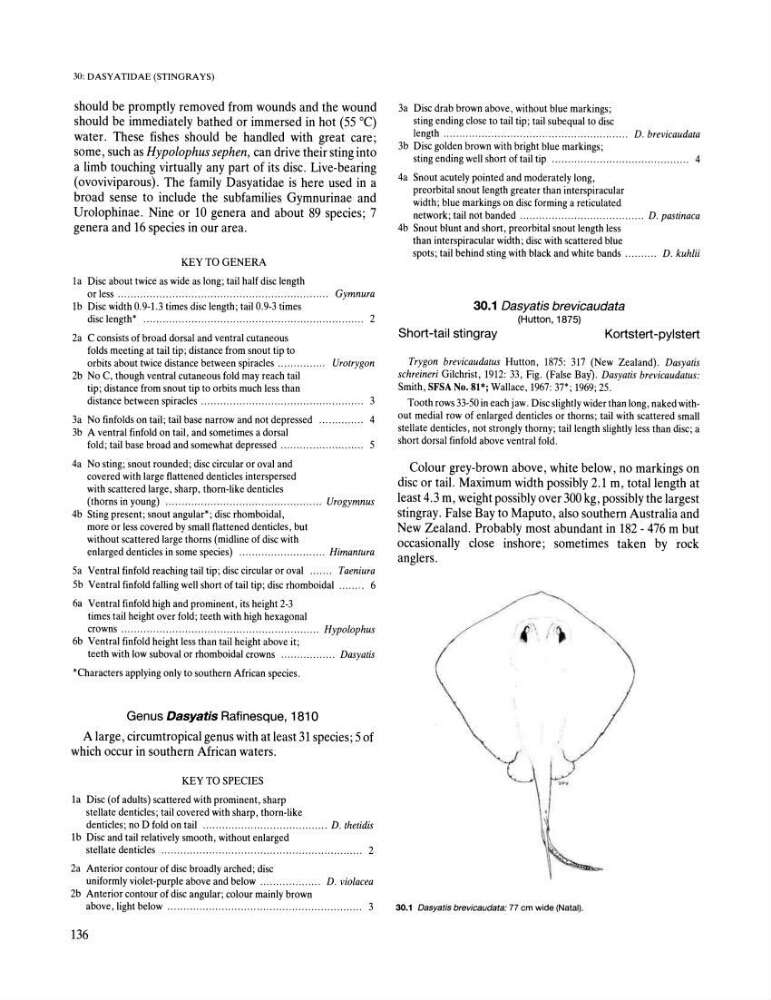
30.1 Oasyatis brevicaudata
(Hutton, 1875)
Short-tail stingray
Kortstert -pylstert
Trygon brevicaudatus Hutton, 1875: 317 (New Zealand). Dasyatis
schreineri Gilchrist, 1912: 33, Fig. (False Bay). Dasyatis brevicaudatus:
Smith , SFSA No. 81*; Wallace, 1967: 37'; 1969; 25.
Tooth rows 33-50 in each jaw. Disc slightly wider than long, naked without medial row of enlarged denticles or thorns; tail with scattered small
stellate denticles, not strongly thorny; tail length slightly less than disc; a
short dorsal finfold above ventral fold.
Colour grey-brown above, white below, no markings on
disc or tail. Maximum width possibly 2.1 m, total length at
least 4.3 m, weight possibly over 300 kg, possibly the largest
stingray. False Bay to Maputo, also southern Australia and
New Zealand. Probably most abundant in 182 - 476 m but
occasionally close inshore; sometimes taken by rock
anglers.
30.1 Dasyatis brevicaudata: 77 cm wide (Natal).
should be promptly removed from wounds and the wound
should be immediately bathed or immersed in hot (55°C)
water. These fishes should be handled with great care;
some, such as Hypolophus sephen, can drive their sting into
a limb touching virtually any part of its disc. Live-bearing
(ovoviviparous). The family Dasyatidae is here used in a
broad sense to include the subfamilies Gymnurinae and
Urolophinae. Nine or 10 genera and about 89 species; 7
genera and 16 species in our area.
KEY TO GENERA
la Disc about twice as wide as long; tail half disc length
or less ...... ........................ ................................... . Gymnura
Ib Disc width 0.9-1.3 times disc length; tail 0.9-3 times
disc length' ..................... , . .. . . .. .. . .. . . . . . .. . . . . . . . .. .. . . . .. . . . . . .. . . . . . 2
2a C consists of broad dorsal and ventral cutaneous
folds meeting at tail tip; distance from snout tip to
orbits about twice distance between spiracles ... ........... . Urotrygon
2b No C, though ventral cutaneous fold may reach tail
tip; distance from snout tip to orbits much less than
distance between spiracles .................... .. ................ .. ........... 3
3a No finfolds on tail; tail base narrow and not depressed .............. 4
3b A ventral finfold on tail, and sometimes a dorsal
fold; tail base broad and somewhat depressed .. .......... .............. 5
4a No sting; snout rounded; disc circular or oval and
covered with large flattened denticles interspersed
with scattered large, sharp, thorn-like denticles
(thorns in young) ................................................. Urogymnus
4b Sting present; snout angular'; disc rhomboidal,
more or less covered by small flattened denticles, but
without scattered large thorns (midline of disc with
enlarged denticles in some species) ..... .. .... ........ ........ Himantura
5a Ventral finfold reaching tail tip; disc circular or oval ....... Taeniura
5b Ventral finfold falling well short oftail tip; disc rhomboidal ........ 6
6a Ventral finfold high and prominent, its height 2-3
times tail height over fold; teeth with high hexagonal
crowns ... ...................... ....... ................ .............. Hypolophus
6b Ventral finfold height less than tail height above it;
teeth with low suboval or rhomboidal crowns ... .............. Dasyatis
'Characters applying only to southern African species.
Genus Dasyatis Rafinesque, 1810
A large, circumtropical genus with at least 31 species; 5 of
which occur in southern African waters.
KEY TO SPECIES
la Disc (of adults) scattered with prominent, sharp
stellate denticles; tail covered with sharp, thorn-like
denticles; no D fold on tail .. ...... ..... ..... .................. ... D. thetidis
Ib Disc and tail relatively smooth, without enlarged
stellate denticles ............................................................... 2
2a Anterior contour of disc broadly arched; disc
uniformly violet-purple above and below ...... .. .......... . D. violacea
2b Anterior contour of disc angular; colour mainly brown
above, light below...... ............................................... ...... .. 3
136
3a Disc drab brown above, without blue markings;
sting ending close to tail tip; tail subequal to disc
length ......................................................... D. brevicaudata
3b Disc golden brown with bright blue markings;
sting ending well short of tail tip ....... ..................... .. ............. 4
4a Snout acutely pointed and moderately long,
preorbital snout length greater than interspiracular
width; blue markings on disc forming a reticulated
network; tail not banded ....................................... D. pastinaca
4b Snout blunt and short, preorbital snout length less
than interspiracular width; disc with scattered blue
spots; tail behind sting with black and white bands .......... D. kuhlii
30.1 Oasyatis brevicaudata
(Hutton, 1875)
Short-tail stingray
Kortstert -pylstert
Trygon brevicaudatus Hutton, 1875: 317 (New Zealand). Dasyatis
schreineri Gilchrist, 1912: 33, Fig. (False Bay). Dasyatis brevicaudatus:
Smith , SFSA No. 81*; Wallace, 1967: 37'; 1969; 25.
Tooth rows 33-50 in each jaw. Disc slightly wider than long, naked without medial row of enlarged denticles or thorns; tail with scattered small
stellate denticles, not strongly thorny; tail length slightly less than disc; a
short dorsal finfold above ventral fold.
Colour grey-brown above, white below, no markings on
disc or tail. Maximum width possibly 2.1 m, total length at
least 4.3 m, weight possibly over 300 kg, possibly the largest
stingray. False Bay to Maputo, also southern Australia and
New Zealand. Probably most abundant in 182 - 476 m but
occasionally close inshore; sometimes taken by rock
anglers.
30.1 Dasyatis brevicaudata: 77 cm wide (Natal).