

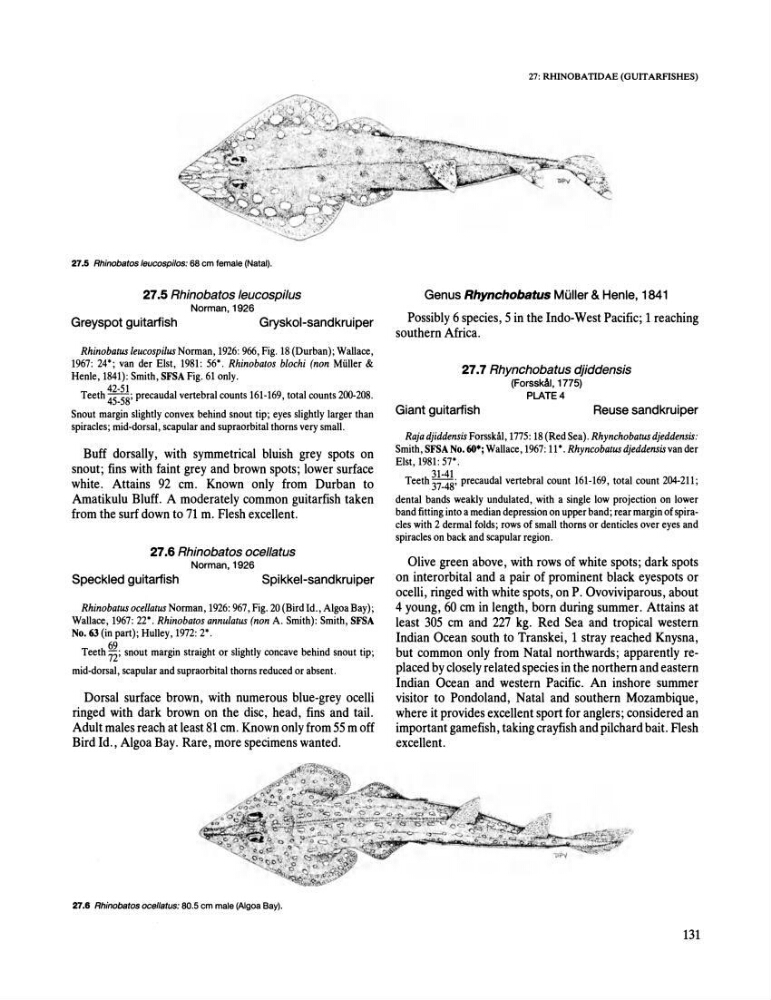
27.5 Rhinobatos leucospilos: 68 em female (Natal).
27.5 Rhinobatos leucospilus
Norman, 1926
Greyspot guitarfish
Gryskol-sandkruiper
Rhinobatus leucospilus Norman,1926: 966, Fig. 18 (Durban); Wallace,
1967: 24*; van der Elst, 1981: 56*. Rhinobatos blochi (non Muller &
Henle, 1841): Smith, SFSA Fig. 61 only.
42-51
Teeth 45-58; precaudal vertebral counts 161-169, total counts 200-208.
Snout margin slightly convex behind snout tip; eyes slightly larger than
spiracles; mid-dorsal, scapular and supraorbital thorns very small.
Buff dorsally, with symmetrical bluish grey spots on
snout; fins with faint grey and brown spots; lower surface
white. Attains 92 cm. Known only from Durban to
Amatikulu Bluff. A moderately common guitarfish taken
from the surf down to 71 m. Flesh excellent.
27.6 Rhinobatos ocel/atus
Norman, 1926
Speckled guitarfish
Spikkel-sandkruiper
Rhinobatus ocellatus Norman, 1926: 967, Fig. 20 (Bird Id., Algoa Bay);
Wallace, 1967: 22*. Rhinobatos annulatus (non A. Smith): Smith, SFSA
No. 63 (in part); Hulley, 1972: 2*.
Teeth~; snout margin straight or slightly concave behind snout tip;
mid-dorsal, scapular and supraorbital thorns reduced or absent.
Dorsal surface brown, with numerous blue-grey ocelli
ringed with dark brown on the disc, head, fins and tail.
Adult males reach at least 81 cm. Known only from 55 m off
Bird Id., Algoa Bay. Rare, more specimens wanted.
27.6 Rhinobatos ocellatus: 80.5 em male (Algoa Bay).
27: RHINOBATIDAE (GUITARFISHES)
Genus Rhynchobatus Muller & Henle, 1841
Possibly 6 species, 5 in the Indo-West Pacific; 1 reaching
southern Africa.
27.7 Rhynchobatus djiddensis
(ForsskAI, 1775)
PLATE 4
Giant guitarfish
Reuse sandkruiper
Raja djiddensis Forsskfll, 1775: 18 (Red Sea). Rhynchobatus djeddensis:
Smith, SFSA No. 60*; Wallace, 1967: 11*. Rhyncobatus djeddensis van der
Elst, 1981: 57*.
31-41
Teeth 37-48; precaudal vertebral count 161-169, total count 204-211;
dental bands weakly undulated, with a single low projection on lower
band fitting into a median depression on upper band; rear margin of spiracles with 2 dermal folds; rows of small thorns or denticles over eyes and
spiracles on back and scapular region.
Olive green above, with rows of white spots; dark spots
on interorbital and a pair of prominent black eyespots or
ocelli, ringed with white spots, on P. Ovoviviparous, about
4 young, 60 cm in length, born during summer. Attains at
least 305 cm and 227 kg. Red Sea and tropical western
Indian Ocean south to Transkei, 1 stray reached Knysna,
but common only from Natal northwards; apparently replaced by closely related species in the northern and eastern
Indian Ocean and western Pacific. An inshore summer
visitor to Pondoland, Natal and southern Mozambique,
where it provides excellent sport for anglers; considered an
important gamefish, taking crayfish and pilchard bait. Flesh
excellent.
131
27.5 Rhinobatos leucospilus
Norman, 1926
Greyspot guitarfish
Gryskol-sandkruiper
Rhinobatus leucospilus Norman,1926: 966, Fig. 18 (Durban); Wallace,
1967: 24*; van der Elst, 1981: 56*. Rhinobatos blochi (non Muller &
Henle, 1841): Smith, SFSA Fig. 61 only.
42-51
Teeth 45-58; precaudal vertebral counts 161-169, total counts 200-208.
Snout margin slightly convex behind snout tip; eyes slightly larger than
spiracles; mid-dorsal, scapular and supraorbital thorns very small.
Buff dorsally, with symmetrical bluish grey spots on
snout; fins with faint grey and brown spots; lower surface
white. Attains 92 cm. Known only from Durban to
Amatikulu Bluff. A moderately common guitarfish taken
from the surf down to 71 m. Flesh excellent.
27.6 Rhinobatos ocel/atus
Norman, 1926
Speckled guitarfish
Spikkel-sandkruiper
Rhinobatus ocellatus Norman, 1926: 967, Fig. 20 (Bird Id., Algoa Bay);
Wallace, 1967: 22*. Rhinobatos annulatus (non A. Smith): Smith, SFSA
No. 63 (in part); Hulley, 1972: 2*.
Teeth~; snout margin straight or slightly concave behind snout tip;
mid-dorsal, scapular and supraorbital thorns reduced or absent.
Dorsal surface brown, with numerous blue-grey ocelli
ringed with dark brown on the disc, head, fins and tail.
Adult males reach at least 81 cm. Known only from 55 m off
Bird Id., Algoa Bay. Rare, more specimens wanted.
27.6 Rhinobatos ocellatus: 80.5 em male (Algoa Bay).
27: RHINOBATIDAE (GUITARFISHES)
Genus Rhynchobatus Muller & Henle, 1841
Possibly 6 species, 5 in the Indo-West Pacific; 1 reaching
southern Africa.
27.7 Rhynchobatus djiddensis
(ForsskAI, 1775)
PLATE 4
Giant guitarfish
Reuse sandkruiper
Raja djiddensis Forsskfll, 1775: 18 (Red Sea). Rhynchobatus djeddensis:
Smith, SFSA No. 60*; Wallace, 1967: 11*. Rhyncobatus djeddensis van der
Elst, 1981: 57*.
31-41
Teeth 37-48; precaudal vertebral count 161-169, total count 204-211;
dental bands weakly undulated, with a single low projection on lower
band fitting into a median depression on upper band; rear margin of spiracles with 2 dermal folds; rows of small thorns or denticles over eyes and
spiracles on back and scapular region.
Olive green above, with rows of white spots; dark spots
on interorbital and a pair of prominent black eyespots or
ocelli, ringed with white spots, on P. Ovoviviparous, about
4 young, 60 cm in length, born during summer. Attains at
least 305 cm and 227 kg. Red Sea and tropical western
Indian Ocean south to Transkei, 1 stray reached Knysna,
but common only from Natal northwards; apparently replaced by closely related species in the northern and eastern
Indian Ocean and western Pacific. An inshore summer
visitor to Pondoland, Natal and southern Mozambique,
where it provides excellent sport for anglers; considered an
important gamefish, taking crayfish and pilchard bait. Flesh
excellent.
131