

25: RAJIDAE (SKATES)
25.7 Raja caudaspinosa
Von Bonde & Swart, 1923
Raja caudaspinosa Von Bonde & Swart, 1923: 8, PI. 21, Fig. 1 (?Natal).
Raia albalinea Von Bonde & Swart, 1923: 6, PI. 20, Fig. 1 (32°3.00'S,
W2.00'E). Raja caudaspinosa: Rulley, 1970: 170'. Raja (Rajella) caudaspinosa: Rulley, 1972: 77*.
Disc 1.2-1.4 times as broad as long; maximum angle in front of spiracles
about 125°-130°; distance from middle of vent to 1st D origin 1.1-1.3 times
distance from tip of snout to middle of vent; D (fins) continuous. Snout
length 2.0-2.6 times interorbital distance. 32-36 rows of teeth in upper
jaw. 66-73 predorsal caudal vertebrae. 5-9 thorns around inner orbital
margin, 0-1 interorbital, 1-2 interspiracular and 3-4 scapular thorns on
each side; 4-5 median nuchal thorns, with 3-5 thorns in a group posteriorly; 22-23 mid-dorsal thorns from nuchal region to 1st D origin, decreasing in size posteriorly and flanked on each side by 1 row of thorns on
back and 2 rows of thorns on tail; large, stellate-based thorns in 4-6 irregular rows along front margins on each side; spines and spinules along front
margins of disc and on tail; ventral surfaces of disc and tail smooth.
Dorsally dusky grey to brown, with or without scattered
darker spots, and juveniles with white-barred pattern on
disc; ventrally pale. Attains about 58 cm TL, 32 cm DW.
Only off west coast between Liideritz and Cape Point in
310 - 520 m.
r
"
.:: ""'.
'. /
: ;"
'f
.
i
....
I
" '.;:'//
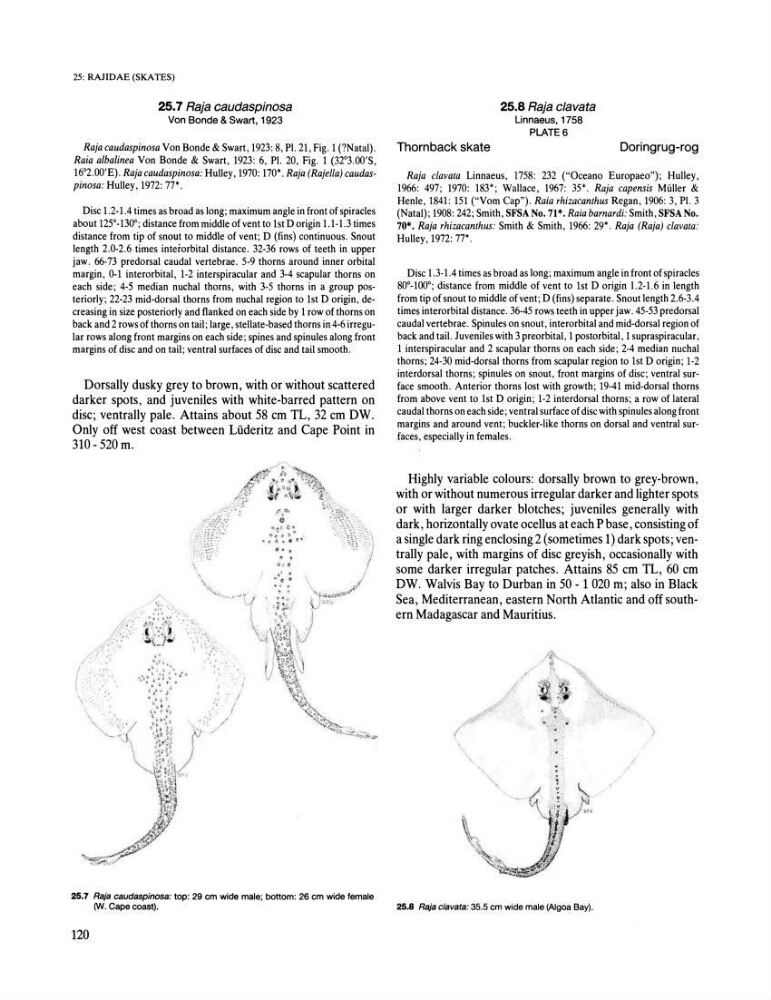
25.7 Raja caudaspinosa: top: 29 em wide male; bottom: 26 em wide female
I)N. Cape coast).
120
Thornback skate
25.8 Raja clavata
Linnaeus, 1758
PLATE 6
Doringrug-rog
Raja clavata Linnaeus, 1758: 232 ("Oceano Europaeo"); Rulley,
1966: 497; 1970: 183*; Wallace, 1967: 35*. Raja capensis Miiller &
Renle, 1841: 151 ("Vom Cap"). Raia rhizacanthus Regan, 1906: 3, PI. 3
(Natal); 1908: 242; Smith, SFSA No. 71*. Raia barnardi: Smith, SFSA No.
70*. Raja rhizacanthus: Smith & Smith, 1966: 29*. Raja (Raja) clavata:
Rulley, 1972: 77*.
Disc 1.3-1.4 times as broad as long; maximum angle in front of spiracles
80°·100°; distance from middle of vent to 1st D origin 1.2·1.6 in length
from tip of snout to middle of vent; D (fins) separate. Snout length 2.6·3.4
times interorbital distance. 36-45 rows teeth in upper jaw. 45-53 predorsal
caudal vertebrae. Spinules on snout, interorbital and mid-dorsal region of
back and tail. Juveniles with 3 preorbital, 1 postorbital, 1 supraspiracular,
1 interspiracular and 2 scapular thorns on each side; 2-4 median nuchal
thorns; 24·30 mid-dorsal thorns from scapular region to 1st D origin; 1-2
interdorsal thorns; spinules on snout, front margins of disc; ventral surface smooth. Anterior thorns lost with growth; 19-41 mid-dorsal thorns
from above vent to 1st D origin; 1-2 interdorsal thorns; a row of lateral
caudal thorns on each side; ventral surface of disc with spinules along front
margins and around vent; buckler-like thorns on dorsal and ventral surfaces, especially in females.
Highly variable colours: dorsally brown to grey-brown,
with or without numerous irregular darker and lighter spots
or with larger darker blotches; juveniles generally with
dark, horizontally ovate ocellus at each P base, consisting of
a single dark ring enclosing 2 (sometimes 1) dark spots; ventrally pale, with margins of disc greyish, occasionally with
some darker irregular patches. Attains 85 cm TL, 60 cm
DW. Walvis Bay to Durban in 50 - 1020 m; also in Black
Sea, Mediterranean, eastern North Atlantic and off southern Madagascar and Mauritius.
.:' !' ,.,.,
,
/
25.8 Raja clavata: 35.5 em wide male (Algoa Say).
25.7 Raja caudaspinosa
Von Bonde & Swart, 1923
Raja caudaspinosa Von Bonde & Swart, 1923: 8, PI. 21, Fig. 1 (?Natal).
Raia albalinea Von Bonde & Swart, 1923: 6, PI. 20, Fig. 1 (32°3.00'S,
W2.00'E). Raja caudaspinosa: Rulley, 1970: 170'. Raja (Rajella) caudaspinosa: Rulley, 1972: 77*.
Disc 1.2-1.4 times as broad as long; maximum angle in front of spiracles
about 125°-130°; distance from middle of vent to 1st D origin 1.1-1.3 times
distance from tip of snout to middle of vent; D (fins) continuous. Snout
length 2.0-2.6 times interorbital distance. 32-36 rows of teeth in upper
jaw. 66-73 predorsal caudal vertebrae. 5-9 thorns around inner orbital
margin, 0-1 interorbital, 1-2 interspiracular and 3-4 scapular thorns on
each side; 4-5 median nuchal thorns, with 3-5 thorns in a group posteriorly; 22-23 mid-dorsal thorns from nuchal region to 1st D origin, decreasing in size posteriorly and flanked on each side by 1 row of thorns on
back and 2 rows of thorns on tail; large, stellate-based thorns in 4-6 irregular rows along front margins on each side; spines and spinules along front
margins of disc and on tail; ventral surfaces of disc and tail smooth.
Dorsally dusky grey to brown, with or without scattered
darker spots, and juveniles with white-barred pattern on
disc; ventrally pale. Attains about 58 cm TL, 32 cm DW.
Only off west coast between Liideritz and Cape Point in
310 - 520 m.
r
"
.:: ""'.
'. /
: ;"
'f
.
i
....
I
" '.;:'//
25.7 Raja caudaspinosa: top: 29 em wide male; bottom: 26 em wide female
I)N. Cape coast).
120
Thornback skate
25.8 Raja clavata
Linnaeus, 1758
PLATE 6
Doringrug-rog
Raja clavata Linnaeus, 1758: 232 ("Oceano Europaeo"); Rulley,
1966: 497; 1970: 183*; Wallace, 1967: 35*. Raja capensis Miiller &
Renle, 1841: 151 ("Vom Cap"). Raia rhizacanthus Regan, 1906: 3, PI. 3
(Natal); 1908: 242; Smith, SFSA No. 71*. Raia barnardi: Smith, SFSA No.
70*. Raja rhizacanthus: Smith & Smith, 1966: 29*. Raja (Raja) clavata:
Rulley, 1972: 77*.
Disc 1.3-1.4 times as broad as long; maximum angle in front of spiracles
80°·100°; distance from middle of vent to 1st D origin 1.2·1.6 in length
from tip of snout to middle of vent; D (fins) separate. Snout length 2.6·3.4
times interorbital distance. 36-45 rows teeth in upper jaw. 45-53 predorsal
caudal vertebrae. Spinules on snout, interorbital and mid-dorsal region of
back and tail. Juveniles with 3 preorbital, 1 postorbital, 1 supraspiracular,
1 interspiracular and 2 scapular thorns on each side; 2-4 median nuchal
thorns; 24·30 mid-dorsal thorns from scapular region to 1st D origin; 1-2
interdorsal thorns; spinules on snout, front margins of disc; ventral surface smooth. Anterior thorns lost with growth; 19-41 mid-dorsal thorns
from above vent to 1st D origin; 1-2 interdorsal thorns; a row of lateral
caudal thorns on each side; ventral surface of disc with spinules along front
margins and around vent; buckler-like thorns on dorsal and ventral surfaces, especially in females.
Highly variable colours: dorsally brown to grey-brown,
with or without numerous irregular darker and lighter spots
or with larger darker blotches; juveniles generally with
dark, horizontally ovate ocellus at each P base, consisting of
a single dark ring enclosing 2 (sometimes 1) dark spots; ventrally pale, with margins of disc greyish, occasionally with
some darker irregular patches. Attains 85 cm TL, 60 cm
DW. Walvis Bay to Durban in 50 - 1020 m; also in Black
Sea, Mediterranean, eastern North Atlantic and off southern Madagascar and Mauritius.
.:' !' ,.,.,
,
/
25.8 Raja clavata: 35.5 em wide male (Algoa Say).