

25: RAJlDAE (SKATES)
25.5 Neoraja (Neoraja) stehmanni
(Hulley, 1972)
Raja plutonia (non Garman): Barnard, 1925: 68. Raja spinacidermis
(non Barnard): Norman, 1935: 46 (part). ?Raja spinacidermis: Hulley,
1970: 173* (in part, juvenile male only). Breviraja stehmanni Hulley,
1972: 254, Figs. 1-5 (off Cape Town). Neoraja stehmanni: McEachran &
Compagno, 1982: 423.
Disc 1.2-1.4 times as broad as long; maximum angle in front of spiracles
115°-130°. D (fins) continuous. Snout rounded and barely produced; its
length 2.9-3 .8 times interorbital distance. 38-44 rows of teeth in upper
jaw. 65-74 predorsal caudal vertebrae. Entire upper surface of disc and
tail with small asperities, except tip of snout, narrow front margin of P and
anterior lobe of V; adult males with naked area at P base; ventral surface
smooth. 1-6 preorbital , 1-4 postorbital/supraspiracular, 1 interspiracular
(some juveniles) and 1 scapular thorns on each side; 1-4 median nuchal
thorns; 11-38 mid-dorsal thorns, usually interrupted between P and V
girdles, extending posteriorly for V:! to 1/3 length of tail, showing alternate
development with age; tail posterior to V axil, with additional rows of
thorns or large prickles.
Dorsally greyish, tail with 6-7 irregular, dark crossbars,
either continuous or interrupted; ventrally pale, tip of snout
with black spot and darker areas along front and rear margins of disc and rear margins of V; dusky irregular areas
between nostrils, around mouth, between gill slits and on
belly; tail with dark crossbars encroaching from sides oftail,
but mature specimens with darker mottling. Attains 35 cm
TL, 20 cm OW. Only south of Agulhas Bank to west of
Cape Town, in 292 - 1 025 m.
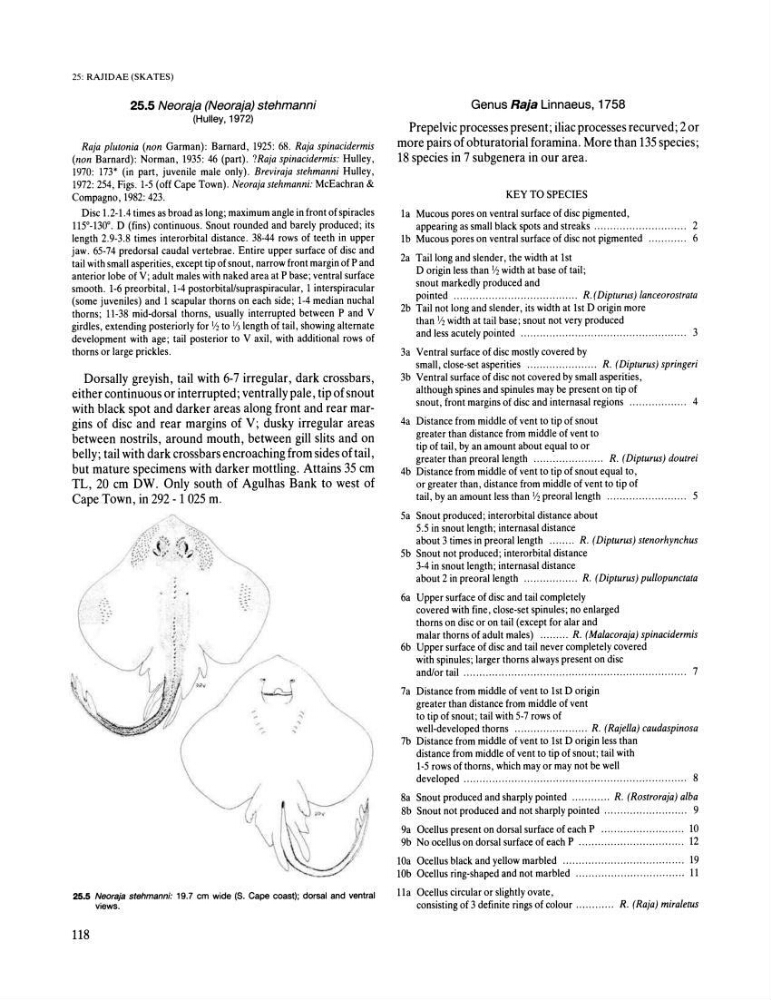
25.5 Neoraja stehmanni: 19.7 cm wide (S. Cape coast); dorsal and ventral
views.
118
Genus Raja Linnaeus, 1758
Prepelvic processes present; iliac processes recurved; 2 or
more pairs of obturatorial foramina. More than 135 species;
18 species in 7 subgenera in our area.
KEY TO SPECIES
la Mucous pores on ventral surface of disc pigmented,
appearing as small black spots and streaks ........................ .. ... 2
1 b Mucous pores on ventral surface of disc not pigmented
6
2a Tail long and slender, the width at 1st
D origin less than V2 width at base of tail;
snout markedly produced and
pointed ..... " .. .... ........ ...... ............ R. (Dipturus) lanceorostrata
2b Tail not long and slender, its width at lst D origin more
than 1/2 width at tail base; snout not very produced
and less acutely pointed .. .... .............. .... ....... ..... .. .............. 3
3a Ventral surface of disc mostly covered by
small, close-set asperities .......... ............ R. (Dipturus) springeri
3b Ventral surface of disc not covered by small asperities,
although spines and spinules may be present on tip of
snout, front margins of disc and internasal regions .................. 4
4a Distance from middle of vent to tip of snout
greater than distance from middle of vent to
tip of tail, by an amount about equal to or
greater than preoral length ...... : ............... R. (Dipturus) doutrei
4b Distance from middle of vent to tip of snout equal to,
or greater than, distance from middle of vent to tip of
tail, by an amount less than 1/2 preoral length ........ .. ............... 5
5a Snout produced; interorbital distance about
5.5 in snout length; internasal distance
about 3 times in preoral length ........ R. (Dipturus) stenorhynchus
5b Snout not produced; interorbital distance
3-4 in snout length; internasal distance
about 2 in preoral length ................. R. (Dipturus) pul/opunctata
6a Upper surface of disc and tail completely
covered with fine, close-set spinules; no enlarged
thorns on disc or on tail (except for alar and
malar thorns of adult males) .... .. ... R. (Malacoraja) spinacidermis
6b Upper surface of disc and tail never completely covered
with spinules; larger thorns always present on disc
and/or tail .............. ..... ................ .... ..... ...... ............ ........ 7
7a Distance from middle of vent to 1st D origin
greater than distance from middle of vent
to tip of snout; tail with 5-7 rows of
well-developed thorns ....................... R. (Rajel/a) caudaspinosa
7b Distance from middle of vent to 1st D origin less than
distance from middle of vent to tip of snout; tail with
1-5 rows of thorns, which mayor may not be well
developed ..................................................................... . 8
8a Snout produced and sharply pointed ............ R. (Rostroraja) alba
8b Snout not produced and not sharply pointed .......... .. .............. 9
9a Ocellus present on dorsal surface of each P .... .. .. .................. 10
9b No ocellus on dorsal surface of each P ................................. 12
lOa Ocellus black and yellow marbled ................ ........ .... .... ...... 19
lOb Ocellus ring-shaped and not marbled .... ........ .... .......... ...... .. 11
lla Ocellus circular or slightly ovate,
consisting of 3 definite rings of colour ...... " .... R. (Raja) miraletus
25.5 Neoraja (Neoraja) stehmanni
(Hulley, 1972)
Raja plutonia (non Garman): Barnard, 1925: 68. Raja spinacidermis
(non Barnard): Norman, 1935: 46 (part). ?Raja spinacidermis: Hulley,
1970: 173* (in part, juvenile male only). Breviraja stehmanni Hulley,
1972: 254, Figs. 1-5 (off Cape Town). Neoraja stehmanni: McEachran &
Compagno, 1982: 423.
Disc 1.2-1.4 times as broad as long; maximum angle in front of spiracles
115°-130°. D (fins) continuous. Snout rounded and barely produced; its
length 2.9-3 .8 times interorbital distance. 38-44 rows of teeth in upper
jaw. 65-74 predorsal caudal vertebrae. Entire upper surface of disc and
tail with small asperities, except tip of snout, narrow front margin of P and
anterior lobe of V; adult males with naked area at P base; ventral surface
smooth. 1-6 preorbital , 1-4 postorbital/supraspiracular, 1 interspiracular
(some juveniles) and 1 scapular thorns on each side; 1-4 median nuchal
thorns; 11-38 mid-dorsal thorns, usually interrupted between P and V
girdles, extending posteriorly for V:! to 1/3 length of tail, showing alternate
development with age; tail posterior to V axil, with additional rows of
thorns or large prickles.
Dorsally greyish, tail with 6-7 irregular, dark crossbars,
either continuous or interrupted; ventrally pale, tip of snout
with black spot and darker areas along front and rear margins of disc and rear margins of V; dusky irregular areas
between nostrils, around mouth, between gill slits and on
belly; tail with dark crossbars encroaching from sides oftail,
but mature specimens with darker mottling. Attains 35 cm
TL, 20 cm OW. Only south of Agulhas Bank to west of
Cape Town, in 292 - 1 025 m.
25.5 Neoraja stehmanni: 19.7 cm wide (S. Cape coast); dorsal and ventral
views.
118
Genus Raja Linnaeus, 1758
Prepelvic processes present; iliac processes recurved; 2 or
more pairs of obturatorial foramina. More than 135 species;
18 species in 7 subgenera in our area.
KEY TO SPECIES
la Mucous pores on ventral surface of disc pigmented,
appearing as small black spots and streaks ........................ .. ... 2
1 b Mucous pores on ventral surface of disc not pigmented
6
2a Tail long and slender, the width at 1st
D origin less than V2 width at base of tail;
snout markedly produced and
pointed ..... " .. .... ........ ...... ............ R. (Dipturus) lanceorostrata
2b Tail not long and slender, its width at lst D origin more
than 1/2 width at tail base; snout not very produced
and less acutely pointed .. .... .............. .... ....... ..... .. .............. 3
3a Ventral surface of disc mostly covered by
small, close-set asperities .......... ............ R. (Dipturus) springeri
3b Ventral surface of disc not covered by small asperities,
although spines and spinules may be present on tip of
snout, front margins of disc and internasal regions .................. 4
4a Distance from middle of vent to tip of snout
greater than distance from middle of vent to
tip of tail, by an amount about equal to or
greater than preoral length ...... : ............... R. (Dipturus) doutrei
4b Distance from middle of vent to tip of snout equal to,
or greater than, distance from middle of vent to tip of
tail, by an amount less than 1/2 preoral length ........ .. ............... 5
5a Snout produced; interorbital distance about
5.5 in snout length; internasal distance
about 3 times in preoral length ........ R. (Dipturus) stenorhynchus
5b Snout not produced; interorbital distance
3-4 in snout length; internasal distance
about 2 in preoral length ................. R. (Dipturus) pul/opunctata
6a Upper surface of disc and tail completely
covered with fine, close-set spinules; no enlarged
thorns on disc or on tail (except for alar and
malar thorns of adult males) .... .. ... R. (Malacoraja) spinacidermis
6b Upper surface of disc and tail never completely covered
with spinules; larger thorns always present on disc
and/or tail .............. ..... ................ .... ..... ...... ............ ........ 7
7a Distance from middle of vent to 1st D origin
greater than distance from middle of vent
to tip of snout; tail with 5-7 rows of
well-developed thorns ....................... R. (Rajel/a) caudaspinosa
7b Distance from middle of vent to 1st D origin less than
distance from middle of vent to tip of snout; tail with
1-5 rows of thorns, which mayor may not be well
developed ..................................................................... . 8
8a Snout produced and sharply pointed ............ R. (Rostroraja) alba
8b Snout not produced and not sharply pointed .......... .. .............. 9
9a Ocellus present on dorsal surface of each P .... .. .. .................. 10
9b No ocellus on dorsal surface of each P ................................. 12
lOa Ocellus black and yellow marbled ................ ........ .... .... ...... 19
lOb Ocellus ring-shaped and not marbled .... ........ .... .......... ...... .. 11
lla Ocellus circular or slightly ovate,
consisting of 3 definite rings of colour ...... " .... R. (Raja) miraletus