

25: RAJIDAE (SKATES)
About 38 species; 1 in our area. Ishiyama (1958) recognises 3 subgenera, Bathyraja, Arctoraja, Notoraja, for
Japanese species.
25.1 Bathyraja smithii
(Mulier & Henle, 1841)
Raja smithii Muller & Henle, 1841 : 150, PI. 49, Fig. 1. (South Africa) .
Raia smithi: Smith, SFSA No. 68 (part). Breviraja smithii Hulley, 1970:
213*; 1972: 2*.
Disc 1.2-1.3 times as broad as long; maximum angle in front of spiracles
about 90°-100°; D (fins) separate . Snout obtuse, its length 2.0-2.6 times
interorbital distance. 24-28 rows of teeth in upper jaw. 68-71 predorsal
caudal vertebrae. Juveniles with 1 preorbital, 1-2 postorbital and 3-4
scapular thorns; 2 median nuchal thorns; about 30 mid-dorsal thorns from
nuchal region to 1st D origin; 1 interdorsal thorn ; entire upper surface of
disc and tail with widely spaced spinules; ventral surface smooth. Adults
with ocular, nuchal and scapular thorns absent; 14-19 mid-dorsal thorns
from above vent to 1st D origin; 0-1 interdorsal thorns; dorsal surface of
disc and tail spinulose, but no enlarged lateral rows of thorns on tail ;
ventral surface smooth.
Dorsally more or less uniform greyish, sometimes with
white spots; ventrally white, with black blotches between
gill slits and around vent; front margins of disc narrowly and
rear margins of disc and V broadly black; ventral surface of
tail smoky black. Attains 114 cm TL, 85 cm OW. Agulhas
Bank and west of Cape Town, in 650 - 1 020 m. Bathyraja
eatoni Gunther, 1879, known from Kerguelen Id ., may be
synonymous.
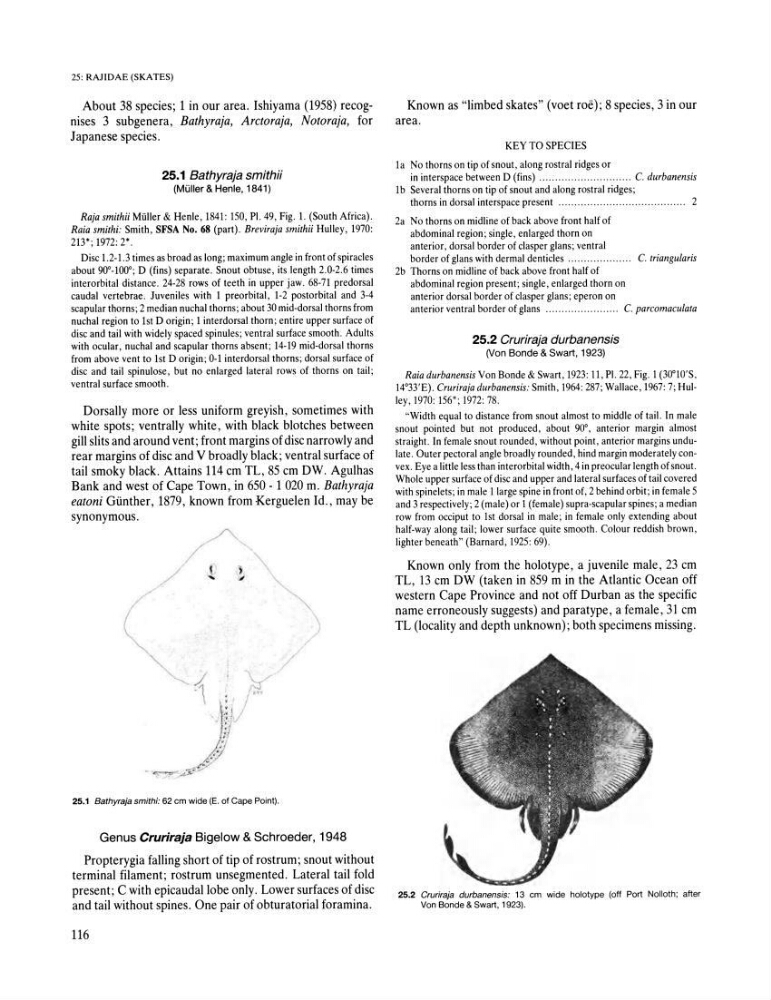
25.1 Bathyraja smithi: 62 em wide (E. of Cape Point).
Genus Cruriraja Bigelow & Schroeder, 1948
Propterygia falling short of tip of rostrum; snout without
terminal filament; rostrum unsegmented. Lateral tail fold
present; C with epicaudallobe only. Lower surfaces of disc
and tail without spines. One pair of obturatorial foramina.
116
Known as "limbed skates" (voet roe); 8 species, 3 in our
area.
KEY TO SPECIES
la No thorns on tip of snout, along rostral ridges or
in interspace between D (fins) .... .... ........ .. .. .. ...... . C. durbanensis
Ib Several thorns on tip of snout and along rostral ridges;
thorns in dorsal interspace present ......................... ......... ...... 2
2a No thorns on midline of back above front half of
abdominal region; single, enlarged thorn on
anterior, dorsal border of clasper glans ; ventral
border of glans with dermal denticles ...... .............. C. triangularis
2b Thorns on midline of back above front half of
abdominal region present; single, enlarged thorn on
anterior dorsal border of clasper glans; eperon on
anterior ventral border of glans .. ..... ........ ..... ... C. parcomaculata
25.2 Cruriraja durbanensis
(Von Bonde & Swart, 1923)
Raia durbanensis Von Bonde & Swart , 1923: 11 , PI. 22, Fig. 1 (3001O'S,
14°33'E). Cruriraja durbanensis: Smith, 1964: 287 ; Wallace , 1967: 7; Hulley, 1970: 156*; 1972: 78.
"Width equal to distance from snout almost to middle of tail. In male
snout pointed but not produced, about 90°, anterior margin almost
straight. In female snout rounded, without point, anterior margins undulate. Outer pectoral angle broadly rounded, hind margin moderately convex. Eye a little less than interorbital width, 4 in preocular length of snout.
Whole upper surface of disc and upper and lateral surfaces of tail covered
with spinelets; in male 1 large spine in front of, 2 behind orbit; in female 5
and 3 respectively; 2 (male) or 1 (female) supra-scapular spines; a median
row from occiput to 1st dorsal in male; in femal e only extending about
half-way along tail ; lower surface quite smooth. Colour reddish brown,
lighter beneath" (Barnard , 1925: 69) .
Known only from the holotype, a juvenile male, 23 cm
TL, 13 cm OW (taken in 859 m in the Atlantic Ocean off
western Cape Province and not off Durban as the specific
name erroneously suggests) and paratype, a female, 31 cm
TL (locality and depth unknown); both specimens missing.
25.2 Cruriraja durbanensis: 13 em wide holotype (off Port Nolloth; after
Von Bonde & Swart, 1923).
About 38 species; 1 in our area. Ishiyama (1958) recognises 3 subgenera, Bathyraja, Arctoraja, Notoraja, for
Japanese species.
25.1 Bathyraja smithii
(Mulier & Henle, 1841)
Raja smithii Muller & Henle, 1841 : 150, PI. 49, Fig. 1. (South Africa) .
Raia smithi: Smith, SFSA No. 68 (part). Breviraja smithii Hulley, 1970:
213*; 1972: 2*.
Disc 1.2-1.3 times as broad as long; maximum angle in front of spiracles
about 90°-100°; D (fins) separate . Snout obtuse, its length 2.0-2.6 times
interorbital distance. 24-28 rows of teeth in upper jaw. 68-71 predorsal
caudal vertebrae. Juveniles with 1 preorbital, 1-2 postorbital and 3-4
scapular thorns; 2 median nuchal thorns; about 30 mid-dorsal thorns from
nuchal region to 1st D origin; 1 interdorsal thorn ; entire upper surface of
disc and tail with widely spaced spinules; ventral surface smooth. Adults
with ocular, nuchal and scapular thorns absent; 14-19 mid-dorsal thorns
from above vent to 1st D origin; 0-1 interdorsal thorns; dorsal surface of
disc and tail spinulose, but no enlarged lateral rows of thorns on tail ;
ventral surface smooth.
Dorsally more or less uniform greyish, sometimes with
white spots; ventrally white, with black blotches between
gill slits and around vent; front margins of disc narrowly and
rear margins of disc and V broadly black; ventral surface of
tail smoky black. Attains 114 cm TL, 85 cm OW. Agulhas
Bank and west of Cape Town, in 650 - 1 020 m. Bathyraja
eatoni Gunther, 1879, known from Kerguelen Id ., may be
synonymous.
25.1 Bathyraja smithi: 62 em wide (E. of Cape Point).
Genus Cruriraja Bigelow & Schroeder, 1948
Propterygia falling short of tip of rostrum; snout without
terminal filament; rostrum unsegmented. Lateral tail fold
present; C with epicaudallobe only. Lower surfaces of disc
and tail without spines. One pair of obturatorial foramina.
116
Known as "limbed skates" (voet roe); 8 species, 3 in our
area.
KEY TO SPECIES
la No thorns on tip of snout, along rostral ridges or
in interspace between D (fins) .... .... ........ .. .. .. ...... . C. durbanensis
Ib Several thorns on tip of snout and along rostral ridges;
thorns in dorsal interspace present ......................... ......... ...... 2
2a No thorns on midline of back above front half of
abdominal region; single, enlarged thorn on
anterior, dorsal border of clasper glans ; ventral
border of glans with dermal denticles ...... .............. C. triangularis
2b Thorns on midline of back above front half of
abdominal region present; single, enlarged thorn on
anterior dorsal border of clasper glans; eperon on
anterior ventral border of glans .. ..... ........ ..... ... C. parcomaculata
25.2 Cruriraja durbanensis
(Von Bonde & Swart, 1923)
Raia durbanensis Von Bonde & Swart , 1923: 11 , PI. 22, Fig. 1 (3001O'S,
14°33'E). Cruriraja durbanensis: Smith, 1964: 287 ; Wallace , 1967: 7; Hulley, 1970: 156*; 1972: 78.
"Width equal to distance from snout almost to middle of tail. In male
snout pointed but not produced, about 90°, anterior margin almost
straight. In female snout rounded, without point, anterior margins undulate. Outer pectoral angle broadly rounded, hind margin moderately convex. Eye a little less than interorbital width, 4 in preocular length of snout.
Whole upper surface of disc and upper and lateral surfaces of tail covered
with spinelets; in male 1 large spine in front of, 2 behind orbit; in female 5
and 3 respectively; 2 (male) or 1 (female) supra-scapular spines; a median
row from occiput to 1st dorsal in male; in femal e only extending about
half-way along tail ; lower surface quite smooth. Colour reddish brown,
lighter beneath" (Barnard , 1925: 69) .
Known only from the holotype, a juvenile male, 23 cm
TL, 13 cm OW (taken in 859 m in the Atlantic Ocean off
western Cape Province and not off Durban as the specific
name erroneously suggests) and paratype, a female, 31 cm
TL (locality and depth unknown); both specimens missing.
25.2 Cruriraja durbanensis: 13 em wide holotype (off Port Nolloth; after
Von Bonde & Swart, 1923).