

Order PRISTIFORMES
Sawfishes
Shark-like batoids with saw-like elongated snouts with a
row of strong large lateral teeth on each side. Sawsharks,
Family No. 20, differ from sawfish in having their pectoral
fins not expanded forwards onto sides of head, gill slits on
sides of head, smaller teeth on sides of snout, and barbels on
underside of snout in front of nostrils. Two dorsal fins: first
originating over or in front of pelvic fin bases; pectoral fins
small; tail thick and long; caudal fin large and functional in
swimming. Ovoviviparous. Adults large, 3 to 7+ m. A
single family of small circum tropical batoids, some entering
freshwater.
Sawfishes
Family No. 22: PRISTIDAE
by L.J.V. Compagno
Saagvisse
Body elongate and shark-like, flattened anteriorly; tail
stout. Snout elongated into a flat, rostral saw, with 16 to 35
large teeth embedded in sockets on either side, but without
ventral barbels. Gill openings on underside of pectoral fins.
Numerous small, blunt teeth in jaws. Two large dorsal fins,
first with origin over or in front of pelvic fins.
Large, bottom dwelling fishes, present in all warm continental seas and often entering estuaries and ascending
rivers. Adults of some species attain over 6 m. Sawfishes use
the rostral saw to kill small fishes with sideways slashes, and
can be dangerous to people when cornered or restrained.
Live-bearing (ovoviviparous), with young born at 40-70 cm,
the "saw" covered to prevent damage to the mother. Excellent eating but little utilised in southern Africa. Two genera, Anoxypristis and Pristis, and 6 or 7 species; 3 species of
the genus Pristis Linck, 1790 occur in our area.
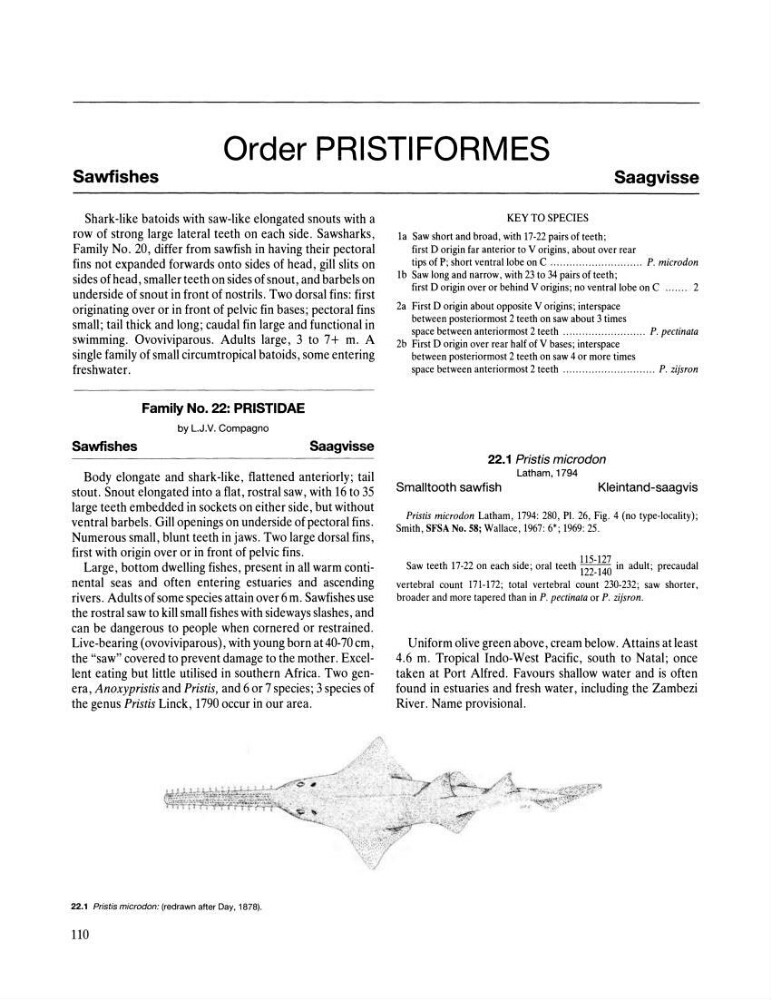
22.1 Pristis microdon: (redrawn after Day, 1878).
110
Saagvisse
KEY TO SPECIES
1a Saw short and broad, with 17-22 pairs of teeth;
first D origin far anterior to V origins, about over rear
tips of P; short ventral lobe on C ............................. P. microdon
1b Saw long and narrow, with 23 to 34 pairs of teeth;
first D origin over or behind V origins; no ventral lobe on C ....... 2
2a First D origin about opposite V origins; interspace
between posteriormost 2 teeth on saw about 3 times
space between anteriormost 2 teeth .......................... P. pectinata
2b First D origin over rear half of V bases; interspace
between posteriormost 2 teeth on saw 4 or more times
space between anteriormost 2 teeth ............................. P. zijsron
22.1 Pristis microdon
Latham, 1794
Smalltooth sawfish
Kleintand-saagvis
Pristis microdon Latham, 1794: 280, PI. 26, Fig. 4 (no type-locality);
Smith, SFSA No. 58; Wallace, 1967: 6*; 1969: 25.
Saw teeth 17-22 on each side; oral teeth g~: ~~~ in adult; precaudal
vertebral count 171-172; total vertebral count 230-232; saw shorter,
broader and more tapered than in P. pectinata or P. zijsron.
Uniform olive green above, cream below. Attains at least
4.6 m. Tropical Indo-West Pacific, south to Natal; once
taken at Port Alfred. Favours shallow water and is often
found in estuaries and fresh water, including the Zambezi
River. Name provisional.
Sawfishes
Shark-like batoids with saw-like elongated snouts with a
row of strong large lateral teeth on each side. Sawsharks,
Family No. 20, differ from sawfish in having their pectoral
fins not expanded forwards onto sides of head, gill slits on
sides of head, smaller teeth on sides of snout, and barbels on
underside of snout in front of nostrils. Two dorsal fins: first
originating over or in front of pelvic fin bases; pectoral fins
small; tail thick and long; caudal fin large and functional in
swimming. Ovoviviparous. Adults large, 3 to 7+ m. A
single family of small circum tropical batoids, some entering
freshwater.
Sawfishes
Family No. 22: PRISTIDAE
by L.J.V. Compagno
Saagvisse
Body elongate and shark-like, flattened anteriorly; tail
stout. Snout elongated into a flat, rostral saw, with 16 to 35
large teeth embedded in sockets on either side, but without
ventral barbels. Gill openings on underside of pectoral fins.
Numerous small, blunt teeth in jaws. Two large dorsal fins,
first with origin over or in front of pelvic fins.
Large, bottom dwelling fishes, present in all warm continental seas and often entering estuaries and ascending
rivers. Adults of some species attain over 6 m. Sawfishes use
the rostral saw to kill small fishes with sideways slashes, and
can be dangerous to people when cornered or restrained.
Live-bearing (ovoviviparous), with young born at 40-70 cm,
the "saw" covered to prevent damage to the mother. Excellent eating but little utilised in southern Africa. Two genera, Anoxypristis and Pristis, and 6 or 7 species; 3 species of
the genus Pristis Linck, 1790 occur in our area.
22.1 Pristis microdon: (redrawn after Day, 1878).
110
Saagvisse
KEY TO SPECIES
1a Saw short and broad, with 17-22 pairs of teeth;
first D origin far anterior to V origins, about over rear
tips of P; short ventral lobe on C ............................. P. microdon
1b Saw long and narrow, with 23 to 34 pairs of teeth;
first D origin over or behind V origins; no ventral lobe on C ....... 2
2a First D origin about opposite V origins; interspace
between posteriormost 2 teeth on saw about 3 times
space between anteriormost 2 teeth .......................... P. pectinata
2b First D origin over rear half of V bases; interspace
between posteriormost 2 teeth on saw 4 or more times
space between anteriormost 2 teeth ............................. P. zijsron
22.1 Pristis microdon
Latham, 1794
Smalltooth sawfish
Kleintand-saagvis
Pristis microdon Latham, 1794: 280, PI. 26, Fig. 4 (no type-locality);
Smith, SFSA No. 58; Wallace, 1967: 6*; 1969: 25.
Saw teeth 17-22 on each side; oral teeth g~: ~~~ in adult; precaudal
vertebral count 171-172; total vertebral count 230-232; saw shorter,
broader and more tapered than in P. pectinata or P. zijsron.
Uniform olive green above, cream below. Attains at least
4.6 m. Tropical Indo-West Pacific, south to Natal; once
taken at Port Alfred. Favours shallow water and is often
found in estuaries and fresh water, including the Zambezi
River. Name provisional.