

Order SQUATINIFORMES
Angelsharks
Curious, greatly flattened, batoid-Iike sharks with large
pectoral fins expanded along sides of head as free triangular
lobes; lower lobe of caudal fin longer than upper; 5 pairs of
gill slits on sides of head; mouth at front of head; no anal fin;
2 spineless dorsal fins rearwards on tail. Ovoviviparous.
Adults 1.8 to 2.4 m in length. A single family of inshore to
deep-water benthic sharks found in all temperate and subtropical seas.
Family No. 21: SQUATINIDAE
by A.J. Bass
Angelsharks
Engelhaaie
Head and body greatly flattened. Pectoral fins expanded
forward to form triangular lobes extending over the ventrolateral gill slits, but not fused to sides of head as in skates
and rays. No anal fin; 2 dorsal fins without spines; lower
lobe of caudal fin larger than upper lobe. Mouth terminal.
Spiracles present. No nictitans.
1
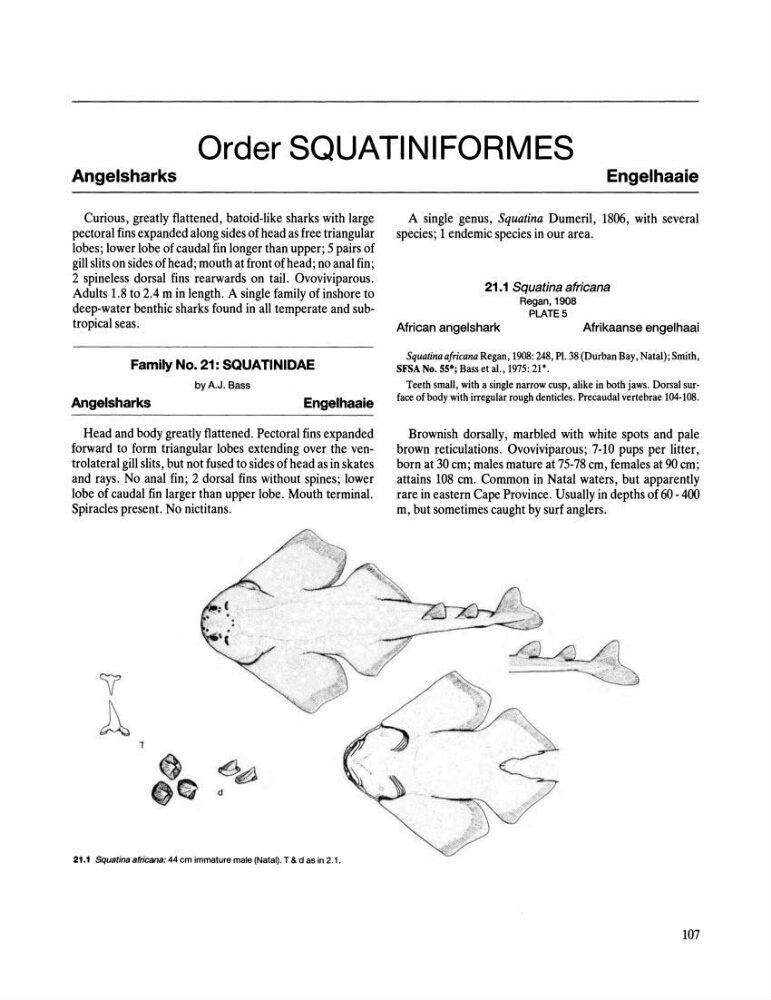
21.1 Squatinaafricana: 44 em immature male (Natal). T & d as in 2.1.
Engelhaaie
A single genus, Squatina Dumeril, 1806, with several
species; 1 endemic species in our area.
21.1 Squatina africana
Regan, 1908
PLATE 5
African angelshark
Afrikaanse engelhaai
Squatinaafricana Regan, 1908: 248, PI. 38 (Durban Bay, Natal); Smith,
SFSA No. 55*; Bass et aI., 1975: 21·.
Teeth small, with a single narrow cusp, alike in both jaws. Dorsal surface of body with irregular rough denticles. Precaudal vertebrae 104-108.
Brownish dorsally, marbled with white spots and pale
brown reticulations. Ovoviviparous; 7-10 pups per litter,
born at 30 cm; males mature at 75-78 cm, females at 90 cm;
attains 108 cm. Common in Natal waters, but apparently
rare in eastern Cape Province. Usually in depths of 60 - 400
m, but sometimes caught by surf anglers.
107
Angelsharks
Curious, greatly flattened, batoid-Iike sharks with large
pectoral fins expanded along sides of head as free triangular
lobes; lower lobe of caudal fin longer than upper; 5 pairs of
gill slits on sides of head; mouth at front of head; no anal fin;
2 spineless dorsal fins rearwards on tail. Ovoviviparous.
Adults 1.8 to 2.4 m in length. A single family of inshore to
deep-water benthic sharks found in all temperate and subtropical seas.
Family No. 21: SQUATINIDAE
by A.J. Bass
Angelsharks
Engelhaaie
Head and body greatly flattened. Pectoral fins expanded
forward to form triangular lobes extending over the ventrolateral gill slits, but not fused to sides of head as in skates
and rays. No anal fin; 2 dorsal fins without spines; lower
lobe of caudal fin larger than upper lobe. Mouth terminal.
Spiracles present. No nictitans.
1
21.1 Squatinaafricana: 44 em immature male (Natal). T & d as in 2.1.
Engelhaaie
A single genus, Squatina Dumeril, 1806, with several
species; 1 endemic species in our area.
21.1 Squatina africana
Regan, 1908
PLATE 5
African angelshark
Afrikaanse engelhaai
Squatinaafricana Regan, 1908: 248, PI. 38 (Durban Bay, Natal); Smith,
SFSA No. 55*; Bass et aI., 1975: 21·.
Teeth small, with a single narrow cusp, alike in both jaws. Dorsal surface of body with irregular rough denticles. Precaudal vertebrae 104-108.
Brownish dorsally, marbled with white spots and pale
brown reticulations. Ovoviviparous; 7-10 pups per litter,
born at 30 cm; males mature at 75-78 cm, females at 90 cm;
attains 108 cm. Common in Natal waters, but apparently
rare in eastern Cape Province. Usually in depths of 60 - 400
m, but sometimes caught by surf anglers.
107