

11: SCYLIORHINIDAE (CATSHARKS)
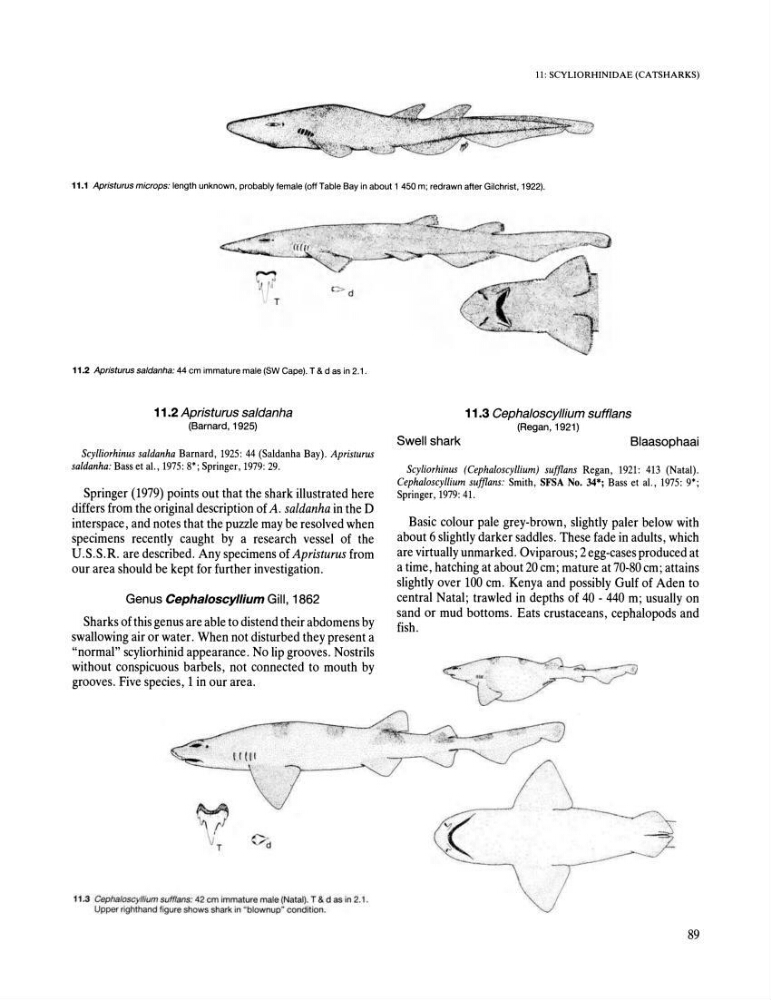
11.1 Apristurus microps: length unknown, probably female (off Table Bay in about 1 450 m; redrawn after Gilchrist. 1922).
11.2 Apristurus saldanha: 44 cm immature male (SW Cape). T & d as in 2.1.
11.2 Apristurus saldanha
(Barnard, 1925)
Scyl/iorhinus saldanha Barnard, 1925: 44 (Saldanha Bay). Apristurus
saldanha: Bass et aI., 1975: 8*; Springer, 1979: 29.
Springer (1979) points out that the shark illustrated here
differs from the original description of A. saldanha in the 0
interspace, and notes that the puzzle may be resolved when
specimens recently caught by a research vessel of the
U.S.S.R. are described. Any specimens of Apristurus from
our area should be kept for further investigation.
Genus Cepha/oscyl/ium Gill, 1862
Sharks of this genus are able to distend their abdomens by
swallowing air or water. When not disturbed they present a
"normal" scyliorhinid appearance. No lip grooves. Nostrils
without conspicuous barbels, not connected to mouth by
grooves. Five species, 1 in our area.
V T
11.3 Cephaloscyllium sufflans: 42 cm immature male (Natal). T & d as in 2.1 .
Upper rjghthand figure shows shark in "blownup" condition .
Swell shark
11.3 Cephaloscyl/ium sufflans
(Regan, 1921)
Blaasophaai
Scyliorhinus (Cephaloscyllium) sufflans Regan, 1921: 413 (Natal).
Cephaloscyllium sufflans: Smith, SFSA No. 34*; Bass et aI., 1975: 9*;
Springer, 1979: 41.
Basic colour pale grey-brown, slightly paler below with
about 6 slightly darker saddles. These fade in adults, which
are virtually unmarked. Oviparous; 2 egg-cases produced at
a time, hatching at about 20 cm; mature at 70-80 cm; attains
slightly over 100 cm. Kenya and possibly Gulf of Aden to
central Natal; trawled in depths of 40 - 440 m; usually on
sand or mud bottoms. Eats crustaceans, cephalopods and
fish.
89
11.1 Apristurus microps: length unknown, probably female (off Table Bay in about 1 450 m; redrawn after Gilchrist. 1922).
11.2 Apristurus saldanha: 44 cm immature male (SW Cape). T & d as in 2.1.
11.2 Apristurus saldanha
(Barnard, 1925)
Scyl/iorhinus saldanha Barnard, 1925: 44 (Saldanha Bay). Apristurus
saldanha: Bass et aI., 1975: 8*; Springer, 1979: 29.
Springer (1979) points out that the shark illustrated here
differs from the original description of A. saldanha in the 0
interspace, and notes that the puzzle may be resolved when
specimens recently caught by a research vessel of the
U.S.S.R. are described. Any specimens of Apristurus from
our area should be kept for further investigation.
Genus Cepha/oscyl/ium Gill, 1862
Sharks of this genus are able to distend their abdomens by
swallowing air or water. When not disturbed they present a
"normal" scyliorhinid appearance. No lip grooves. Nostrils
without conspicuous barbels, not connected to mouth by
grooves. Five species, 1 in our area.
V T
11.3 Cephaloscyllium sufflans: 42 cm immature male (Natal). T & d as in 2.1 .
Upper rjghthand figure shows shark in "blownup" condition .
Swell shark
11.3 Cephaloscyl/ium sufflans
(Regan, 1921)
Blaasophaai
Scyliorhinus (Cephaloscyllium) sufflans Regan, 1921: 413 (Natal).
Cephaloscyllium sufflans: Smith, SFSA No. 34*; Bass et aI., 1975: 9*;
Springer, 1979: 41.
Basic colour pale grey-brown, slightly paler below with
about 6 slightly darker saddles. These fade in adults, which
are virtually unmarked. Oviparous; 2 egg-cases produced at
a time, hatching at about 20 cm; mature at 70-80 cm; attains
slightly over 100 cm. Kenya and possibly Gulf of Aden to
central Natal; trawled in depths of 40 - 440 m; usually on
sand or mud bottoms. Eats crustaceans, cephalopods and
fish.
89