

2 Microscopy and Imaging Systems
57
designed to reflect light at shorter wavelengths (e.g. blue light) while they
will transmit longer wavelengths (e.g. green and red). The specimen emits
fluorescence but also reflects some of the incident light. As the intensity of
the reflected excitation light may be orders of magnitude higher than the
fluorescence signal, it must not be transmitted into the observation path of
the microscope. Most of the reflected light will not pass the dichroic mirror
but will be reflected back towards the lamp. Any residual excitation light
will be blocked by the emission filter that follows the dichroic mirror.
Fluorescence filters are always a compromise of selectivity and
throughput. Very narrow excitation and emission filters will be higWy selective but the fluorescence intensity may be too low for manual scanning
of the slides and for focussing. If the filters are too wide autofluorescence
and optical cross talk may obscure the FISH signal, particularly in the case
of multi-fluorochrome techniques. The image contrast will depend critically on the correct choice of filter sets.
Single band filter sets provide the best compromise of selectivity and
optical throughput. They may, however, introduce a registration error or
pixel shift when the subsequent capture of several dyes requires filter
block changes within the same image. Although registration errors
may be corrected automatically or interactively in the digital image,
CCD
CCD
From
Light Source
,
"
'.
: I
Exciter
'. I '
: : :: Filter Wheel
• I ' •
I I . '
I
I •
I I
I ,
"
Polychroic L.,,;+-_-+:D
Mirror
Triple Band'f;~=;;;~
Emitter
I
From
Light Source
Emitter'l;;;;;;;;;;;;;;;+u Dichroic mirror
Specimen
Specimen
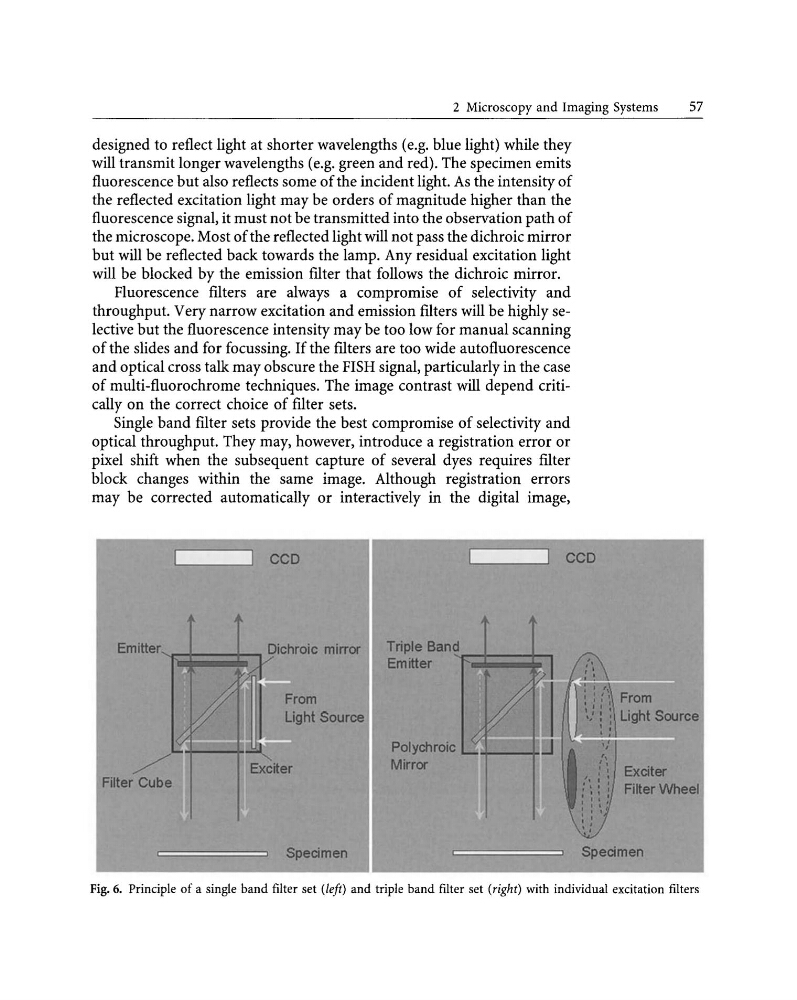
Fig. 6. Principle of a single band filter set (left) and triple band filter set (right) with individual excitation filters
57
designed to reflect light at shorter wavelengths (e.g. blue light) while they
will transmit longer wavelengths (e.g. green and red). The specimen emits
fluorescence but also reflects some of the incident light. As the intensity of
the reflected excitation light may be orders of magnitude higher than the
fluorescence signal, it must not be transmitted into the observation path of
the microscope. Most of the reflected light will not pass the dichroic mirror
but will be reflected back towards the lamp. Any residual excitation light
will be blocked by the emission filter that follows the dichroic mirror.
Fluorescence filters are always a compromise of selectivity and
throughput. Very narrow excitation and emission filters will be higWy selective but the fluorescence intensity may be too low for manual scanning
of the slides and for focussing. If the filters are too wide autofluorescence
and optical cross talk may obscure the FISH signal, particularly in the case
of multi-fluorochrome techniques. The image contrast will depend critically on the correct choice of filter sets.
Single band filter sets provide the best compromise of selectivity and
optical throughput. They may, however, introduce a registration error or
pixel shift when the subsequent capture of several dyes requires filter
block changes within the same image. Although registration errors
may be corrected automatically or interactively in the digital image,
CCD
CCD
From
Light Source
,
"
'.
: I
Exciter
'. I '
: : :: Filter Wheel
• I ' •
I I . '
I
I •
I I
I ,
"
Polychroic L.,,;+-_-+:D
Mirror
Triple Band'f;~=;;;~
Emitter
I
From
Light Source
Emitter'l;;;;;;;;;;;;;;;+u Dichroic mirror
Specimen
Specimen
Fig. 6. Principle of a single band filter set (left) and triple band filter set (right) with individual excitation filters