

52
ANDREAS PLESCH
where lambda is the wavelength, f the focal length of the lens, and D the
clear diameter (aperture) of the lens. As D/(2f) is also called the numerical
aperture (N.A.) of the lens, Eq. (1) can be written as
d = 1.22 A / N.A.
(2)
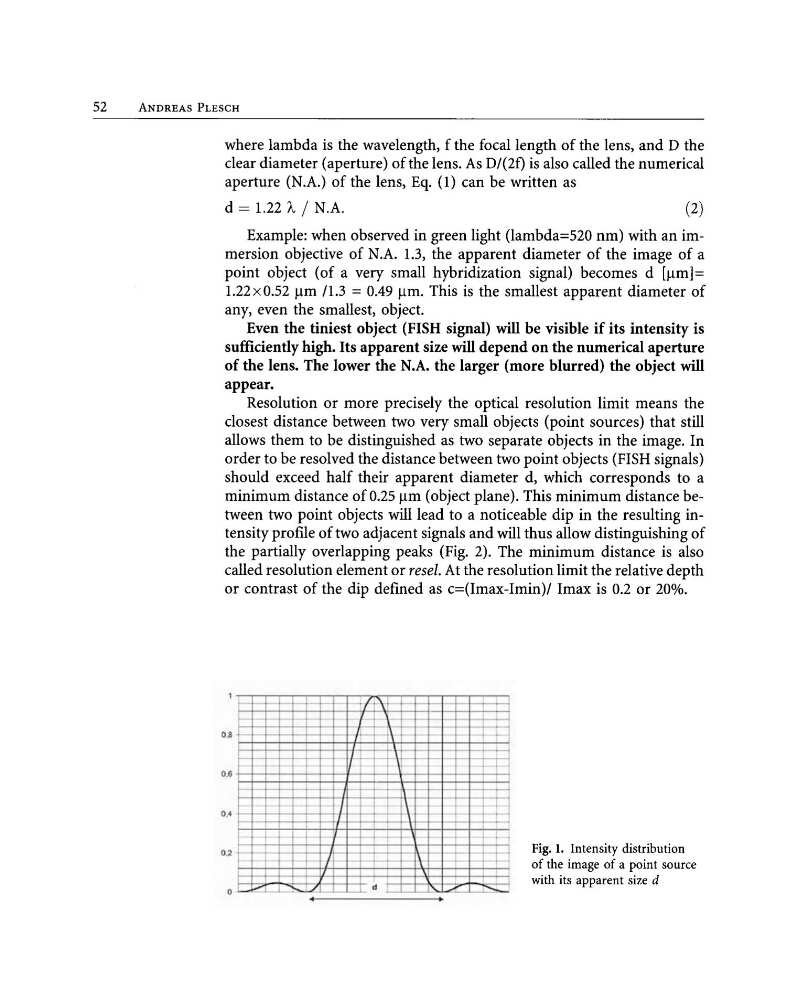
Example: when observed in green light (lambda=520 nm) with an immersion objective of N.A. 1.3, the apparent diameter of the image of a
point object (of a very small hybridization signal) becomes d [~ml=
1.22x0.52 ~m 11.3 = 0.49 ~m. This is the smallest apparent diameter of
any, even the smallest, object.
Even the tiniest object (FISH signal) will be visible if its intensity is
sufficiently high. Its apparent size will depend on the numerical aperture
of the lens. The lower the N.A. the larger (more blurred) the object will
appear.
Resolution or more precisely the optical resolution limit means the
closest distance between two very small objects (point sources) that still
allows them to be distinguished as two separate objects in the image. In
order to be resolved the distance between two point objects (FISH signals)
should exceed half their apparent diameter d, which corresponds to a
minimum distance of 0.25 ~m (object plane). This minimum distance between two point objects will lead to a noticeable dip in the resulting intensity profIle of two adjacent signals and will thus allow distinguishing of
the partially overlapping peaks (Fig. 2). The minimum distance is also
called resolution element or resel. At the resolution limit the relative depth
or contrast of the dip defined as c=(Imax-Imin)/ Imax is 0.2 or 20%.
0.8
0.6
0.'
0.2
o
./ 1\ I -
t------I
-
I-r-=
r/- r\
r~ ~
\.
. t
-lI-t- ~
I
,\
1~
j-:-- 1-\
f,
r-I /1
L . . \
'-- ........1 i _
d
~
•
•
Fig. I. Intensity distribution
of the image of a point source
with its apparent size d
ANDREAS PLESCH
where lambda is the wavelength, f the focal length of the lens, and D the
clear diameter (aperture) of the lens. As D/(2f) is also called the numerical
aperture (N.A.) of the lens, Eq. (1) can be written as
d = 1.22 A / N.A.
(2)
Example: when observed in green light (lambda=520 nm) with an immersion objective of N.A. 1.3, the apparent diameter of the image of a
point object (of a very small hybridization signal) becomes d [~ml=
1.22x0.52 ~m 11.3 = 0.49 ~m. This is the smallest apparent diameter of
any, even the smallest, object.
Even the tiniest object (FISH signal) will be visible if its intensity is
sufficiently high. Its apparent size will depend on the numerical aperture
of the lens. The lower the N.A. the larger (more blurred) the object will
appear.
Resolution or more precisely the optical resolution limit means the
closest distance between two very small objects (point sources) that still
allows them to be distinguished as two separate objects in the image. In
order to be resolved the distance between two point objects (FISH signals)
should exceed half their apparent diameter d, which corresponds to a
minimum distance of 0.25 ~m (object plane). This minimum distance between two point objects will lead to a noticeable dip in the resulting intensity profIle of two adjacent signals and will thus allow distinguishing of
the partially overlapping peaks (Fig. 2). The minimum distance is also
called resolution element or resel. At the resolution limit the relative depth
or contrast of the dip defined as c=(Imax-Imin)/ Imax is 0.2 or 20%.
0.8
0.6
0.'
0.2
o
./ 1\ I -
t------I
-
I-r-=
r/- r\
r~ ~
\.
. t
-lI-t- ~
I
,\
1~
j-:-- 1-\
f,
r-I /1
L . . \
'-- ........1 i _
d
~
•
•
Fig. I. Intensity distribution
of the image of a point source
with its apparent size d