

376
JINGLY FUNG et a1.
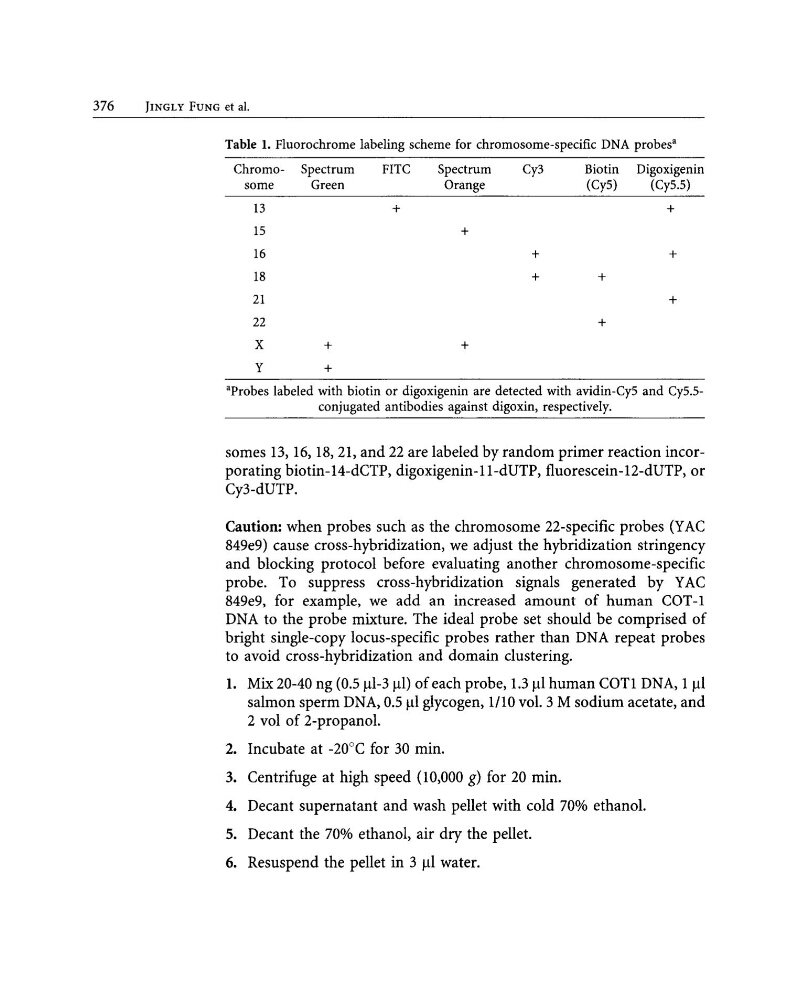
Table 1. Fluorochrome labeling scheme for chromosome-specific DNA probes'
Chromo- Spectrum
FITC
Spectrum
Cy3
Biotin Digoxigenin
some
Green
Orange
(CyS)
(CyS.5)
13
+
+
IS
+
16
+
+
18
+
+
21
+
22
+
X
+
+
y
+
'Probes labeled with biotin or digoxigenin are detected with avidin-CyS and CyS.5conjugated antibodies against digoxin, respectively.
somes 13, 16, 18,21, and 22 are labeled by random primer reaction incorporating biotin-14-dCTP, digoxigenin-ll-dUTP, tluorescein-12-dUTP, or
Cy3-dUTP.
Caution: when probes such as the chromosome 22-specific probes (YAC
84ge9) cause cross-hybridization, we adjust the hybridization stringency
and blocking protocol before evaluating another chromosome-specific
probe. To suppress cross-hybridization signals generated by YAC
84ge9, for example, we add an increased amount of human COT-l
DNA to the probe mixture. The ideal probe set should be comprised of
bright single-copy locus-specific probes rather than DNA repeat probes
to avoid cross-hybridization and domain clustering.
1. Mix 20-40 ng (0.5 J.l1-3 J.ll) of each probe, 1.3 J.lI human con DNA, 1 J.lI
salmon sperm DNA, 0.5 J.lI glycogen, 1/10 vol. 3 M sodium acetate, and
2 vol of 2-propanol.
2. Incubate at -20°C for 30 min.
3. Centrifuge at high speed (10,000 g) for 20 min.
4. Decant supernatant and wash pellet with cold 70% ethanol.
5. Decant the 70% ethanol, air dry the pellet.
6. Resuspend the pellet in 3 J.lI water.
JINGLY FUNG et a1.
Table 1. Fluorochrome labeling scheme for chromosome-specific DNA probes'
Chromo- Spectrum
FITC
Spectrum
Cy3
Biotin Digoxigenin
some
Green
Orange
(CyS)
(CyS.5)
13
+
+
IS
+
16
+
+
18
+
+
21
+
22
+
X
+
+
y
+
'Probes labeled with biotin or digoxigenin are detected with avidin-CyS and CyS.5conjugated antibodies against digoxin, respectively.
somes 13, 16, 18,21, and 22 are labeled by random primer reaction incorporating biotin-14-dCTP, digoxigenin-ll-dUTP, tluorescein-12-dUTP, or
Cy3-dUTP.
Caution: when probes such as the chromosome 22-specific probes (YAC
84ge9) cause cross-hybridization, we adjust the hybridization stringency
and blocking protocol before evaluating another chromosome-specific
probe. To suppress cross-hybridization signals generated by YAC
84ge9, for example, we add an increased amount of human COT-l
DNA to the probe mixture. The ideal probe set should be comprised of
bright single-copy locus-specific probes rather than DNA repeat probes
to avoid cross-hybridization and domain clustering.
1. Mix 20-40 ng (0.5 J.l1-3 J.ll) of each probe, 1.3 J.lI human con DNA, 1 J.lI
salmon sperm DNA, 0.5 J.lI glycogen, 1/10 vol. 3 M sodium acetate, and
2 vol of 2-propanol.
2. Incubate at -20°C for 30 min.
3. Centrifuge at high speed (10,000 g) for 20 min.
4. Decant supernatant and wash pellet with cold 70% ethanol.
5. Decant the 70% ethanol, air dry the pellet.
6. Resuspend the pellet in 3 J.lI water.