

302
MARTIN LAWRIE, MARIA OCANA GIL, and DON CARDY
any subtle deletion event within these regions of the chromosome cannot
be detected (8,9, 10). Chromosome-specific unique sequence probes are
more appropriate but are often not sufficiently telomeric to exclude a rearrangement. The complex and repeated structure of the telomeric regions
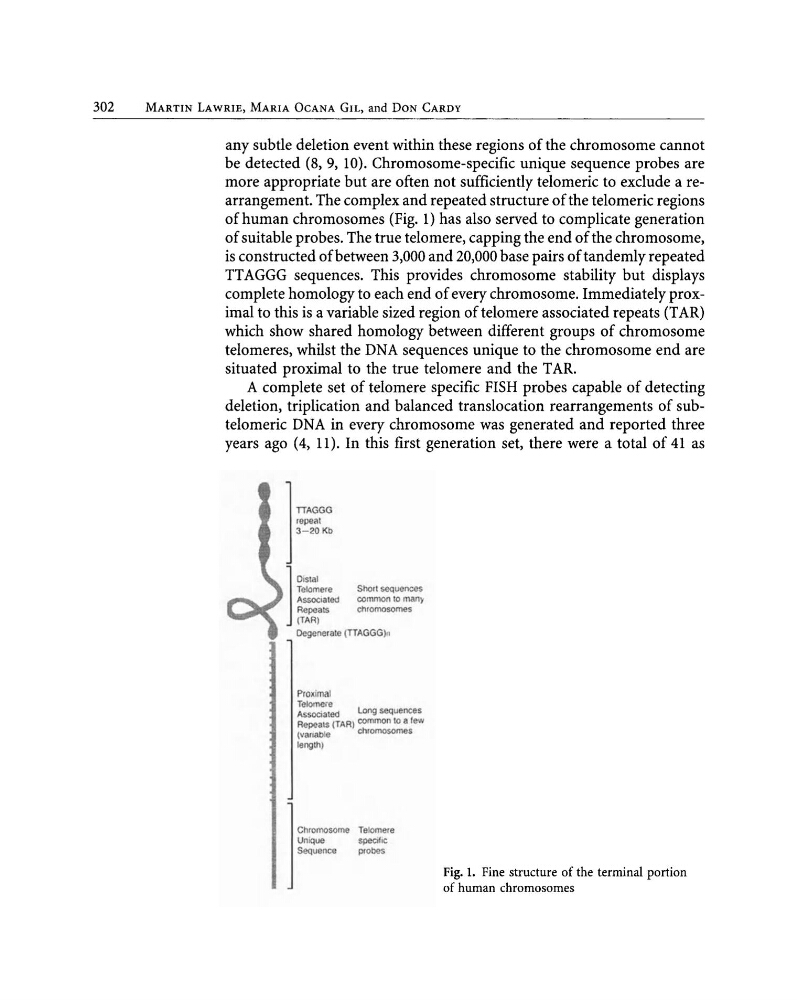
of human chromosomes (Fig. 1) has also served to complicate generation
of suitable probes. The true telomere, capping the end of the chromosome,
is constructed ofbetween 3,000 and 20,000 base pairs of tandemly repeated
TTAGGG sequences. This provides chromosome stability but displays
complete homology to each end of every chromosome. Immediately proximal to this is a variable sized region of telomere associated repeats (TAR)
which show shared homology between different groups of chromosome
telomeres, whilst the DNA sequences unique to the chromosome end are
situated proximal to the true telomere and the TAR.
A complete set of telomere specific FISH probes capable of detecting
deletion, triplication and balanced translocation rearrangements of subtelomeric DNA in every chromosome was generated and reported three
years ago (4, ll). In this first generation set, there were a total of 41 as
]~~~~,:
]
~~~~ere Shorl sequences
ASSOCIated
common 10 man~
Repeats
cnromosomes
(TAR)
Degenerate (nAGGG)"
Pro)[imai
Telomere
Associaled
Long sequences
Repeals (TAR) common 10 a lew
(va r l8ble
chromosomes
lenglh)
I
Chromosome
Unique
5eQuence
Telomere
spec,f,c
probes
Fig. 1. Fine structure of the terminal portion
of human chromosomes
MARTIN LAWRIE, MARIA OCANA GIL, and DON CARDY
any subtle deletion event within these regions of the chromosome cannot
be detected (8,9, 10). Chromosome-specific unique sequence probes are
more appropriate but are often not sufficiently telomeric to exclude a rearrangement. The complex and repeated structure of the telomeric regions
of human chromosomes (Fig. 1) has also served to complicate generation
of suitable probes. The true telomere, capping the end of the chromosome,
is constructed ofbetween 3,000 and 20,000 base pairs of tandemly repeated
TTAGGG sequences. This provides chromosome stability but displays
complete homology to each end of every chromosome. Immediately proximal to this is a variable sized region of telomere associated repeats (TAR)
which show shared homology between different groups of chromosome
telomeres, whilst the DNA sequences unique to the chromosome end are
situated proximal to the true telomere and the TAR.
A complete set of telomere specific FISH probes capable of detecting
deletion, triplication and balanced translocation rearrangements of subtelomeric DNA in every chromosome was generated and reported three
years ago (4, ll). In this first generation set, there were a total of 41 as
]~~~~,:
]
~~~~ere Shorl sequences
ASSOCIated
common 10 man~
Repeats
cnromosomes
(TAR)
Degenerate (nAGGG)"
Pro)[imai
Telomere
Associaled
Long sequences
Repeals (TAR) common 10 a lew
(va r l8ble
chromosomes
lenglh)
I
Chromosome
Unique
5eQuence
Telomere
spec,f,c
probes
Fig. 1. Fine structure of the terminal portion
of human chromosomes