

21 The Combined Use of Nuclease in Situ Digestion and FISH (NU-FISH)
273
changes when the DNA remaining on the slide after "in situ" digestion is
"in situ" hybridised with specific DNA sequences. This approach reveals
more accurately the action of the nucleases on targeted DNA sequences
and interpretations concerning the effect of nucleases on the chromatin
can be made in parallel with the chromosome assignment of the probe.
Two main types of nucleases have been extensively used to produce a
selective "in situ" DNA extraction/modification: Restriction Endonucleases (RE) and Modifying Enzymes (ME).
Outline
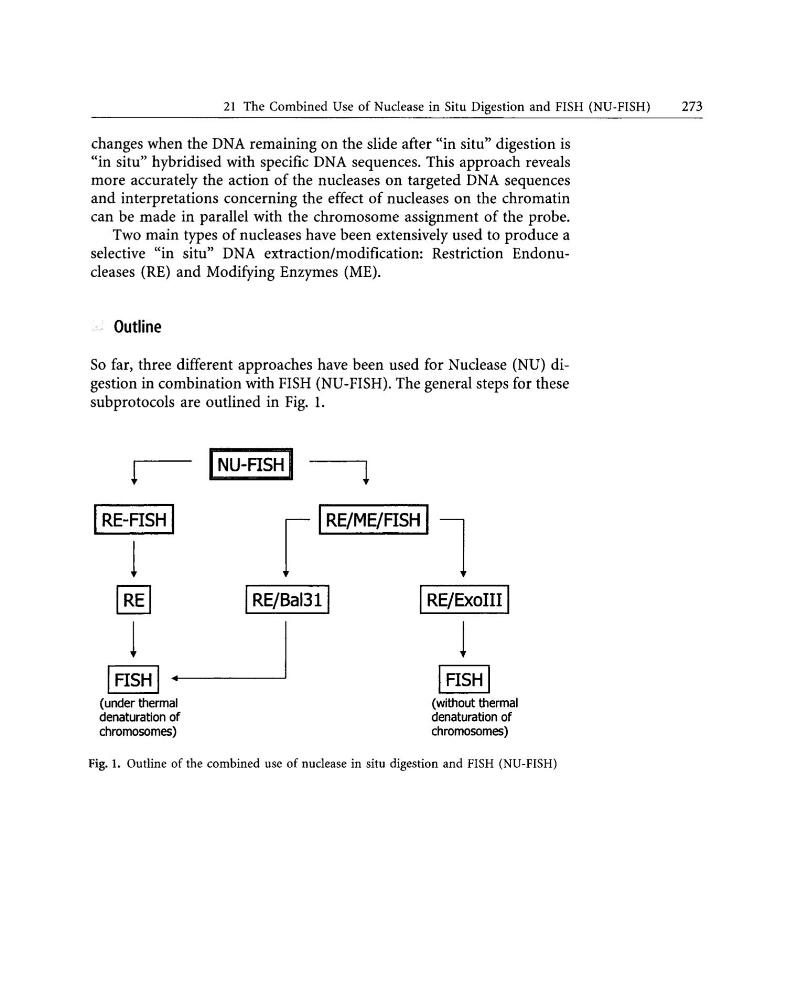
So far, three different approaches have been used for Nuclease (NU) digestion in combination with FISH (NU-FISH). The general steps for these
subprotocols are outlined in Fig. 1.
INU-FI SH I 1
IRE-1SH I
rI RE/ME/ASH Il
IRE I
IRE/BaI31I
IRE/ExoIII I
IA~HI ~
IA~HI
(under thermal
(Without thermal
denaturation of
denaturation of
chromosomes)
chromosomes)
Fig. 1. Outline of the combined use of nuclease in situ digestion and FISH (NU-FISH)
273
changes when the DNA remaining on the slide after "in situ" digestion is
"in situ" hybridised with specific DNA sequences. This approach reveals
more accurately the action of the nucleases on targeted DNA sequences
and interpretations concerning the effect of nucleases on the chromatin
can be made in parallel with the chromosome assignment of the probe.
Two main types of nucleases have been extensively used to produce a
selective "in situ" DNA extraction/modification: Restriction Endonucleases (RE) and Modifying Enzymes (ME).
Outline
So far, three different approaches have been used for Nuclease (NU) digestion in combination with FISH (NU-FISH). The general steps for these
subprotocols are outlined in Fig. 1.
INU-FI SH I 1
IRE-1SH I
rI RE/ME/ASH Il
IRE I
IRE/BaI31I
IRE/ExoIII I
IA~HI ~
IA~HI
(under thermal
(Without thermal
denaturation of
denaturation of
chromosomes)
chromosomes)
Fig. 1. Outline of the combined use of nuclease in situ digestion and FISH (NU-FISH)