

18 Quantitative DNA Fiber Mapping
227
I
a
clone I
gap
m:
~
I" : 1
~
..
clone 2
. .
~
b
..
~
C
si£e 2
n~
clone 1
veclO,"UJ illserl
~
clone 2
overlap
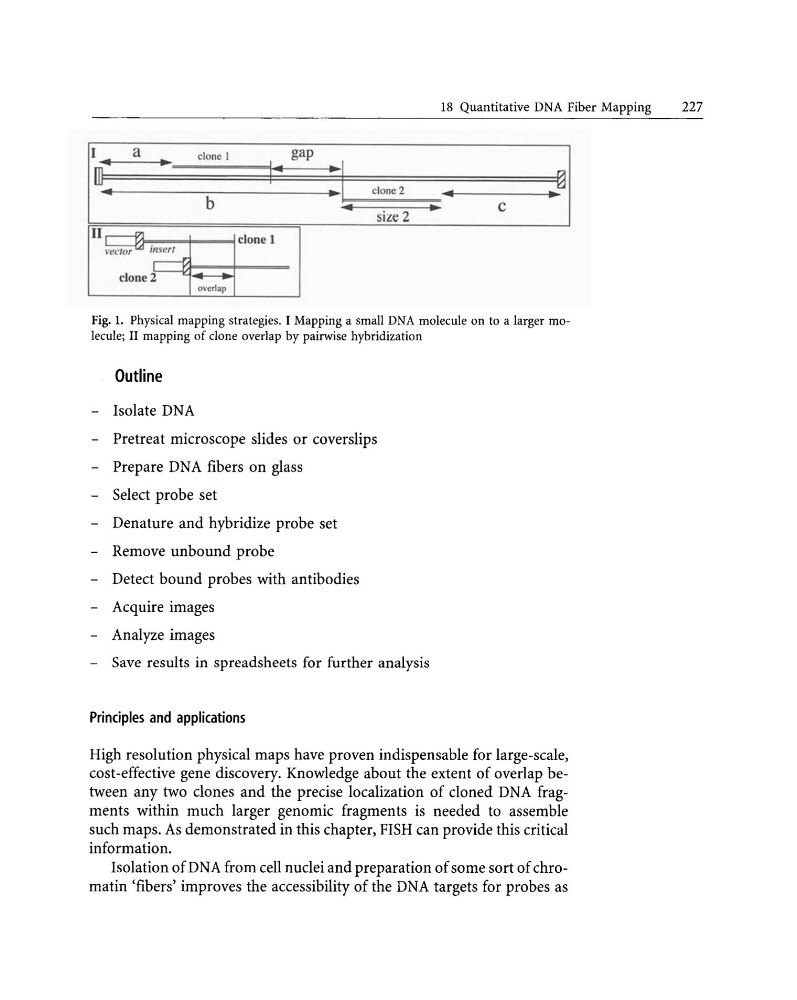
Fig. 1. Physical mapping strategies. I Mapping a small DNA molecule on to a larger molecule; II mapping of clone overlap by pairwise hybridization
Outline
- Isolate DNA
- Pretreat microscope slides or coverslips
- Prepare DNA fibers on glass
- Select probe set
- Denature and hybridize probe set
- Remove unbound probe
- Detect bound probes with antibodies
- Acquire images
- Analyze images
- Save results in spreadsheets for further analysis
Principles and applications
High resolution physical maps have proven indispensable for large-scale,
cost-effective gene discovery. Knowledge about the extent of overlap between any two clones and the precise localization of cloned DNA fragments within much larger genomic fragments is needed to assemble
such maps. As demonstrated in this chapter, FISH can provide this critical
information.
Isolation of DNA from cell nuclei and preparation ofsome sort of chromatin 'fibers' improves the accessibility of the DNA targets for probes as
227
I
a
clone I
gap
m:
~
I" : 1
~
..
clone 2
. .
~
b
..
~
C
si£e 2
n~
clone 1
veclO,"UJ illserl
~
clone 2
overlap
Fig. 1. Physical mapping strategies. I Mapping a small DNA molecule on to a larger molecule; II mapping of clone overlap by pairwise hybridization
Outline
- Isolate DNA
- Pretreat microscope slides or coverslips
- Prepare DNA fibers on glass
- Select probe set
- Denature and hybridize probe set
- Remove unbound probe
- Detect bound probes with antibodies
- Acquire images
- Analyze images
- Save results in spreadsheets for further analysis
Principles and applications
High resolution physical maps have proven indispensable for large-scale,
cost-effective gene discovery. Knowledge about the extent of overlap between any two clones and the precise localization of cloned DNA fragments within much larger genomic fragments is needed to assemble
such maps. As demonstrated in this chapter, FISH can provide this critical
information.
Isolation of DNA from cell nuclei and preparation ofsome sort of chromatin 'fibers' improves the accessibility of the DNA targets for probes as