

Development, Dispersal and Recruitment: A Paradox for Survival Among Antarctic Fish
59
Consequences for Recruitment and Fisheries
Notothenia ros~ii is reported to have been the major component of the
commercial-scale catches in the Southern Oeean during the late 1960s
and early 1970s [4]. Subsequent to this period little targeted fishing on
this species has occurred, Despite this, the species has not returned to its
former abundance. The lack of a recovery is a puzzle and implies that
factors controlling the population dynamics of Antarctic fish are not
fully understood. The larval phase is considered to be the most
vulnerable stage in the life-history of any fish species [27].
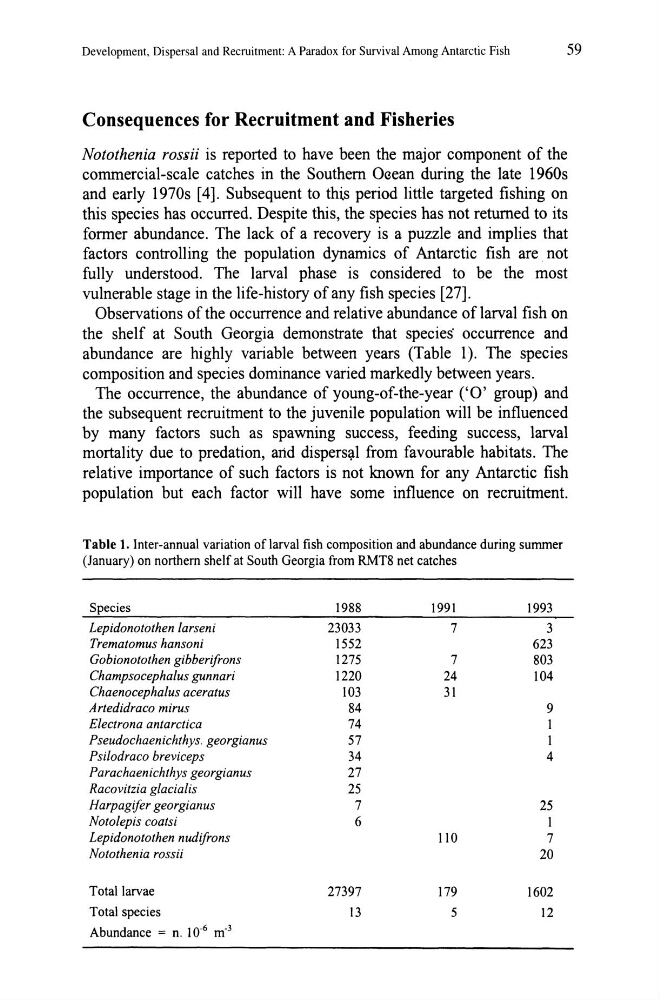
Observations of the occurrence and relative abundance of larval fish on
the shelf at South Georgia demonstrate that species occurrence and
abundance are highly variable between years (Table 1). The species
composition and species dominance varied markedly between years.
The occurrence, the abundance of young-of-the-year ('0' group) and
the subsequent recruitment to the juvenile population will be influenced
by many factors such as spawning success, feeding success, larval
mortality due to predation, arid dispersl;ll from favourable habitats. The
relative importance of such factors is not known for any Antarctic fish
population but each factor will have some influence on recruitment.
Table 1. Inter-annual variation of larval fish composition and abundance during summer
(January) on northern shelf at South Georgia from RMT8 net catches
Species
1988
1991
1993
Lepidonotothen larseni
23033
7
3
Trematomus hansoni
1552
623
Gobionotothen gibberifrons
1275
7
803
Champsocephalus gunnari
1220
24
104
Chaenocephalus aceratus
103
31
Artedidraco mirus
84
9
Electrona antarctica
74
1
Pseudochaenichthys. georgian us
57
1
Psilodraco breviceps
34
4
Parachaenichthys georgian us
27
Racovitzia glacialis
25
Harpagifer georgianus
7
25
Notolepis coatsi
6
1
Lepidonotothen nudifrons
110
7
Notothenia rossii
20
Total larvae
27397
179
1602
Total species
13
5
12
Abundance = n. 10- 6 m- 3
59
Consequences for Recruitment and Fisheries
Notothenia ros~ii is reported to have been the major component of the
commercial-scale catches in the Southern Oeean during the late 1960s
and early 1970s [4]. Subsequent to this period little targeted fishing on
this species has occurred, Despite this, the species has not returned to its
former abundance. The lack of a recovery is a puzzle and implies that
factors controlling the population dynamics of Antarctic fish are not
fully understood. The larval phase is considered to be the most
vulnerable stage in the life-history of any fish species [27].
Observations of the occurrence and relative abundance of larval fish on
the shelf at South Georgia demonstrate that species occurrence and
abundance are highly variable between years (Table 1). The species
composition and species dominance varied markedly between years.
The occurrence, the abundance of young-of-the-year ('0' group) and
the subsequent recruitment to the juvenile population will be influenced
by many factors such as spawning success, feeding success, larval
mortality due to predation, arid dispersl;ll from favourable habitats. The
relative importance of such factors is not known for any Antarctic fish
population but each factor will have some influence on recruitment.
Table 1. Inter-annual variation of larval fish composition and abundance during summer
(January) on northern shelf at South Georgia from RMT8 net catches
Species
1988
1991
1993
Lepidonotothen larseni
23033
7
3
Trematomus hansoni
1552
623
Gobionotothen gibberifrons
1275
7
803
Champsocephalus gunnari
1220
24
104
Chaenocephalus aceratus
103
31
Artedidraco mirus
84
9
Electrona antarctica
74
1
Pseudochaenichthys. georgian us
57
1
Psilodraco breviceps
34
4
Parachaenichthys georgian us
27
Racovitzia glacialis
25
Harpagifer georgianus
7
25
Notolepis coatsi
6
1
Lepidonotothen nudifrons
110
7
Notothenia rossii
20
Total larvae
27397
179
1602
Total species
13
5
12
Abundance = n. 10- 6 m- 3