

358
w.T. Starn et al.
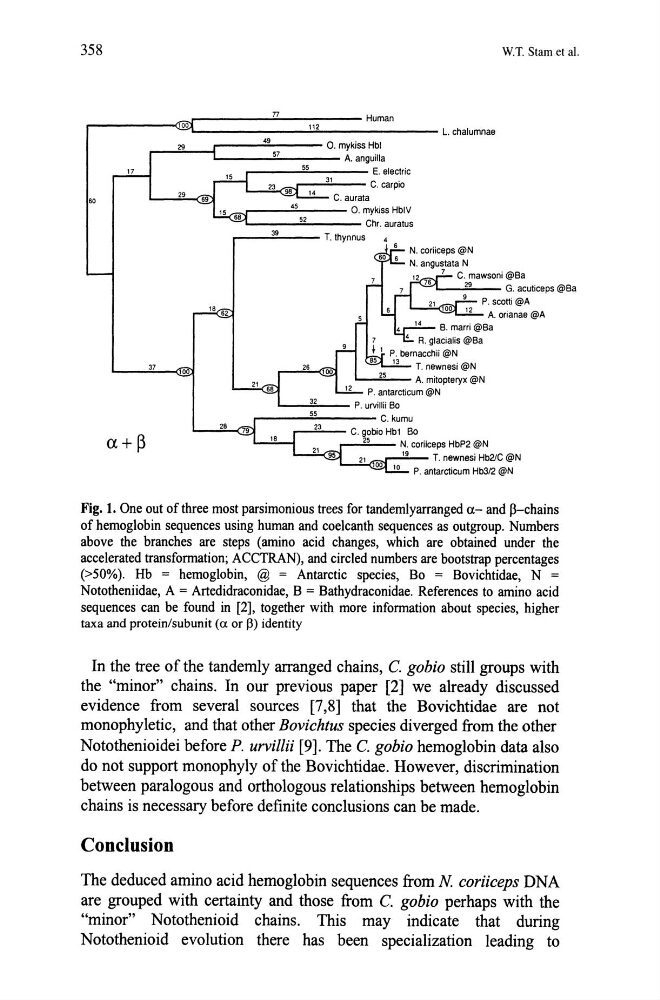
Fig. 1. One out of three most parsimonious trees for tandemlyarranged u- and p-chains
of hemoglobin sequences using human and coelcanth sequences as outgroup. Numbers
above the branches are steps (amino acid changes, which are obtained under the
accelerated transformation; ACCTRAN), and circled numbers are bootstrap percentages
(>50%). Hb = hemoglobin, @ = Antarctic species, Bo = Bovichtidae, N =
Nototheniidae, A = Artedidraconidae, B = Bathydraconidae. References to amino acid
sequences can be found in [2], together with more information about species, higher
taxa and protein/subunit (a or /3) identity
In the tree of the tandemly arranged chains, C. gobio still groups with
the "minor" chains. In our previous paper [2] we already discussed
evidence from several sources [7,8] that the Bovichtidae are not
monophyletic, and that other Bovichtus species diverged from the other
Notothenioidei before P. urvillii [9]. The C. gobio hemoglobin data also
do not support monophyly of the Bovichtidae. However, discrimination
between paralogous and orthologous relationships between hemoglobin
chains is necessary before definite conclusions can be made.
Conclusion
The deduced amino acid hemoglobin sequences from N coriiceps DNA
are grouped with certainty and those from C. gobio perhaps with the
"minor" Notothenioid chains. This may indicate that during
Notothenioid evolution there has been specialization leading to
w.T. Starn et al.
Fig. 1. One out of three most parsimonious trees for tandemlyarranged u- and p-chains
of hemoglobin sequences using human and coelcanth sequences as outgroup. Numbers
above the branches are steps (amino acid changes, which are obtained under the
accelerated transformation; ACCTRAN), and circled numbers are bootstrap percentages
(>50%). Hb = hemoglobin, @ = Antarctic species, Bo = Bovichtidae, N =
Nototheniidae, A = Artedidraconidae, B = Bathydraconidae. References to amino acid
sequences can be found in [2], together with more information about species, higher
taxa and protein/subunit (a or /3) identity
In the tree of the tandemly arranged chains, C. gobio still groups with
the "minor" chains. In our previous paper [2] we already discussed
evidence from several sources [7,8] that the Bovichtidae are not
monophyletic, and that other Bovichtus species diverged from the other
Notothenioidei before P. urvillii [9]. The C. gobio hemoglobin data also
do not support monophyly of the Bovichtidae. However, discrimination
between paralogous and orthologous relationships between hemoglobin
chains is necessary before definite conclusions can be made.
Conclusion
The deduced amino acid hemoglobin sequences from N coriiceps DNA
are grouped with certainty and those from C. gobio perhaps with the
"minor" Notothenioid chains. This may indicate that during
Notothenioid evolution there has been specialization leading to