

336
I.e. Montgomery and I.A. Macdonald
that was described by Robilliard and Dayton [22] as perching on a sponge.
The stance of Chionodraco is an even more striking parallel (Fig. 2D). A
number of other channichthyids also have elongate pelvic fins probably
used in a similar manner. In Cryodraco antarcticus these may be as much
as 63% of body length and bear flattened tips suitable for surface contact.
Icefishes and tripod fishes seem to have converged on a similar strategy to
sit motionless above the substrate with the attendant benefits that
motionlessness brings to nonvisual, particularly mechanosensory, function.
Discussion
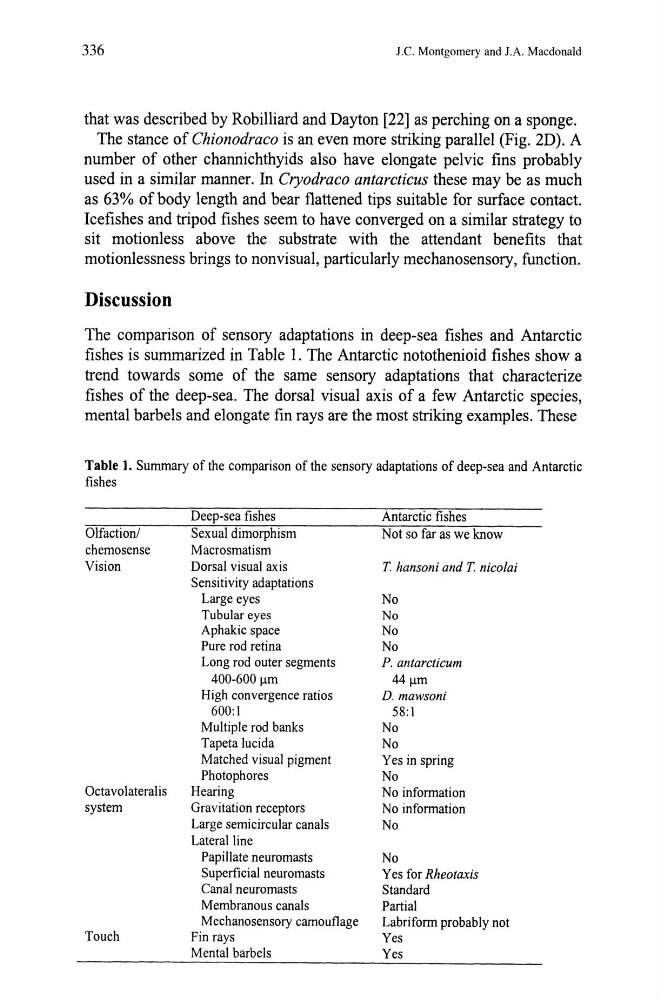
The comparison of sensory adaptations in deep-sea fishes and Antarctic
fishes is summarized in Table 1. The Antarctic notothenioid fishes show a
trend towards some of the same sensory adaptations that characterize
fishes of the deep-sea. The dorsal visual axis of a few Antarctic species,
mental barbels and elongate fin rays are the most striking examples. These
Table 1. Summary of the comparison of the sensory adaptations of deep-sea and Antarctic
fishes
Deep-sea fishes
Olfaction/
Sexual dimorphism
chemosense
Macrosmatism
Vision
Dorsal visual axis
Sensitivity adaptations
Large eyes
Tubular eyes
Aphakic space
Pure rod retina
Long rod outer segments
400-600 Ilm
High convergence ratios
600:1
Multiple rod banks
Tapeta lucida
Matched visual pigment
Photo ph ores
Octavolateralis
Hearing
system
Gravitation receptors
Large semicircular canals
Lateral line
Touch
Papillate neuromasts
Superficial neuromasts
Canal neuromasts
Membranous canals
Mechanosensory camouflage
Fin rays
Mental barbels
Antarctic fishes
Not so far as we know
T hansoni and T nicolai
No
No
No
No
P. antarcticum
441lm
D. mawsoni
58:1
No
No
Yes in spring
No
No information
No information
No
No
Yes for Rheotaxis
Standard
Partial
Labriform probably not
Yes
Yes
I.e. Montgomery and I.A. Macdonald
that was described by Robilliard and Dayton [22] as perching on a sponge.
The stance of Chionodraco is an even more striking parallel (Fig. 2D). A
number of other channichthyids also have elongate pelvic fins probably
used in a similar manner. In Cryodraco antarcticus these may be as much
as 63% of body length and bear flattened tips suitable for surface contact.
Icefishes and tripod fishes seem to have converged on a similar strategy to
sit motionless above the substrate with the attendant benefits that
motionlessness brings to nonvisual, particularly mechanosensory, function.
Discussion
The comparison of sensory adaptations in deep-sea fishes and Antarctic
fishes is summarized in Table 1. The Antarctic notothenioid fishes show a
trend towards some of the same sensory adaptations that characterize
fishes of the deep-sea. The dorsal visual axis of a few Antarctic species,
mental barbels and elongate fin rays are the most striking examples. These
Table 1. Summary of the comparison of the sensory adaptations of deep-sea and Antarctic
fishes
Deep-sea fishes
Olfaction/
Sexual dimorphism
chemosense
Macrosmatism
Vision
Dorsal visual axis
Sensitivity adaptations
Large eyes
Tubular eyes
Aphakic space
Pure rod retina
Long rod outer segments
400-600 Ilm
High convergence ratios
600:1
Multiple rod banks
Tapeta lucida
Matched visual pigment
Photo ph ores
Octavolateralis
Hearing
system
Gravitation receptors
Large semicircular canals
Lateral line
Touch
Papillate neuromasts
Superficial neuromasts
Canal neuromasts
Membranous canals
Mechanosensory camouflage
Fin rays
Mental barbels
Antarctic fishes
Not so far as we know
T hansoni and T nicolai
No
No
No
No
P. antarcticum
441lm
D. mawsoni
58:1
No
No
Yes in spring
No
No information
No information
No
No
Yes for Rheotaxis
Standard
Partial
Labriform probably not
Yes
Yes