

Chromosome Diversification in Antarctic Fish (Notothenioidei)
279
2,8). The karyotypic stability on chromosome number of the icefish has
already been discussed as well as the limited number of derived
karyological features which contrasts with their great phenotypic
differentiation and with their derived phyletic position among
Notothenioidei [6,10].
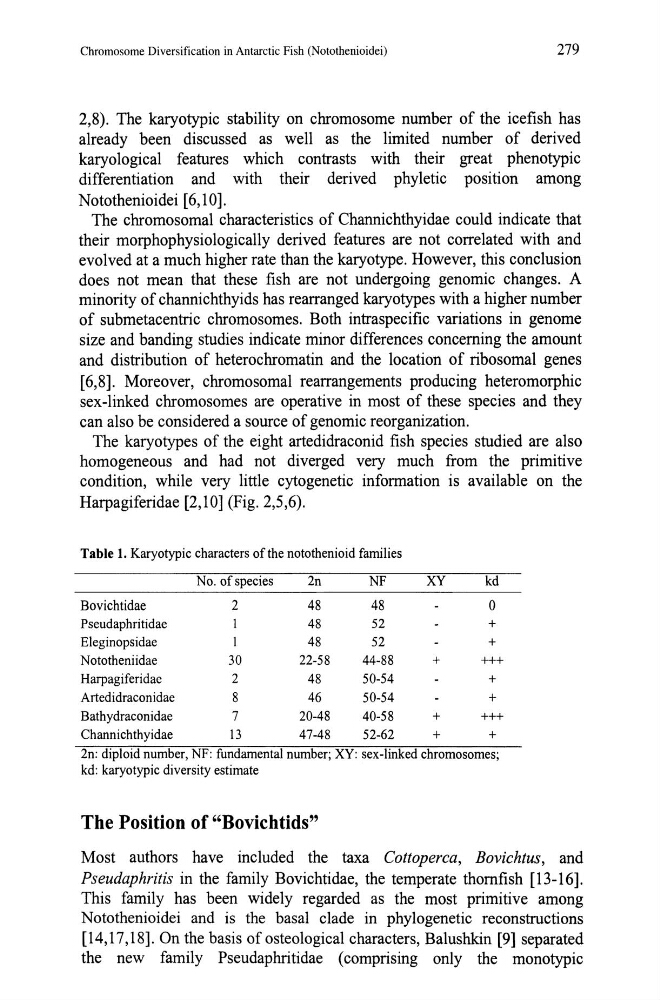
The chromosomal characteristics of Channichthyidae could indicate that
their morphophysiologically derived features are not correlated with and
evolved at a much higher rate than the karyotype. However, this conclusion
does not mean that these fish are not undergoing genomic changes. A
minority of channichthyids has rearranged karyotypes with a higher number
of submetacentric chromosomes. Both intraspecific variations in genome
size and banding studies indicate minor differences concerning the amount
and distribution of heterochromatin and the location of ribosomal genes
[6,8]. Moreover, chromosomal rearrangements producing heteromorphic
sex-linked chromosomes are operative in most of these species and they
can also be considered a source of genomic reorganization.
The karyotypes of the eight artedidraconid fish species studied are also
homogeneous and had not diverged very much from the primitive
condition, while very little cytogenetic information is available on the
Harpagiferidae [2,10] (Fig. 2,5,6).
Table 1. Karyotypic characters of the notothenioid families
No. of species
2n
NF
XY
kd
Bovichtidae
2
48
48
0
Pseudaphritidae
48
52
+
Eleginopsidae
1
48
52
+
Nototheniidae
30
22-58
44-88
+
+++
Harpagiferidae
2
48
50-54
+
Artedidraconidae
8
46
50-54
+
Bathydraconidae
7
20-48
40-58
+
+++
Channichthyidae
13
47-48
52-62
+
+
2n: diploid number, NF: fundamental number; XY: sex-linked chromosomes;
kd: karyotypic diversity estimate
The Position of "Bovichtids"
Most authors have included the taxa Cottoperca, Bovichtus, and
Pseudaphritis in the family Bovichtidae, the temperate thornfish [13-16].
This family has been widely regarded as the most primitive among
Notothenioidei and is the basal clade in phylogenetic reconstructions
[14,17,18]. On the basis of osteological characters, Balushkin [9] separated
the new family Pseudaphritidae (comprising only the monotypic
279
2,8). The karyotypic stability on chromosome number of the icefish has
already been discussed as well as the limited number of derived
karyological features which contrasts with their great phenotypic
differentiation and with their derived phyletic position among
Notothenioidei [6,10].
The chromosomal characteristics of Channichthyidae could indicate that
their morphophysiologically derived features are not correlated with and
evolved at a much higher rate than the karyotype. However, this conclusion
does not mean that these fish are not undergoing genomic changes. A
minority of channichthyids has rearranged karyotypes with a higher number
of submetacentric chromosomes. Both intraspecific variations in genome
size and banding studies indicate minor differences concerning the amount
and distribution of heterochromatin and the location of ribosomal genes
[6,8]. Moreover, chromosomal rearrangements producing heteromorphic
sex-linked chromosomes are operative in most of these species and they
can also be considered a source of genomic reorganization.
The karyotypes of the eight artedidraconid fish species studied are also
homogeneous and had not diverged very much from the primitive
condition, while very little cytogenetic information is available on the
Harpagiferidae [2,10] (Fig. 2,5,6).
Table 1. Karyotypic characters of the notothenioid families
No. of species
2n
NF
XY
kd
Bovichtidae
2
48
48
0
Pseudaphritidae
48
52
+
Eleginopsidae
1
48
52
+
Nototheniidae
30
22-58
44-88
+
+++
Harpagiferidae
2
48
50-54
+
Artedidraconidae
8
46
50-54
+
Bathydraconidae
7
20-48
40-58
+
+++
Channichthyidae
13
47-48
52-62
+
+
2n: diploid number, NF: fundamental number; XY: sex-linked chromosomes;
kd: karyotypic diversity estimate
The Position of "Bovichtids"
Most authors have included the taxa Cottoperca, Bovichtus, and
Pseudaphritis in the family Bovichtidae, the temperate thornfish [13-16].
This family has been widely regarded as the most primitive among
Notothenioidei and is the basal clade in phylogenetic reconstructions
[14,17,18]. On the basis of osteological characters, Balushkin [9] separated
the new family Pseudaphritidae (comprising only the monotypic