

244
M. Maffia et al.
I)-(ilu os.: -~---i'......L-~
Allllno-ac.ds
II
K
J),pepudc _....;;=:::::::O"......L_~
Ir
LlIm ll1al ~ ,dc
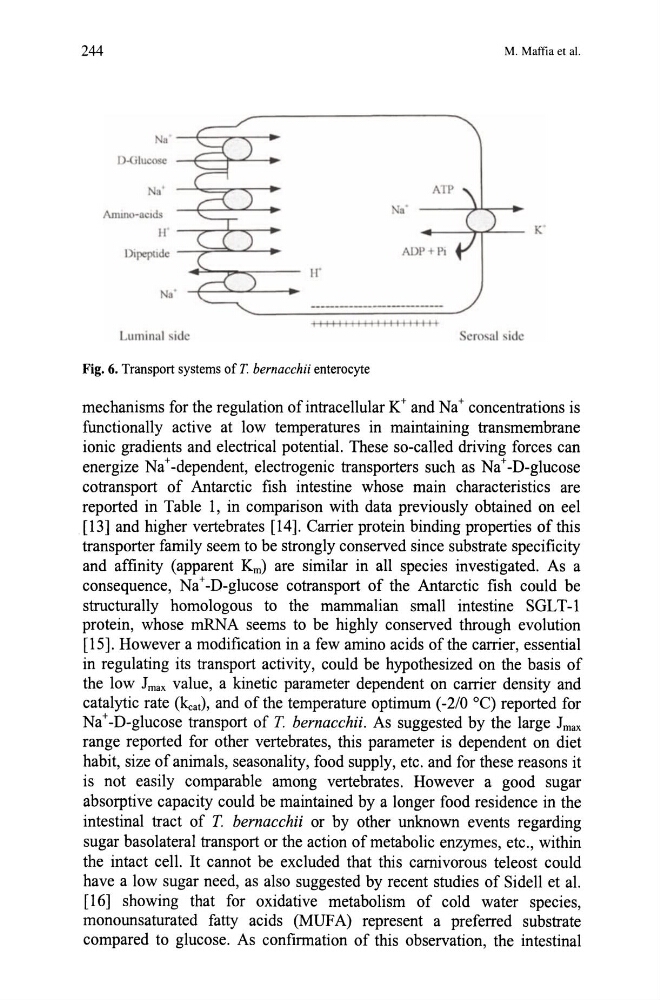
Fig. 6. Transport systems of T bernacchii enterocyte
mechanisms for the regulation of intracellular K+ and N a + concentrations is
functionally active at low temperatures in maintaining transmembrane
ionic gradients and electrical potential. These so-called driving forces can
energize Na + -dependent, electrogenic transporters such as Na + -D-glucose
cotransport of Antarctic fish intestine whose main characteristics are
reported in Table 1, in comparison with data previously obtained on eel
[13] and higher vertebrates [14]. Carrier protein binding properties of this
transporter family seem to be strongly conserved since substrate specificity
and affinity (apparent Krn) are similar in all species investigated. As a
consequence, Na+-D-glucose cotransport of the Antarctic fish could be
structurally homologous to the mammalian small intestine SGL T-l
protein, whose mRNA seems to be highly conserved through evolution
[15]. However a modification in a few amino acids of the carrier, essential
in regulating its transport activity, could be hypothesized on the basis of
the low Jrnax value, a kinetic parameter dependent on carrier density and
catalytic rate (kcat), and of the temperature optimum (-2/0 0c) reported for
Na+-D-glucose transport of T. bernacchii. As suggested by the large Jrnax
range reported for other vertebrates, this parameter is dependent on diet
habit, size of animals, seasonality, food supply, etc. and for these reasons it
is not easily comparable among vertebrates. However a good sugar
absorptive capacity could be maintained by a longer food residence in the
intestinal tract of T. bernacchii or by other unknown events regarding
sugar basolateral transport or the action of metabolic enzymes, etc., within
the intact cell. It cannot be excluded that this carnivorous teleost could
have a low sugar need, as also suggested by recent studies of Sidell et al.
[16] showing that for oxidative metabolism of cold water species,
monounsaturated fatty acids (MUF A) represent a preferred substrate
compared to glucose. As confirmation of this observation, the intestinal
M. Maffia et al.
I)-(ilu os.: -~---i'......L-~
Allllno-ac.ds
II
K
J),pepudc _....;;=:::::::O"......L_~
Ir
LlIm ll1al ~ ,dc
Fig. 6. Transport systems of T bernacchii enterocyte
mechanisms for the regulation of intracellular K+ and N a + concentrations is
functionally active at low temperatures in maintaining transmembrane
ionic gradients and electrical potential. These so-called driving forces can
energize Na + -dependent, electrogenic transporters such as Na + -D-glucose
cotransport of Antarctic fish intestine whose main characteristics are
reported in Table 1, in comparison with data previously obtained on eel
[13] and higher vertebrates [14]. Carrier protein binding properties of this
transporter family seem to be strongly conserved since substrate specificity
and affinity (apparent Krn) are similar in all species investigated. As a
consequence, Na+-D-glucose cotransport of the Antarctic fish could be
structurally homologous to the mammalian small intestine SGL T-l
protein, whose mRNA seems to be highly conserved through evolution
[15]. However a modification in a few amino acids of the carrier, essential
in regulating its transport activity, could be hypothesized on the basis of
the low Jrnax value, a kinetic parameter dependent on carrier density and
catalytic rate (kcat), and of the temperature optimum (-2/0 0c) reported for
Na+-D-glucose transport of T. bernacchii. As suggested by the large Jrnax
range reported for other vertebrates, this parameter is dependent on diet
habit, size of animals, seasonality, food supply, etc. and for these reasons it
is not easily comparable among vertebrates. However a good sugar
absorptive capacity could be maintained by a longer food residence in the
intestinal tract of T. bernacchii or by other unknown events regarding
sugar basolateral transport or the action of metabolic enzymes, etc., within
the intact cell. It cannot be excluded that this carnivorous teleost could
have a low sugar need, as also suggested by recent studies of Sidell et al.
[16] showing that for oxidative metabolism of cold water species,
monounsaturated fatty acids (MUF A) represent a preferred substrate
compared to glucose. As confirmation of this observation, the intestinal