

232
PL.M. van Dijk et al.
shows a different response to cold acclimation. While most other
eurythermic species show perfect compensation of recovery processes,
roach not only produce less lactate during burst activity at 4 °e, but also
need about 4 times longer to regain pre-exercise lactate levels than their
counterparts acclimated to 20 °e. Obviously, no compensatory
mechanisms are functioning in this species despite an enhanced aerobic
capacity [40].
In Antarctic fish the time required for recovery of blood composition
and rates of oxygen consumption after exercise and capture stress is
similar to temperate species. For most parameters this is essentially
achieved within 8-24 h [8,9,42].
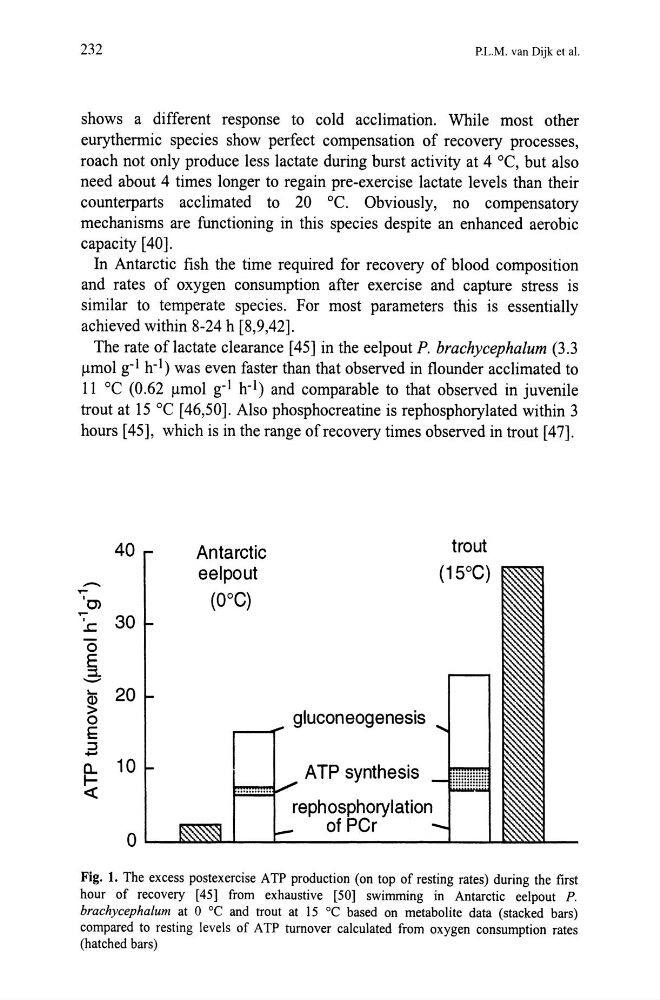
The rate of lactate clearance [45] in the eelpout P. brachycephalum (3.3
j..lmol g-I h- I ) was even faster than that observed in flounder acclimated to
11 °e (0.62 j..lmol g-I h- I ) and comparable to that observed in juvenile
trout at 15 °e [46,50]. Also phosphocreatine is rephosphorylated within 3
hours [45], which is in the range of recovery times observed in trout [47].
Fig. 1. The excess postexercise ATP production (on top of resting rates) during the first
hour of recovery [45] from exhaustive [50] swimming in Antarctic eelpout P.
brachycephalum at 0 °C and trout at IS °C based on metabolite data (stacked bars)
compared to resting levels of ATP turnover calculated from oxygen consumption rates
(hatched bars)
PL.M. van Dijk et al.
shows a different response to cold acclimation. While most other
eurythermic species show perfect compensation of recovery processes,
roach not only produce less lactate during burst activity at 4 °e, but also
need about 4 times longer to regain pre-exercise lactate levels than their
counterparts acclimated to 20 °e. Obviously, no compensatory
mechanisms are functioning in this species despite an enhanced aerobic
capacity [40].
In Antarctic fish the time required for recovery of blood composition
and rates of oxygen consumption after exercise and capture stress is
similar to temperate species. For most parameters this is essentially
achieved within 8-24 h [8,9,42].
The rate of lactate clearance [45] in the eelpout P. brachycephalum (3.3
j..lmol g-I h- I ) was even faster than that observed in flounder acclimated to
11 °e (0.62 j..lmol g-I h- I ) and comparable to that observed in juvenile
trout at 15 °e [46,50]. Also phosphocreatine is rephosphorylated within 3
hours [45], which is in the range of recovery times observed in trout [47].
Fig. 1. The excess postexercise ATP production (on top of resting rates) during the first
hour of recovery [45] from exhaustive [50] swimming in Antarctic eelpout P.
brachycephalum at 0 °C and trout at IS °C based on metabolite data (stacked bars)
compared to resting levels of ATP turnover calculated from oxygen consumption rates
(hatched bars)