

Exercise in the Cold: High Energy Turnover in Antarctic Fish
227
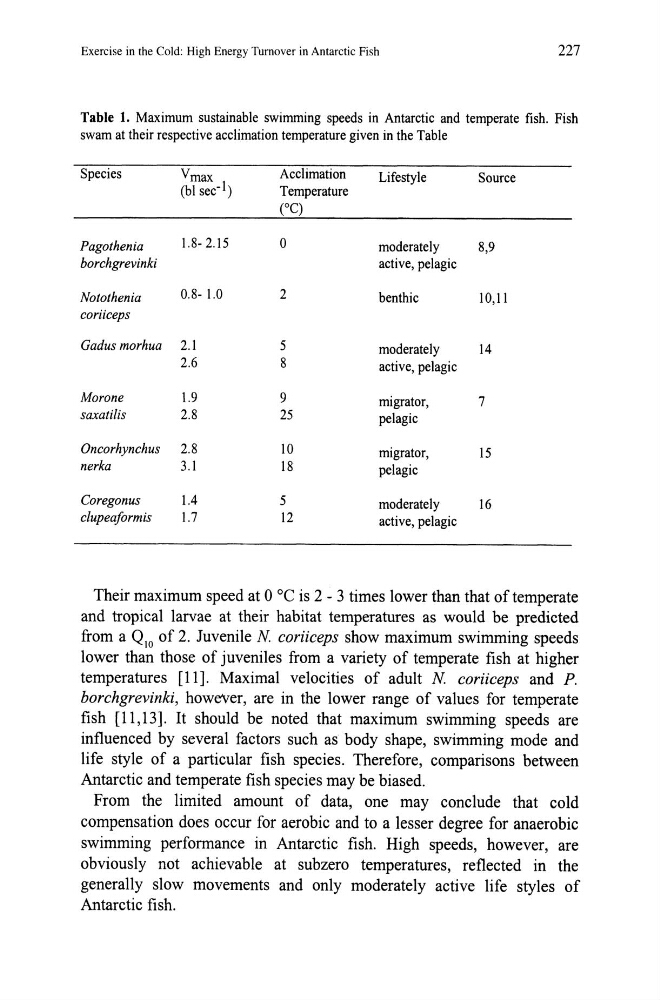
Table 1. Maximum sustainable swimming speeds in Antarctic and temperate fish. Fish
swam at their respective acclimation temperature given in the Table
Species
Vmax
Acclimation
Lifestyle
Source
(bl sec-I)
Temperature
COC)
Pagothenia
1.8-2.15
0
moderately
8,9
borchgrevinki
active, pelagic
Notothenia
0.8- 1.0
2
benthic
10,11
coriiceps
Gadus morhua 2.1
5
moderately
14
2.6
8
active, pelagic
Morone
1.9
9
migrator,
7
saxatilis
2.8
25
pelagic
Oncorhynchus
2.8
10
migrator,
15
nerka
3.1
18
pelagic
Coregonus
1.4
5
moderately
16
clupeaformis
1.7
12
active, pelagic
Their maximum speed at 0 °C is 2 - 3 times lower than that of temperate
and tropical larvae at their habitat temperatures as would be predicted
from a QIO of 2. Juvenile N coriiceps show maximum swimming speeds
lower than those of juveniles from a variety of temperate fish at higher
temperatures [11]. Maximal velocities of adult N coriiceps and P.
borchgrevinki, however, are in the lower range of values for temperate
fish [11,13]. It should be noted that maximum swimming speeds are
influenced by several factors such as body shape, swimming mode and
life style of a particular fish species. Therefore, comparisons between
Antarctic and temperate fish species may be biased.
From the limited amount of data, one may conclude that cold
compensation does occur for aerobic and to a lesser degree for anaerobic
swimming performance in Antarctic fish. High speeds, however, are
obviously not achievable at subzero temperatures, reflected in the
generally slow movements and only moderately active life styles of
Antarctic fish.
227
Table 1. Maximum sustainable swimming speeds in Antarctic and temperate fish. Fish
swam at their respective acclimation temperature given in the Table
Species
Vmax
Acclimation
Lifestyle
Source
(bl sec-I)
Temperature
COC)
Pagothenia
1.8-2.15
0
moderately
8,9
borchgrevinki
active, pelagic
Notothenia
0.8- 1.0
2
benthic
10,11
coriiceps
Gadus morhua 2.1
5
moderately
14
2.6
8
active, pelagic
Morone
1.9
9
migrator,
7
saxatilis
2.8
25
pelagic
Oncorhynchus
2.8
10
migrator,
15
nerka
3.1
18
pelagic
Coregonus
1.4
5
moderately
16
clupeaformis
1.7
12
active, pelagic
Their maximum speed at 0 °C is 2 - 3 times lower than that of temperate
and tropical larvae at their habitat temperatures as would be predicted
from a QIO of 2. Juvenile N coriiceps show maximum swimming speeds
lower than those of juveniles from a variety of temperate fish at higher
temperatures [11]. Maximal velocities of adult N coriiceps and P.
borchgrevinki, however, are in the lower range of values for temperate
fish [11,13]. It should be noted that maximum swimming speeds are
influenced by several factors such as body shape, swimming mode and
life style of a particular fish species. Therefore, comparisons between
Antarctic and temperate fish species may be biased.
From the limited amount of data, one may conclude that cold
compensation does occur for aerobic and to a lesser degree for anaerobic
swimming performance in Antarctic fish. High speeds, however, are
obviously not achievable at subzero temperatures, reflected in the
generally slow movements and only moderately active life styles of
Antarctic fish.