

210
M.e. Cerra et al.
and 178±41 pM, respectively) than the other cardiac chambers, while the
maximum number of binding sites was similar to those of the other
regions. These observations, together with the results of previous studies
on temperate teleosts [24,26], indicate that only the inner bulbar layer
constantly demonstrates the presence of two classes of binding sites. Our
work does not specifically address the functional significance of such a
constant receptor pattern of the inner bulbar layer, but it suggests that it
is independent of either environmental influences, and/or of cardiac
adjustments since it occurs equally in both the enlarged heart of C.
hamatus and in the heart of temperate fish species.
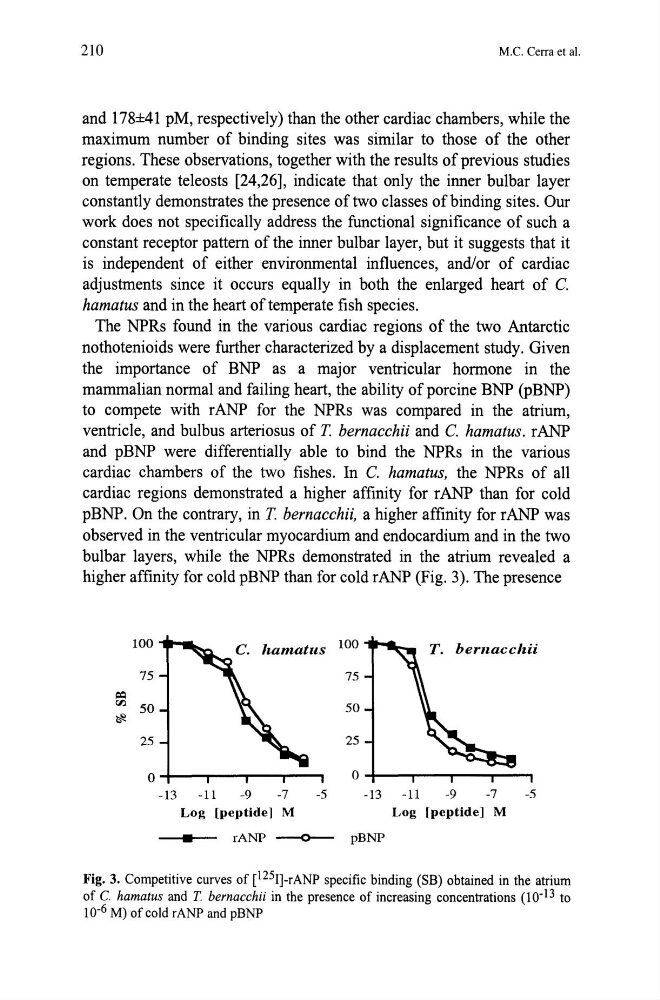
The NPRs found in the various cardiac regions of the two Antarctic
nothotenioids were further characterized by a displacement study. Given
the importance of BNP as a major ventricular hormone in the
mammalian normal and failing heart, the ability of porcine BNP (pBNP)
to compete with rANP for the NPRs was compared in the atrium,
ventricle, and bulbus arteriosus of T bernacchii and C. hamatus. rANP
and pBNP were differentially able to bind the NPRs in the various
cardiac chambers of the two fishes. In C. hamatus, the NPRs of all
cardiac regions demonstrated a higher affinity for rANP than for cold
pBNP. On the contrary, in T bernacchii, a higher affinity for rANP was
observed in the ventricular myocardium and endocardium and in the two
bulbar layers, while the NPRs demonstrated in the atrium revealed a
higher affinity for cold pBNP than for cold rANP (Fig. 3). The presence
100
100
T. berllacchii
75
75
~
00
50
50
~
25
25
0
0
-13
-11
-9
-7
-5
-13
-11
-9
-7
-5
Log [peptide] M
Log [peptide] M
•
rANP - - 0 - - pBNP
Fig. 3. Competitive curves of [1 25I]-rANP specific binding (SB) obtained in the atrium
of C. hamatus and T bernacchii in the presence of increasing concentrations (10- 13 to
10- 6 M) of cold r ANP and pBNP
M.e. Cerra et al.
and 178±41 pM, respectively) than the other cardiac chambers, while the
maximum number of binding sites was similar to those of the other
regions. These observations, together with the results of previous studies
on temperate teleosts [24,26], indicate that only the inner bulbar layer
constantly demonstrates the presence of two classes of binding sites. Our
work does not specifically address the functional significance of such a
constant receptor pattern of the inner bulbar layer, but it suggests that it
is independent of either environmental influences, and/or of cardiac
adjustments since it occurs equally in both the enlarged heart of C.
hamatus and in the heart of temperate fish species.
The NPRs found in the various cardiac regions of the two Antarctic
nothotenioids were further characterized by a displacement study. Given
the importance of BNP as a major ventricular hormone in the
mammalian normal and failing heart, the ability of porcine BNP (pBNP)
to compete with rANP for the NPRs was compared in the atrium,
ventricle, and bulbus arteriosus of T bernacchii and C. hamatus. rANP
and pBNP were differentially able to bind the NPRs in the various
cardiac chambers of the two fishes. In C. hamatus, the NPRs of all
cardiac regions demonstrated a higher affinity for rANP than for cold
pBNP. On the contrary, in T bernacchii, a higher affinity for rANP was
observed in the ventricular myocardium and endocardium and in the two
bulbar layers, while the NPRs demonstrated in the atrium revealed a
higher affinity for cold pBNP than for cold rANP (Fig. 3). The presence
100
100
T. berllacchii
75
75
~
00
50
50
~
25
25
0
0
-13
-11
-9
-7
-5
-13
-11
-9
-7
-5
Log [peptide] M
Log [peptide] M
•
rANP - - 0 - - pBNP
Fig. 3. Competitive curves of [1 25I]-rANP specific binding (SB) obtained in the atrium
of C. hamatus and T bernacchii in the presence of increasing concentrations (10- 13 to
10- 6 M) of cold r ANP and pBNP