

208
M.e. Cerra et al.
12,
C. hamatus
25
T. bernacchii
o
20
o
15
o
10
5
O+---r-------,r----..,.---lI...,
o 100 200 300 400 0 100 200 300 400
SB (fmol/mg p)
Kd 1 = 8,9 ± 3,0 pM
Bmax 1 = 130 ± 41 fmol/mg p
Kd 2 = 224 ± 67 pM
Bmax 2 = 350 ± 32 fmol/mg p
SB (fmol/mg p)
Kd= 14± 3,2 pM
Bmax = 370 ± 36 fmol/mg p
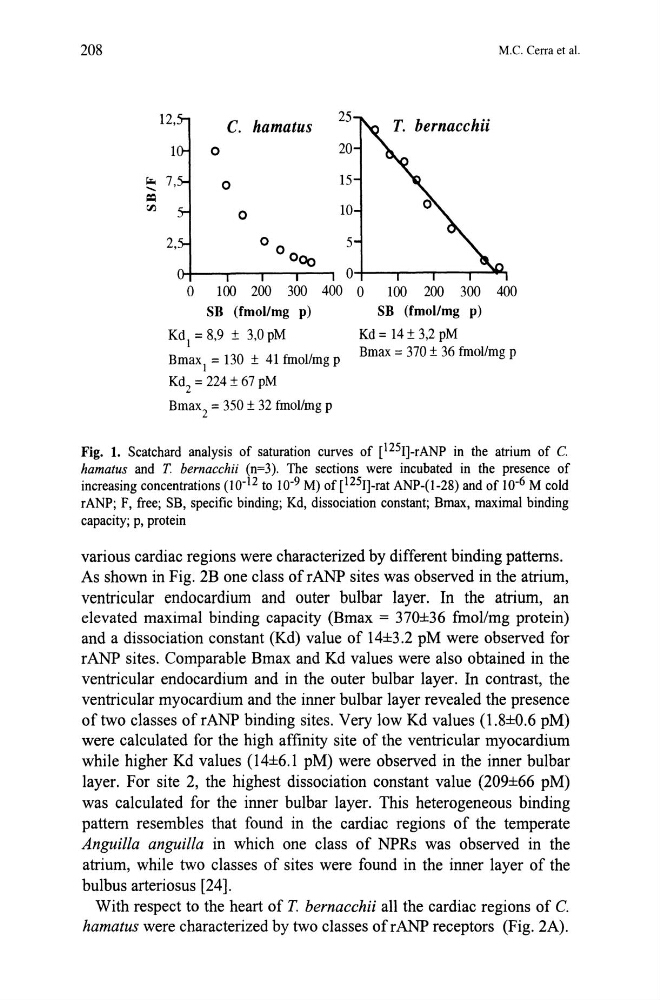
Fig. 1. Scatchard analysis of saturation curves of [125I]_rANP in the atrium of C.
hamatus and T bernacchii (n=3). The sections were incubated in the presence of
increasing concentrations (10- 12 to 10- 9 M) of[125I]-rat ANP-(l-28) and of 10- 6 M cold
rANP; F, free; SB, specific binding; Kd, dissociation constant; Bmax, maximal binding
capacity; p, protein
various cardiac regions were characterized by different binding patterns.
As shown in Fig. 2B one class ofrANP sites was observed in the atrium,
ventricular endocardium and outer bulbar layer. In the atrium, an
elevated maximal binding capacity (Bmax = 370±36 fmol/mg protein)
and a dissociation constant (Kd) value of 14±3.2 pM were observed for
rANP sites. Comparable Bmax and Kd values were also obtained in the
ventricular endocardium and in the outer bulbar layer. In contrast, the
ventricular myocardium and the inner bulbar layer revealed the presence
of two classes ofrANP binding sites. Very low Kd values (1.8±O.6 pM)
were calculated for the high affinity site of the ventricular myocardium
while higher Kd values (14±6.1 pM) were observed in the inner bulbar
layer. For site 2, the highest dissociation constant value (209±66 pM)
was calculated for the inner bulbar layer. This heterogeneous binding
pattern resembles that found in the cardiac regions of the temperate
Anguilla anguilla in which one class of NPRs was observed in the
atrium, while two classes of sites were found in the inner layer of the
bulbus arteriosus [24].
With respect to the heart of T. bernacchii all the cardiac regions of C.
hamatus were characterized by two classes ofrANP receptors (Fig.2A).
M.e. Cerra et al.
12,
C. hamatus
25
T. bernacchii
o
20
o
15
o
10
5
O+---r-------,r----..,.---lI...,
o 100 200 300 400 0 100 200 300 400
SB (fmol/mg p)
Kd 1 = 8,9 ± 3,0 pM
Bmax 1 = 130 ± 41 fmol/mg p
Kd 2 = 224 ± 67 pM
Bmax 2 = 350 ± 32 fmol/mg p
SB (fmol/mg p)
Kd= 14± 3,2 pM
Bmax = 370 ± 36 fmol/mg p
Fig. 1. Scatchard analysis of saturation curves of [125I]_rANP in the atrium of C.
hamatus and T bernacchii (n=3). The sections were incubated in the presence of
increasing concentrations (10- 12 to 10- 9 M) of[125I]-rat ANP-(l-28) and of 10- 6 M cold
rANP; F, free; SB, specific binding; Kd, dissociation constant; Bmax, maximal binding
capacity; p, protein
various cardiac regions were characterized by different binding patterns.
As shown in Fig. 2B one class ofrANP sites was observed in the atrium,
ventricular endocardium and outer bulbar layer. In the atrium, an
elevated maximal binding capacity (Bmax = 370±36 fmol/mg protein)
and a dissociation constant (Kd) value of 14±3.2 pM were observed for
rANP sites. Comparable Bmax and Kd values were also obtained in the
ventricular endocardium and in the outer bulbar layer. In contrast, the
ventricular myocardium and the inner bulbar layer revealed the presence
of two classes ofrANP binding sites. Very low Kd values (1.8±O.6 pM)
were calculated for the high affinity site of the ventricular myocardium
while higher Kd values (14±6.1 pM) were observed in the inner bulbar
layer. For site 2, the highest dissociation constant value (209±66 pM)
was calculated for the inner bulbar layer. This heterogeneous binding
pattern resembles that found in the cardiac regions of the temperate
Anguilla anguilla in which one class of NPRs was observed in the
atrium, while two classes of sites were found in the inner layer of the
bulbus arteriosus [24].
With respect to the heart of T. bernacchii all the cardiac regions of C.
hamatus were characterized by two classes ofrANP receptors (Fig.2A).