

Respiration and Activity of Arctic and Antarctic Fish: A Multivariate Analysis
171
In factorial plane 1-2, experiments are clearly separated by activity and
temperature. The measurements of the extremely sluggish Pogonophryne,
conducted at temperatures of about 1 DC, have negative scores on factor 1,
whereas the more active species are characterized by positive scores. Of
these experiments, the Arctic fish (2.0 to 2.8 DC) had positive scores on
factor 2, and the Antarctic fish (-0.6 to +0.7 DC) had negative scores.
The picture is less clear for scores in the factorial plane 1-3 (Fig. 3b).
From the distribution pattern, a "mode of life" gradient can be discerned
between sluggish, strictly benthic animals in the lower left comer and
active, cryopelagic hunters in the upper right comer. This gradient is
symbolized by the grey outlined arrow. The direction of this arrow is
similar to that for the factor loading of the variable "quotient of maximum
and mean movement rate" (Fig. 2b). This similarity suggests to use the
latter variable for the quantification of the weak term "mode of life".
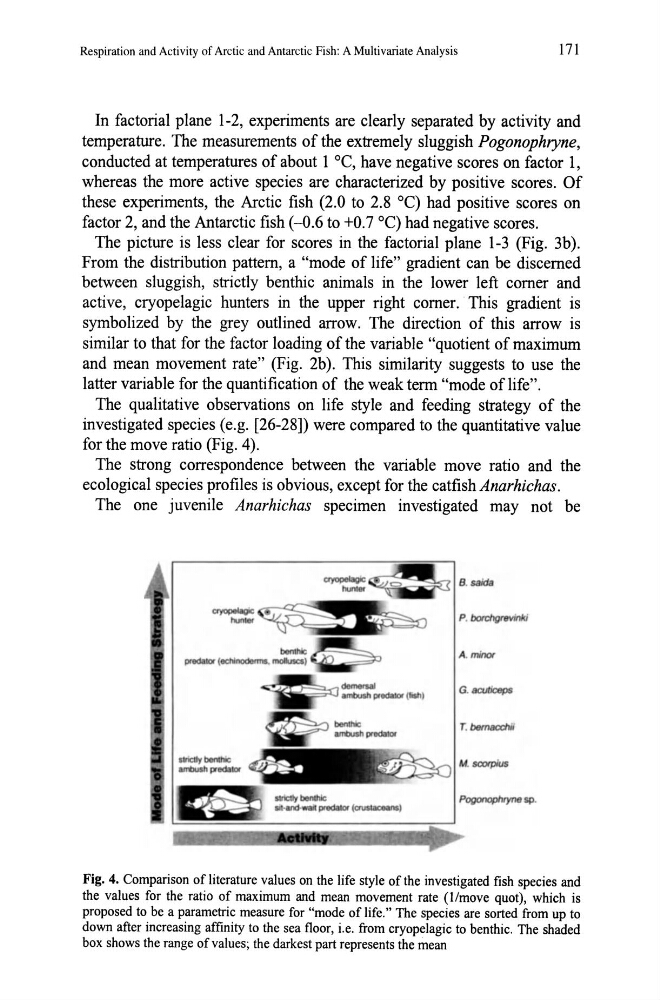
The qualitative observations on life style and feeding strategy of the
investigated species (e.g. [26-28]) were compared to the quantitative value
for the move ratio (Fig. 4).
The strong correspondence between the variable move ratio and the
ecological species profiles is obvious, except for the catfish Anarhichas.
The one juvenile Anarhichas specimen investigated may not be
P. bott:hgr8vinIu
G. /JCUtJOtJpS
T. bemacchil
Pogonophtyne $p.
Fig. 4. Comparison of literature values on the life style of the investigated fish species and
the values for the ratio of maximum and mean movement rate (llmove quot), which is
proposed to be a parametric measure for "mode of life." The species are sorted from up to
down after increasing affinity to the sea floor, i.e. from cryopelagic to benthic. The shaded
box shows the range of values; the darkest part represents the mean
171
In factorial plane 1-2, experiments are clearly separated by activity and
temperature. The measurements of the extremely sluggish Pogonophryne,
conducted at temperatures of about 1 DC, have negative scores on factor 1,
whereas the more active species are characterized by positive scores. Of
these experiments, the Arctic fish (2.0 to 2.8 DC) had positive scores on
factor 2, and the Antarctic fish (-0.6 to +0.7 DC) had negative scores.
The picture is less clear for scores in the factorial plane 1-3 (Fig. 3b).
From the distribution pattern, a "mode of life" gradient can be discerned
between sluggish, strictly benthic animals in the lower left comer and
active, cryopelagic hunters in the upper right comer. This gradient is
symbolized by the grey outlined arrow. The direction of this arrow is
similar to that for the factor loading of the variable "quotient of maximum
and mean movement rate" (Fig. 2b). This similarity suggests to use the
latter variable for the quantification of the weak term "mode of life".
The qualitative observations on life style and feeding strategy of the
investigated species (e.g. [26-28]) were compared to the quantitative value
for the move ratio (Fig. 4).
The strong correspondence between the variable move ratio and the
ecological species profiles is obvious, except for the catfish Anarhichas.
The one juvenile Anarhichas specimen investigated may not be
P. bott:hgr8vinIu
G. /JCUtJOtJpS
T. bemacchil
Pogonophtyne $p.
Fig. 4. Comparison of literature values on the life style of the investigated fish species and
the values for the ratio of maximum and mean movement rate (llmove quot), which is
proposed to be a parametric measure for "mode of life." The species are sorted from up to
down after increasing affinity to the sea floor, i.e. from cryopelagic to benthic. The shaded
box shows the range of values; the darkest part represents the mean