

Respiration and Activity of Arctic and Antarctic Fish: A Multivariate Analysis
169
Furthermore, correlations between variables can be deduced from the
plot of the factor loadings in the factorial space: highly correlated variables
have a rather narrow angle to each other, while uncorrelated ones are
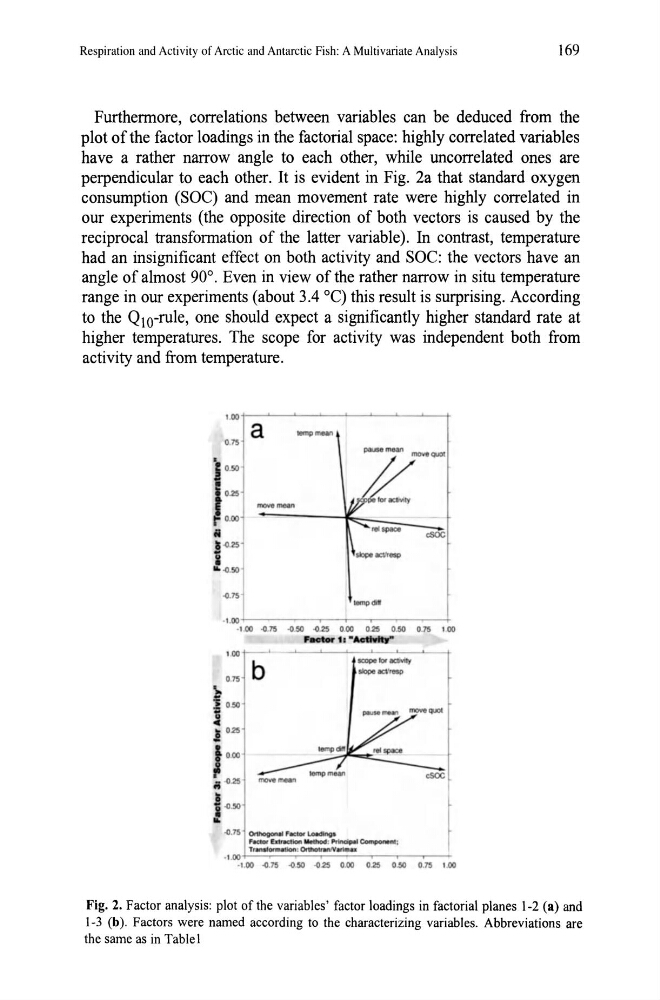
perpendicular to each other. It is evident in Fig. 2a that standard oxygen
consumption (SOC) and mean movement rate were highly correlated in
our experiments (the opposite direction of both vectors is caused by the
reciprocal transformation of the latter variable). In contrast, temperature
had an insignificant effect on both activity and soc: the vectors have an
angle of almost 90°. Even in view of the rather narrow in situ temperature
range in our experiments (about 3.4 0C) this result is surprising. According
to the QlO-rule, one should expect a significantly higher standard rate at
higher temperatures. The scope for activity was independent both from
activity and from temperature.
0.75
,
10 . 50
0.25
r 0.00
a
11 .0·25 "
1.0.
50
1
.0.75
a
' \.00
' "
cSOC
. \ .00 .0.75 .0.50 .0.25 0.00 0.25 0.50 0.75 , 00
1.00
..... moon
, , - •• "AotIwItY'
_ ... .....,
_1011_
cSOC
Fig. 2. Factor analysis: plot of the variables' factor loadings in factorial planes 1-2 (a) and
1-3 (b). Factors were named according to the characterizing variables. Abbreviations are
the same as in Table 1
169
Furthermore, correlations between variables can be deduced from the
plot of the factor loadings in the factorial space: highly correlated variables
have a rather narrow angle to each other, while uncorrelated ones are
perpendicular to each other. It is evident in Fig. 2a that standard oxygen
consumption (SOC) and mean movement rate were highly correlated in
our experiments (the opposite direction of both vectors is caused by the
reciprocal transformation of the latter variable). In contrast, temperature
had an insignificant effect on both activity and soc: the vectors have an
angle of almost 90°. Even in view of the rather narrow in situ temperature
range in our experiments (about 3.4 0C) this result is surprising. According
to the QlO-rule, one should expect a significantly higher standard rate at
higher temperatures. The scope for activity was independent both from
activity and from temperature.
0.75
,
10 . 50
0.25
r 0.00
a
11 .0·25 "
1.0.
50
1
.0.75
a
' \.00
' "
cSOC
. \ .00 .0.75 .0.50 .0.25 0.00 0.25 0.50 0.75 , 00
1.00
..... moon
, , - •• "AotIwItY'
_ ... .....,
_1011_
cSOC
Fig. 2. Factor analysis: plot of the variables' factor loadings in factorial planes 1-2 (a) and
1-3 (b). Factors were named according to the characterizing variables. Abbreviations are
the same as in Table 1