

Respiration and Activity of Arctic and Antarctic Fish: A Multivariate Analysis
165
sculpin is the only investigated species not exclusively found in polar
waters.
To accommodate the animals to the experimental conditions, fish were
kept in tanks for at least 10 days prior to the experiment at in situ
temperature and salinity (for the Kiel lab experiments more than 15
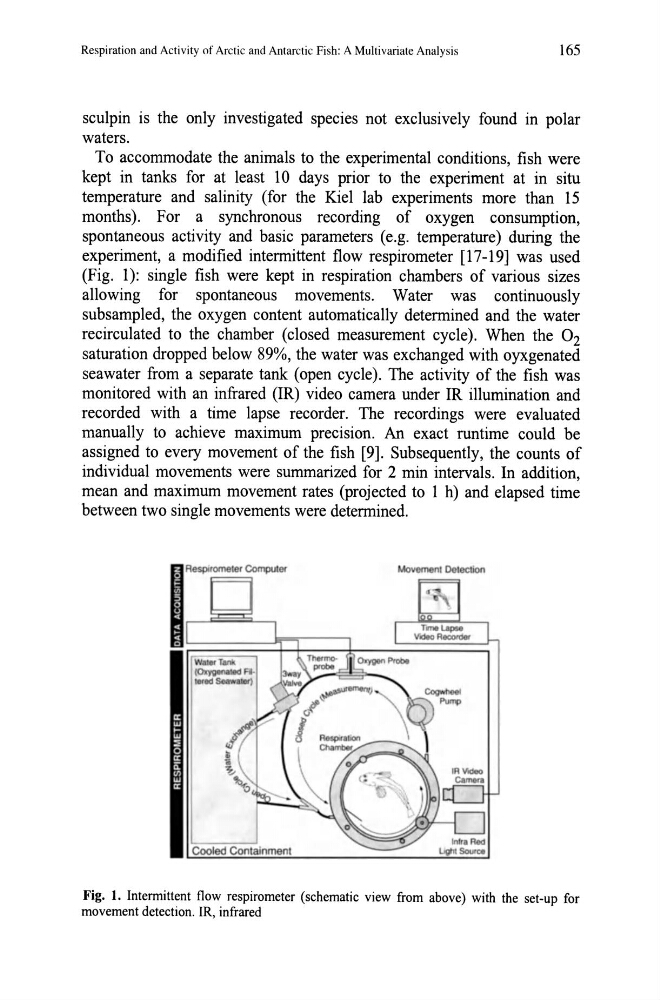
months). For a synchronous recording of oxygen consumption,
spontaneous activity and basic parameters (e.g. temperature) during the
experiment, a modified intermittent flow respirometer [17-19] was used
(Fig. 1): single fish were kept in respiration chambers of various sizes
allowing for spontaneous movements. Water was continuously
subsampled, the oxygen content automatically determined and the water
recirculated to the chamber (closed measurement cycle). When the 02
saturation dropped below 89%, the water was exchanged with oyxgenated
seawater from a separate tank (open cycle). The activity of the fish was
monitored with an infrared (IR) video camera under IR illumination and
recorded with a time lapse recorder. The recordings were evaluated
manually to achieve maximum precision. An exact runtime could be
assigned to every movement of the fish [9]. Subsequently, the counts of
individual movements were summarized for 2 min intervals. In addition,
mean and maximum movement rates (projected to 1 h) and elapsed time
between two single movements were determined.
Movement Oelec1ion
Fig. 1. Intennittent flow respirometer (schematic view from above) with the set-up for
movement detection. IR, infrared
165
sculpin is the only investigated species not exclusively found in polar
waters.
To accommodate the animals to the experimental conditions, fish were
kept in tanks for at least 10 days prior to the experiment at in situ
temperature and salinity (for the Kiel lab experiments more than 15
months). For a synchronous recording of oxygen consumption,
spontaneous activity and basic parameters (e.g. temperature) during the
experiment, a modified intermittent flow respirometer [17-19] was used
(Fig. 1): single fish were kept in respiration chambers of various sizes
allowing for spontaneous movements. Water was continuously
subsampled, the oxygen content automatically determined and the water
recirculated to the chamber (closed measurement cycle). When the 02
saturation dropped below 89%, the water was exchanged with oyxgenated
seawater from a separate tank (open cycle). The activity of the fish was
monitored with an infrared (IR) video camera under IR illumination and
recorded with a time lapse recorder. The recordings were evaluated
manually to achieve maximum precision. An exact runtime could be
assigned to every movement of the fish [9]. Subsequently, the counts of
individual movements were summarized for 2 min intervals. In addition,
mean and maximum movement rates (projected to 1 h) and elapsed time
between two single movements were determined.
Movement Oelec1ion
Fig. 1. Intennittent flow respirometer (schematic view from above) with the set-up for
movement detection. IR, infrared