

Molecular Adaptation of Microtubules and Microtubule Motors from Antarctic Fish
,........
0>
E
-... c
E
-...
cC
o
E
::t
'-"
0.4
0.3
0.2
0.1
0.0 -=~::""""'...l.-.J....-.!.--,---L--,--~:::J::=.l....Cr--J
o 5 10 15 20 25 30 35 40
Temperature (0C)
147
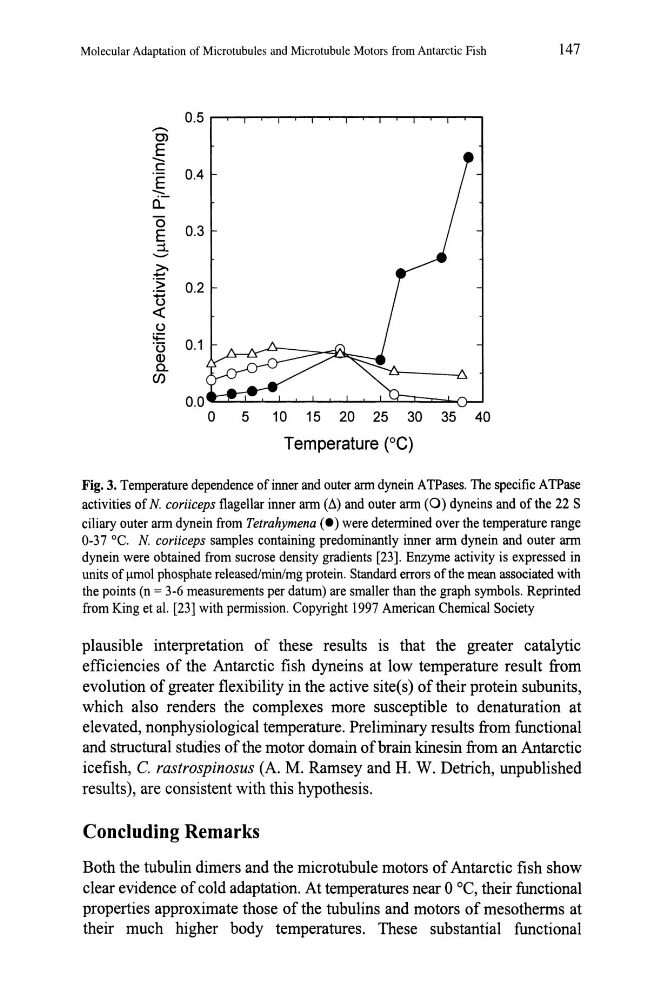
Fig. 3. Temperature dependence of inner and outer arm dynein ATPases. The specific ATPase
activities of N. coriiceps flagellar inner arm (6) and outer arm (0) dyneins and of the 22 S
ciliary outer arm dynein from Tetrahymena (e) were determined over the temperature range
0-37°C. N. coriiceps samples containing predominantly inner arm dynein and outer arm
dynein were obtained from sucrose density gradients [23]. Enzyme activity is expressed in
units of Ilmol phosphate released/min/mg protein. Standard errors of the mean associated with
the points (n = 3-6 measurements per datum) are smaller than the graph symbols. Reprinted
from King et al. [23] with permission. Copyright 1997 American Chemical Society
plausible interpretation of these results is that the greater catalytic
efficiencies of the Antarctic fish dyne ins at low temperature result from
evolution of greater flexibility in the active site(s) of their protein subunits,
which also renders the complexes more susceptible to denaturation at
elevated, nonphysiological temperature. Preliminary results from functional
and structural studies of the motor domain of brain kinesin from an Antarctic
icefish, C. rastrospinosus (A. M. Ramsey and H. W. Detrich, unpublished
results), are consistent with this hypothesis.
Concluding Remarks
Both the tubulin dimers and the microtubule motors of Antarctic fish show
clear evidence of cold adaptation. At temperatures near 0 °e, their functional
properties approximate those of the tubulins and motors of mesotherms at
their much higher body temperatures. These substantial functional
,........
0>
E
-... c
E
-...
cC
o
E
::t
'-"
0.4
0.3
0.2
0.1
0.0 -=~::""""'...l.-.J....-.!.--,---L--,--~:::J::=.l....Cr--J
o 5 10 15 20 25 30 35 40
Temperature (0C)
147
Fig. 3. Temperature dependence of inner and outer arm dynein ATPases. The specific ATPase
activities of N. coriiceps flagellar inner arm (6) and outer arm (0) dyneins and of the 22 S
ciliary outer arm dynein from Tetrahymena (e) were determined over the temperature range
0-37°C. N. coriiceps samples containing predominantly inner arm dynein and outer arm
dynein were obtained from sucrose density gradients [23]. Enzyme activity is expressed in
units of Ilmol phosphate released/min/mg protein. Standard errors of the mean associated with
the points (n = 3-6 measurements per datum) are smaller than the graph symbols. Reprinted
from King et al. [23] with permission. Copyright 1997 American Chemical Society
plausible interpretation of these results is that the greater catalytic
efficiencies of the Antarctic fish dyne ins at low temperature result from
evolution of greater flexibility in the active site(s) of their protein subunits,
which also renders the complexes more susceptible to denaturation at
elevated, nonphysiological temperature. Preliminary results from functional
and structural studies of the motor domain of brain kinesin from an Antarctic
icefish, C. rastrospinosus (A. M. Ramsey and H. W. Detrich, unpublished
results), are consistent with this hypothesis.
Concluding Remarks
Both the tubulin dimers and the microtubule motors of Antarctic fish show
clear evidence of cold adaptation. At temperatures near 0 °e, their functional
properties approximate those of the tubulins and motors of mesotherms at
their much higher body temperatures. These substantial functional