

144
H.W. Detrich
probably belongs to the type II P-isotypic class [11].
We compared its primary sequence to those of other P tubulins to identify
potentially adaptive residue changes in Ncnpl. With respect to vertebrate p
chains, the Ncnpl polypeptide contains several unique amino acid
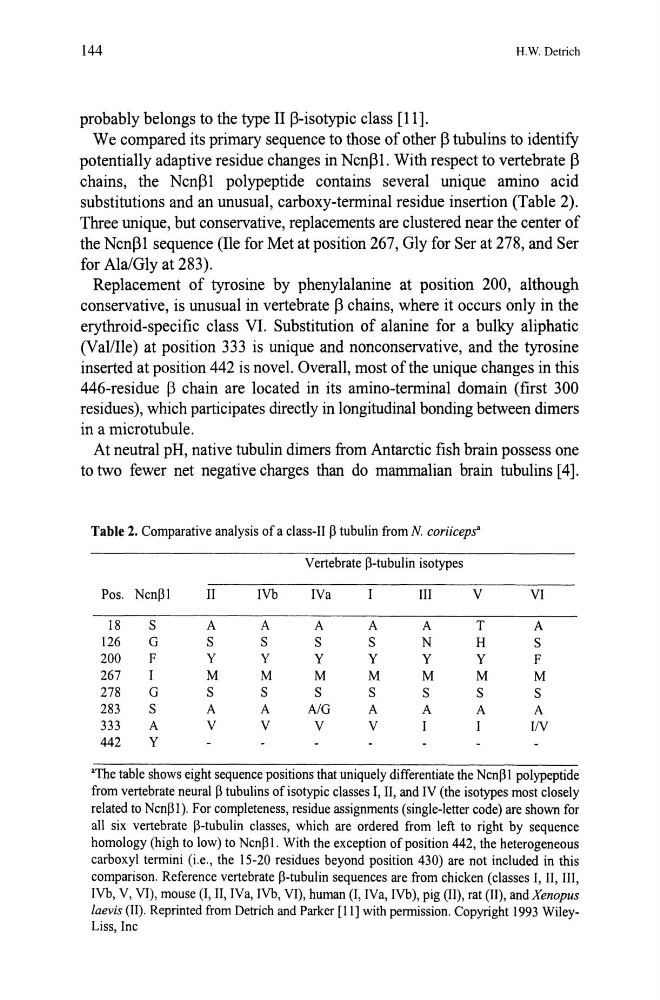
substitutions and an unusual, carboxy-terminal residue insertion (Table 2).
Three unique, but conservative, replacements are clustered near the center of
the Ncnpl sequence (Ile for Met at position 267, Gly for Ser at 278, and Ser
for Ala/Gly at 283).
Replacement of tyrosine by phenylalanine at position 200, although
conservative, is unusual in vertebrate p chains, where it occurs only in the
erythroid-specific class VI. Substitution of alanine for a bulky aliphatic
(Val/Ile) at position 333 is unique and nonconservative, and the tyrosine
inserted at position 442 is novel. Overall, most of the unique changes in this
446-residue p chain are located in its amino-terminal domain (first 300
residues), which participates directly in longitudinal bonding between dimers
in a microtubule.
At neutral pH, native tubulin dimers from Antarctic fish brain possess one
to two fewer net negative charges than do mammalian brain tubulins [4].
Table 2. Comparative analysis of a class-lIp tubulin from N. coriiceps"
Vertebrate p-tubulin isotypes
Pos. NcnpI
II
IVb
IVa
III
V
VI
18
S
A
A
A
A
A
T
A
126
G
S
S
S
S
N
H
S
200
F
Y
Y
Y
Y
Y
Y
F
267
I
M
M
M
M
M
M
M
278
G
S
S
S
S
S
S
S
283
S
A
A
AlG
A
A
A
A
333
A
V
V
V
V
I
IN
442
Y
"The table shows eight sequence positions that uniquely differentiate the Ncnpl polypeptide
from vertebrate neural p tubulins ofisotypic classes I, II, and IV (the isotypes most closely
related to Ncnl3l). For completeness, residue assignments (single-letter code) are shown for
all six vertebrate p-tubulin classes, which are ordered from left to right by sequence
homology (high to low) to Ncnpl. With the exception of position 442, the heterogeneous
carboxyl termini (i.e., the 15-20 residues beyond position 430) are not included in this
comparison. Reference vertebrate p-tubulin sequences are from chicken (classes I, II, III,
IVb, V, VI), mouse (I, II, IVa, IVb, VI), human (I, IVa, IVb), pig (II), rat (II), and Xenopus
laevis (II). Reprinted from Detrich and Parker [11] with permission. Copyright 1993 WileyLiss, Inc
H.W. Detrich
probably belongs to the type II P-isotypic class [11].
We compared its primary sequence to those of other P tubulins to identify
potentially adaptive residue changes in Ncnpl. With respect to vertebrate p
chains, the Ncnpl polypeptide contains several unique amino acid
substitutions and an unusual, carboxy-terminal residue insertion (Table 2).
Three unique, but conservative, replacements are clustered near the center of
the Ncnpl sequence (Ile for Met at position 267, Gly for Ser at 278, and Ser
for Ala/Gly at 283).
Replacement of tyrosine by phenylalanine at position 200, although
conservative, is unusual in vertebrate p chains, where it occurs only in the
erythroid-specific class VI. Substitution of alanine for a bulky aliphatic
(Val/Ile) at position 333 is unique and nonconservative, and the tyrosine
inserted at position 442 is novel. Overall, most of the unique changes in this
446-residue p chain are located in its amino-terminal domain (first 300
residues), which participates directly in longitudinal bonding between dimers
in a microtubule.
At neutral pH, native tubulin dimers from Antarctic fish brain possess one
to two fewer net negative charges than do mammalian brain tubulins [4].
Table 2. Comparative analysis of a class-lIp tubulin from N. coriiceps"
Vertebrate p-tubulin isotypes
Pos. NcnpI
II
IVb
IVa
III
V
VI
18
S
A
A
A
A
A
T
A
126
G
S
S
S
S
N
H
S
200
F
Y
Y
Y
Y
Y
Y
F
267
I
M
M
M
M
M
M
M
278
G
S
S
S
S
S
S
S
283
S
A
A
AlG
A
A
A
A
333
A
V
V
V
V
I
IN
442
Y
"The table shows eight sequence positions that uniquely differentiate the Ncnpl polypeptide
from vertebrate neural p tubulins ofisotypic classes I, II, and IV (the isotypes most closely
related to Ncnl3l). For completeness, residue assignments (single-letter code) are shown for
all six vertebrate p-tubulin classes, which are ordered from left to right by sequence
homology (high to low) to Ncnpl. With the exception of position 442, the heterogeneous
carboxyl termini (i.e., the 15-20 residues beyond position 430) are not included in this
comparison. Reference vertebrate p-tubulin sequences are from chicken (classes I, II, III,
IVb, V, VI), mouse (I, II, IVa, IVb, VI), human (I, IVa, IVb), pig (II), rat (II), and Xenopus
laevis (II). Reprinted from Detrich and Parker [11] with permission. Copyright 1993 WileyLiss, Inc