

134
B. Giardina et al.
structures [27]. To counteract the effect of toxic oxygen metabolites the
cells are endowed with specific scavenging systems. Oxidants that are not
detoxified may attack structural proteins and enzymes, membrane lipids,
and nucleic acids, thus affecting cell function.
Lipid peroxidation has been proposed to be a major mechanism of
oxygen free radical toxicity. Unsaturated fatty acids are particularly
susceptible to oxygen radical attack, owing to the presence of double
bonds which can undergo peroxidation through a chain of oxidative
reactions [28]. In the process of mitochondrial electron transport, oxygen
is normally reduced to water through several steps in which hydrogen
atoms act as electron donors. However, studies on isolated mitochondria
have shown that oxygen can also undergo 1-e1ectron reduction, with
formation of superoxide radicals (02-) and hydrogen peroxide (H20 2).
Although these two chemical species alone are generally accepted as
being insufficiently reactive in aqueous media to initiate deleterious
reactions such as lipid peroxidation, their potential danger lies in their
ability to lead to the formation of more strongly oxidizing species such as
the OH- radical. At least two sites in the mitochondrial respiratory chain
have been identified where oxygen radicals may be generated: NADH
dehydrogenase and CoQ. It is estimated that under normal conditions 1-2%
of oxygen utilized by mitochondria leads to the formation of superoxide
radicals.
This "physiologic" generation of oxygen radicals is normally inactivated
by endogenous scavenger mechanisms present within the cells. On this
basis, the presence, in various tissues from different Antarctic fishes, of
those ions and molecules which are at the basis of the antioxidant defense
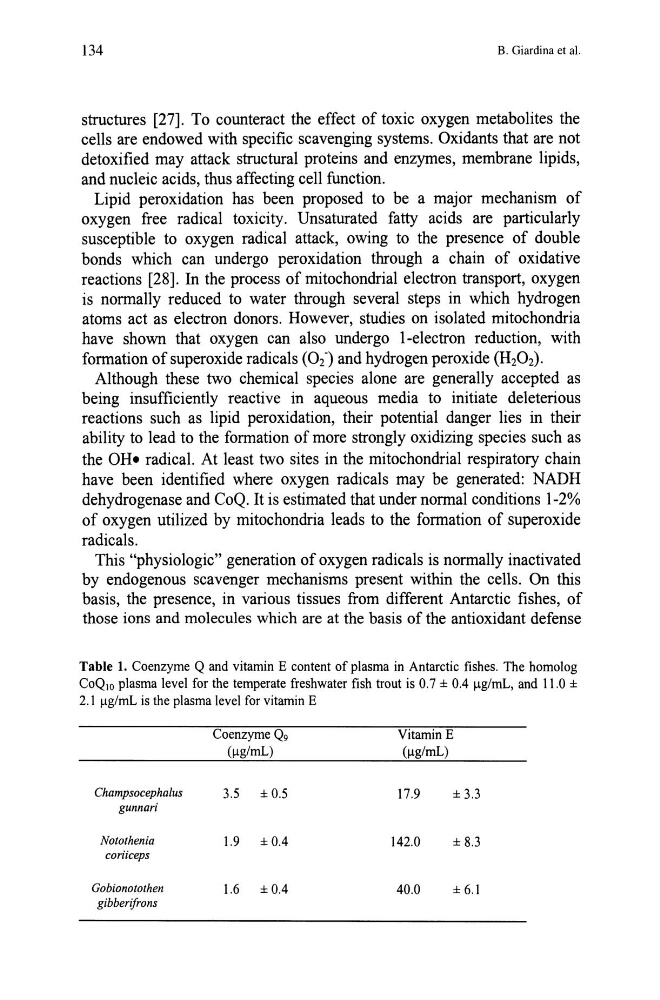
Table 1. Coenzyme Q and vitamin E content of plasma in Antarctic fishes. The homolog
COQlO plasma level for the temperate freshwater fish trout is 0.7 ± 0.4 Ilg/mL, and 11.0 ±
2.1 Ilg/mL is the plasma level for vitamin E
Coenzyme Q9
VitaminE
(llg/mL )
(llg/mL)
Champsocepha/us
3.5
±O.S
17.9
±3.3
gunnari
Notothenia
1.9
±0.4
142.0
± 8.3
coriiceps
Gobionotothen
1.6
±0.4
40.0
± 6.1
gibberifrons
B. Giardina et al.
structures [27]. To counteract the effect of toxic oxygen metabolites the
cells are endowed with specific scavenging systems. Oxidants that are not
detoxified may attack structural proteins and enzymes, membrane lipids,
and nucleic acids, thus affecting cell function.
Lipid peroxidation has been proposed to be a major mechanism of
oxygen free radical toxicity. Unsaturated fatty acids are particularly
susceptible to oxygen radical attack, owing to the presence of double
bonds which can undergo peroxidation through a chain of oxidative
reactions [28]. In the process of mitochondrial electron transport, oxygen
is normally reduced to water through several steps in which hydrogen
atoms act as electron donors. However, studies on isolated mitochondria
have shown that oxygen can also undergo 1-e1ectron reduction, with
formation of superoxide radicals (02-) and hydrogen peroxide (H20 2).
Although these two chemical species alone are generally accepted as
being insufficiently reactive in aqueous media to initiate deleterious
reactions such as lipid peroxidation, their potential danger lies in their
ability to lead to the formation of more strongly oxidizing species such as
the OH- radical. At least two sites in the mitochondrial respiratory chain
have been identified where oxygen radicals may be generated: NADH
dehydrogenase and CoQ. It is estimated that under normal conditions 1-2%
of oxygen utilized by mitochondria leads to the formation of superoxide
radicals.
This "physiologic" generation of oxygen radicals is normally inactivated
by endogenous scavenger mechanisms present within the cells. On this
basis, the presence, in various tissues from different Antarctic fishes, of
those ions and molecules which are at the basis of the antioxidant defense
Table 1. Coenzyme Q and vitamin E content of plasma in Antarctic fishes. The homolog
COQlO plasma level for the temperate freshwater fish trout is 0.7 ± 0.4 Ilg/mL, and 11.0 ±
2.1 Ilg/mL is the plasma level for vitamin E
Coenzyme Q9
VitaminE
(llg/mL )
(llg/mL)
Champsocepha/us
3.5
±O.S
17.9
±3.3
gunnari
Notothenia
1.9
±0.4
142.0
± 8.3
coriiceps
Gobionotothen
1.6
±0.4
40.0
± 6.1
gibberifrons