

Aspects of Eco-Physiological Adaptations in Antarctic Fish
125
_
.....
.cowky
tIIrt!*
bet(hc
.~
.... ~
pMgIIC.
Moo Of Ute
QIII~
tnOIIIIQIIIhgl'!
•
~&.
1Dtr~
Aft ...,1COftIM'I1
llA.u'
[SW
.• d:
...
. , 00.0,
.. 01 CliO
• ew
1100 ..
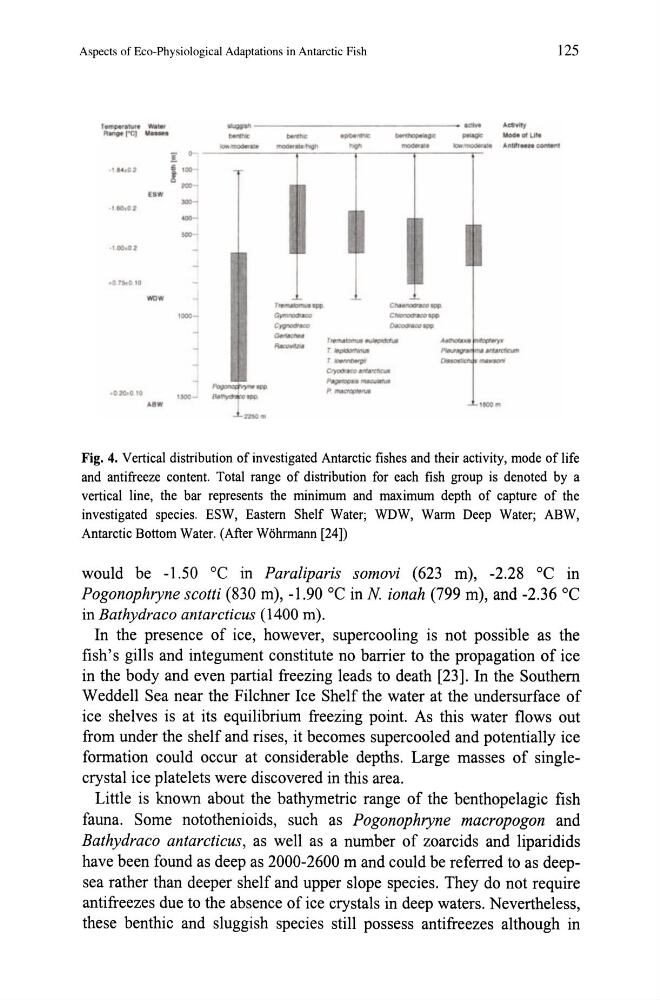
Fig. 4. Vertical distribution of investigated Antarctic fishes and their activity, mode of life
and antifreeze content. Total range of distribution for each fish group is denoted by a
vertical line, the bar represents the minimum and maximum depth of capture of the
investigated species. ESW, Eastern Shelf Water; WDW, Warm Deep Water; ABW,
Antarctic Bottom Water. (After Wohrmann [24])
would be -1.50 °C in Paraliparis somovi (623 m), -2.28 °C in
Pogonophryne scotti (830 m), -1.90 °C in N ionah (799 m), and -2.36 °C
in Bathydraco antarcticus (1400 m).
In the presence of ice, however, supercooling is not possible as the
fish's gills and integument constitute no barrier to the propagation of ice
in the body and even partial freezing leads to death [23]. In the Southern
Weddell Sea near the Filchner Ice Shelf the water at the undersurface of
ice shelves is at its equilibrium freezing point. As this water flows out
from under the shelf and rises, it becomes supercooled and potentially ice
formation could occur at considerable depths. Large masses of singlecrystal ice platelets were discovered in this area.
Little is known about the bathymetric range of the benthopelagic fish
fauna. Some notothenioids, such as Pogonophryne macropogon and
Bathydraco antarcticus, as well as a number of zoarcids and liparidids
have been found as deep as 2000-2600 m and could be referred to as deepsea rather than deeper shelf and upper slope species. They do not require
antifreezes due to the absence of ice crystals in deep waters. Nevertheless,
these benthic and sluggish species still possess antifreezes although in
125
_
.....
.cowky
tIIrt!*
bet(hc
.~
.... ~
pMgIIC.
Moo Of Ute
QIII~
tnOIIIIQIIIhgl'!
•
~&.
1Dtr~
Aft ...,1COftIM'I1
llA.u'
[SW
.• d:
...
. , 00.0,
.. 01 CliO
• ew
1100 ..
Fig. 4. Vertical distribution of investigated Antarctic fishes and their activity, mode of life
and antifreeze content. Total range of distribution for each fish group is denoted by a
vertical line, the bar represents the minimum and maximum depth of capture of the
investigated species. ESW, Eastern Shelf Water; WDW, Warm Deep Water; ABW,
Antarctic Bottom Water. (After Wohrmann [24])
would be -1.50 °C in Paraliparis somovi (623 m), -2.28 °C in
Pogonophryne scotti (830 m), -1.90 °C in N ionah (799 m), and -2.36 °C
in Bathydraco antarcticus (1400 m).
In the presence of ice, however, supercooling is not possible as the
fish's gills and integument constitute no barrier to the propagation of ice
in the body and even partial freezing leads to death [23]. In the Southern
Weddell Sea near the Filchner Ice Shelf the water at the undersurface of
ice shelves is at its equilibrium freezing point. As this water flows out
from under the shelf and rises, it becomes supercooled and potentially ice
formation could occur at considerable depths. Large masses of singlecrystal ice platelets were discovered in this area.
Little is known about the bathymetric range of the benthopelagic fish
fauna. Some notothenioids, such as Pogonophryne macropogon and
Bathydraco antarcticus, as well as a number of zoarcids and liparidids
have been found as deep as 2000-2600 m and could be referred to as deepsea rather than deeper shelf and upper slope species. They do not require
antifreezes due to the absence of ice crystals in deep waters. Nevertheless,
these benthic and sluggish species still possess antifreezes although in